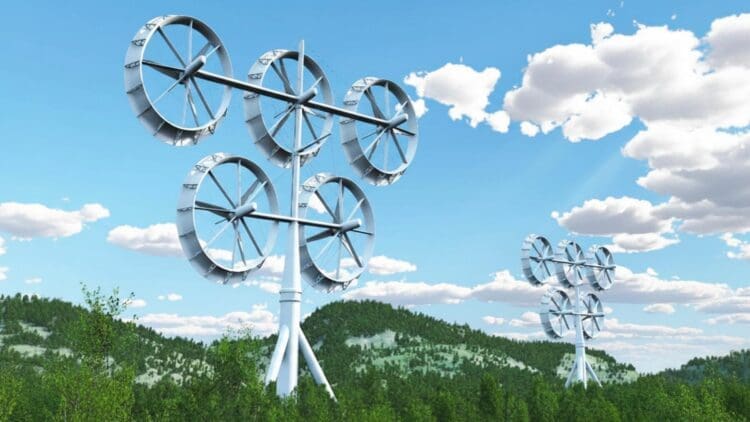

The global renewable energy capacity is growing rapidly, and experts predict that the total global energy capacity will be 60% renewable by 2035. However, Japanese experts believe that the typical tower design may not be the optimal way to achieve this, and their prototype, consisting of up to 100 wind turbines in a cluster, may prove it. This 754-foot, 20 MW Japanese prototype is unlike any other design, but will it truly be the right answer to achieve global climate targets? Let’s find out.
Japanese experts prove the tower design was a historic mistake
Wind energy has proven that it will not stand aside when it comes to the global installed renewable capacity. In fact, it has become one of the most popular renewable energy sources to boost nations’ energy security. According to REN21’s 2025 Global Status Report, at the end of 2024 and the beginning of 2025, the global installed wind capacity surpassed 1 TW.
As global energy demand continues to increase, it is evident that the scale of wind turbines has significantly increased over recent years. However, the typical tower design that has been used primarily for onshore and offshore installations may not be the most optimal design choice, as the design still presents several disadvantages, which include, but are not limited to:
- The bigger the turbine, the bigger the blade, the bigger its noise pollution will be
- Bigger rotors mean that fewer turbines can be installed in one area
- Larger blades that spin at significant speeds are more susceptible to damage
This is why Japanese experts have created a new design, and their prototype may just prove that the tower design was a historic mistake.
A 754-foot, 20 MW prototype is the right answer
Japan’s Kyushu University and its Fukuoka-based spin-off startup company, Riamwind, have collaborated to create a prototype that could be the right answer for the future of wind capacity. Now, there have been several unique wind turbine designs in the past, such as the bladeless 2 kW green “pod” turbine, but this prototype will give rise to another of significant scale and power.
According to EE Power, the prototype was built in 2024, and it consists of two 82-foot turbine arrays. While news of the current status of this prototype is limited, the majority of reports indicate that it is still presently under testing. The data obtained from the testing will be utilized for the Japanese experts’ goal design, which is a 754-foot-high and 918-foot-wide, 20 MW design.
While the scale of this design may not sound significant, one must not be fooled, as what truly makes it noteworthy is that it will consist of 100 turbines in a cluster
Up to 100 wind turbines in a cluster that produce more than just power
The smaller 100 turbines will be placed in a 10-unit by 10-unit systematic cluster arrangement, and will feature Riamwind’s “diffuser shroud,” which concentrates wind energy. This enables the use of smaller turbines known as wind lenses for this design. These wind lenses present the following advantages compared to typical turbine designs:
- Decrease noise pollution
- Higher energy-capture efficiency per unit
- Increased power production efficiency
- Potential to operate in higher wind pressure
Benefits of cluster design
- More cost-effective production and maintenance
- Continued power production while one turbine is under maintenance
- Increased wind capture
- Offshore and onshore applications
EE Power added that the testing phase would include determining the amount of wind pressure the cluster design can withstand and whether horizontal turbine installation would decrease the risk of damage during high wind speeds. As we await the results of the Japanese experts’ testing and development stage, there is no doubt that this clustered wind lens design has tremendous potential and may even reshape wind energy’s future. In the meantime, Japan’s ‘Typhoon Catcher’ has already made wind history.