
Every rooftop solar panel can push a neighborhood’s voltage out of bounds, but a privacy-preserving AI system cut those violations by 83%
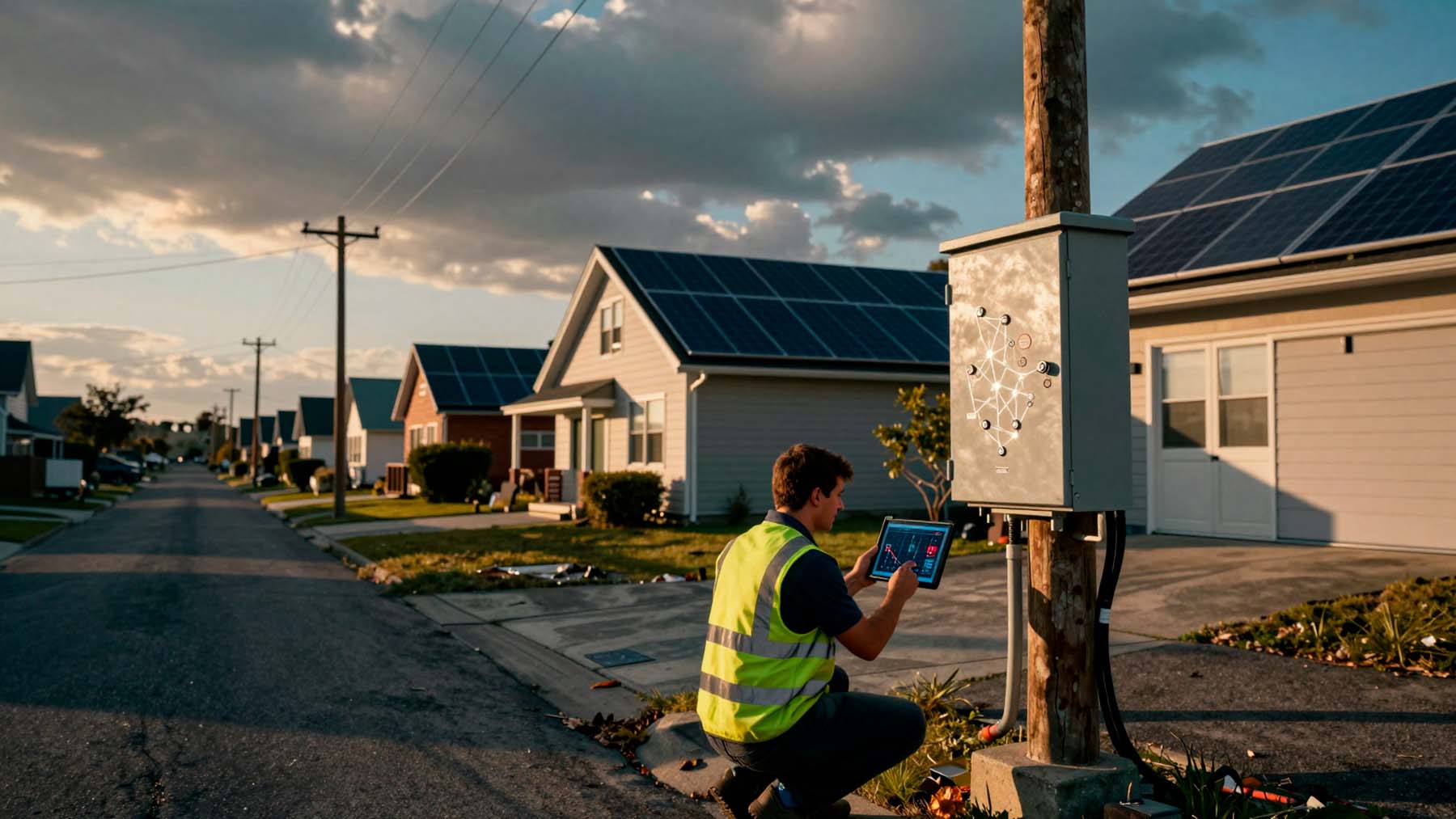
Every rooftop solar panel added to a neighborhood is a small stress test for the wires buried beneath the street. Multiply that by millions of installations, and the grid faces a problem most electricity bills never mention: voltage swings that can damage equipment and cascade into broader network failures.
China is living that experiment at scale. As of mid-2025, the country’s installed solar capacity has surpassed 1.1 billion kilowatts — roughly half of all its renewable generation. Managing the voltage ripples that come with that much intermittent power has pushed engineers toward two very different strategies, and neither one is quite enough on its own.
When solar floods the grid, voltage becomes the hidden problem
Voltage violations sound technical, but their consequences are concrete. When voltage at a distribution node climbs too high or drops too low — outside the safe band of 0.95 to 1.05 per unit — equipment degrades faster, protective relays can trip, and failures cascade across connected lines. For utilities, that means shortened transformer lifespans and rising maintenance costs. For customers, it means flickering lights or damaged appliances.
There’s also a privacy problem: aggregating household-level energy data exposes sensitive information about when people are home and which appliances they run.
Solar panels are a primary driver of this instability. PV output swings with cloud cover, shifting irradiance, and temperature changes throughout the day, pushing voltage at nearby grid nodes up or down — sometimes rapidly. The more panels connected to a local distribution network, the more pronounced those swings become.
Traditional voltage control was built around centralized, dispatchable power plants. Output was foreseeable; adjustments were gradual. Distributed PV breaks both assumptions, and control methods inherited from that earlier era struggle to keep up.
Two imperfect solutions and why neither is enough
Engineers have approached voltage control from two directions, each with real weaknesses.
Centralized control collects real-time data from every node and runs global optimization from a single unit. Integrating thousands of rooftop inverters creates a computational burden that grows faster than the systems meant to handle it. There’s also a privacy problem: aggregating household-level energy data exposes sensitive information about when people are home and which appliances they run.
Decentralized control takes the opposite approach — each inverter responds to its own local voltage reading without communicating with the rest of the network. Fast and simple, but an inverter reacting to low voltage at one node has no way of knowing whether its response will worsen conditions two nodes away. Resources get used inefficiently, and voltage problems shift rather than resolve.
Most existing research compounds this by relying on deterministic optimization, assuming the best available forecast and planning for that single scenario. Real solar generation doesn’t cooperate with forecasts. A cloud bank arriving an hour early can invalidate the entire plan.
A two-layer architecture that keeps data private and voltage stable
The framework proposed in a study published in Frontiers in Energy Research splits the grid into two distinct layers, each with a control strategy matched to its data environment.
The medium-voltage primary network is managed centrally. Researchers used a Copula-based Monte Carlo method to model how nearby PV plants behave together, capturing the fact that adjacent installations often share the same weather — meaning output rises and falls in sync. This generates a realistic range of futures rather than a single best guess.
The low-voltage secondary networks — where rooftop panels connect — are managed in a distributed way using federated learning with differential privacy. Each local node trains a shared AI model on its own data, then sends only encrypted model parameters to the central server, which builds a global model without ever seeing raw household data.
Coordination between layers runs through the ADMM algorithm. Within each low-voltage subnetwork, a Back-and-Forth Communication algorithm lets agents pass information to neighboring nodes, enabling distributed optimization without requiring every node to talk to every other.
Stress-testing the system under extreme solar swings
The researchers simulated the framework on a modified IEEE 33-bus medium-voltage network paired with two 11-bus low-voltage subnetworks, incorporating PV systems, energy storage, and distributed generation across both layers.
The stress test was deliberately harsh. At 10 a.m., main grid PV output surged under clear-sky conditions. At 2 p.m., a PV node crashed as cloud cover arrived, creating a sharp power deficit elsewhere. Without any control active, voltage at end nodes swung to 1.06 per unit on the high end and 0.947 per unit on the low end — both outside the safe 0.95–1.05 per unit band.
With the framework running, those extremes were held to 1.047 per unit and 0.953 per unit, just inside the safety margins. Energy storage units and PV inverters responded quickly enough during the midday surge to absorb the shock before voltage went out of bounds.
An 83% drop in voltage violations — and privacy intact
The headline result is quantified through a cumulative voltage violation index. Under extreme conditions, deterministic control produced an index of 4.43. The uncertainty-aware framework brought that down to 0.76 — a reduction of roughly 83%.
The improvement held across both network layers. In the first low-voltage subnetwork, the violation index fell from 1.85 to 0.38; in the second, it dropped from 2.04 to 0.16. The medium-voltage primary network improved from 0.55 to 0.22. Gains were largest where PV penetration and variability were highest.
On privacy, the researchers compared joint probability distributions generated by federated learning against those from centralized training with full data access. The two overlapped closely — statistical accuracy preserved even though the server never touched raw household data. One limitation remains: communication delays and packet loss can slow the BFC algorithm’s convergence. The authors flag asynchronous ADMM as a direction for future work.
What this means for the solar-heavy grids of tomorrow
As PV penetration rises across Europe, the United States, Australia, and elsewhere, voltage instability in distribution networks will become an increasingly common challenge. The physics don’t change with the flag on the transformer.
This framework addresses two problems at once. The technical problem — managing voltage under uncertain, intermittent PV output — gets handled through stochastic optimization across realistic scenario ranges. The social problem — protecting household energy-use privacy — gets handled through federated learning and differential privacy. Solving both simultaneously, rather than trading one off against the other, is the core architectural contribution.
ADMM’s computational load scales linearly as networks grow, and BFC relies only on communication between adjacent nodes. That suggests the approach could extend to much larger real-world networks without hitting the walls that plague purely centralized methods. Real-world pilots testing the framework under actual communication latency — not just simulation — will be the next meaningful proof point.
You can learn more about this discovery here: Yan Z, Liu J, Tian Y, Bai R, Meng Y and Chu B (2026) Centralized-distributed collaborative voltage control for distribution networks considering photovoltaic uncertainties. Front. Energy Res. 14:1805545. doi: 10.3389/fenrg.2026.1805545


Carlos is an engineer with strong expertise in technical and industrial topics. He previously worked at international companies such as Siemens and is multilingual.
