
Plants have been turning sunlight into fuel for millions of years and now chemists have finally cracked their secret
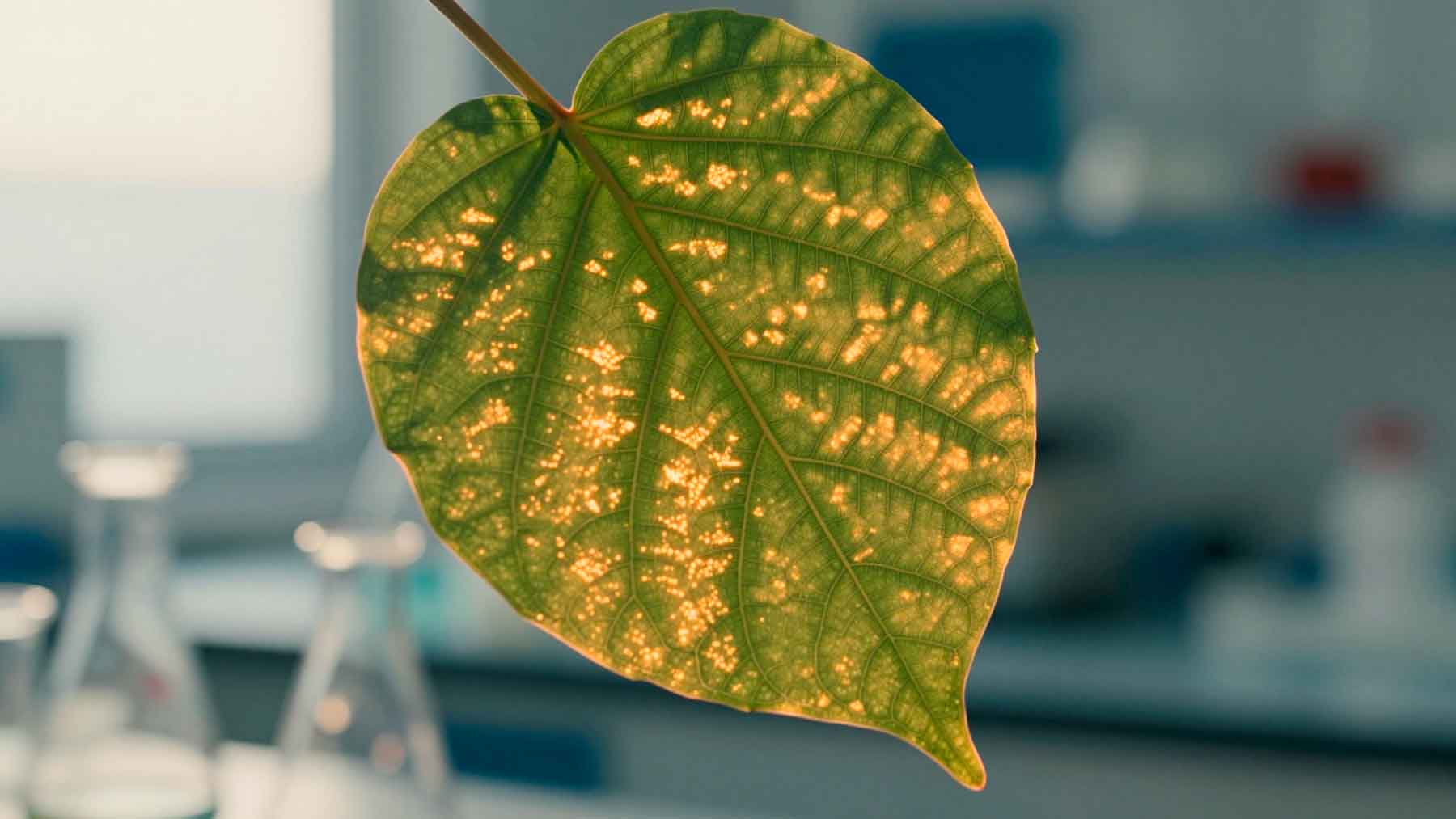 Image generated with artificial intelligence
Every leaf on every tree does something chemists have spent decades trying to copy: it catches sunlight and locks that energy into chemical bonds, quietly and without fuss. The obstacle in the lab has always been brute force — previous attempts demanded intense laser light that bears little resemblance to an afternoon in the sun.
Now a small team at the University of Basel says it has built a molecule that takes a genuinely different approach — one that behaves, in a modest but meaningful way, like the working heart of a leaf.
The leaf as a blueprint
Photosynthesis is deceptively simple to describe. Plants absorb sunlight, pull carbon dioxide from the air, and convert both into energy-rich sugars. Oxygen comes out as a byproduct. That cycle is carbon-neutral in the truest sense: when an animal burns those sugars for energy, it releases only the CO2 the plant originally captured. Nothing extra enters the atmosphere.
The search for carbon-neutral energy sources isn’t an abstract scientific exercise; it’s one of the central engineering challenges of the coming decades.
That closed loop is exactly what makes photosynthesis so attractive as a model. Researchers have long dreamed of running the same trick in a lab — using sunlight to produce what are called solar fuels: hydrogen, methanol, or synthetic fuels that, when burned, would return only the carbon already borrowed from the air.
A fuel that carries no net carbon cost would sidestep one of the central problems of the energy transition. But artificial photosynthesis has remained stubbornly out of reach at any practical scale, despite decades of effort. The chemistry is hard, and the engineering is harder still.
A molecule built in five parts
The Basel team’s new molecule is designed from first principles to mimic what a plant’s photosynthetic machinery actually does. It consists of five components linked in a chain, each assigned a specific job.
On one side, two components act as electron donors — they release electrons when triggered, leaving themselves positively charged. On the other side, two components act as electron acceptors, capturing those electrons and becoming negatively charged. In the middle sits a light-absorbing unit, the engine of the whole system. When light hits it, electron transfer begins immediately, sending charges racing toward opposite ends of the molecule.
The result, when everything works as designed, is a molecule carrying two positive charges at one end and two negative charges at the other — four stored charges in total. That number matters. Driving useful chemical reactions requires moving multiple electrons at once; splitting water into hydrogen and oxygen, for instance, demands exactly that kind of multi-electron chemistry. A molecule capable of holding four charges simultaneously is, in principle, capable of powering that reaction. Getting there has been the challenge.
Two flashes, four charges
The team’s key insight was to build up those four charges in steps rather than all at once, using two separate flashes of light rather than a single intense burst.
The first flash hits the central light-absorbing component and triggers a charge separation: one positive charge moves toward one end of the molecule, one negative charge toward the other. After that first flash, the molecule holds two charges. The second flash repeats the process, doubling the count to four.
This sequential approach is what allows the molecule to work under much dimmer light. As doctoral student Mathis Brändlin explained, the stepwise excitation means the experiment can operate close to the intensity of ordinary sunlight — a crucial distinction from earlier work in the field, which relied on extremely powerful laser light with no real-world equivalent outside a laboratory. Equally important, the charges don’t immediately collapse back into a neutral state. They remain stable long enough to be available for further chemical reactions, which is a basic practical requirement — a molecule that loses its stored charges within a fraction of a second is of little use for driving any downstream chemistry.
Progress, not a finish line
It would be easy to overstate what this molecule does. The researchers themselves are careful not to. The new compound doesn’t constitute a working artificial photosynthesis system, doesn’t produce hydrogen or any solar fuel, and isn’t ready for any application.
What it demonstrates is a principle. The study, published in Nature Chemistry, advances the field’s understanding of how electron transfers can be structured and controlled in artificial molecules — foundational knowledge the field has needed. Professor Oliver Wenger described the result plainly: “We have identified and implemented an important piece of the puzzle.” His framing is deliberate. The puzzle is large, and this is one piece — but one that hadn’t been clearly placed before.
The broader context is worth keeping in mind. The search for carbon-neutral energy sources isn’t an abstract scientific exercise; it’s one of the central engineering challenges of the coming decades. Every incremental advance in understanding how to store solar energy in chemical bonds brings that goal a little closer.
The next steps for the Basel team will likely involve connecting this charge-storage capability to actual catalytic reactions — the step that would begin to close the gap between a promising molecule and a functioning system. That work is still ahead. But they now have a clearer map of the territory, and a molecule that behaves, under dim light, a little more like a leaf than anything that came before it.


Carlos is an engineer with strong expertise in technical and industrial topics. He previously worked at international companies such as Siemens and is multilingual.
