Gladys DeClouet: Navigating Uncharted Waters
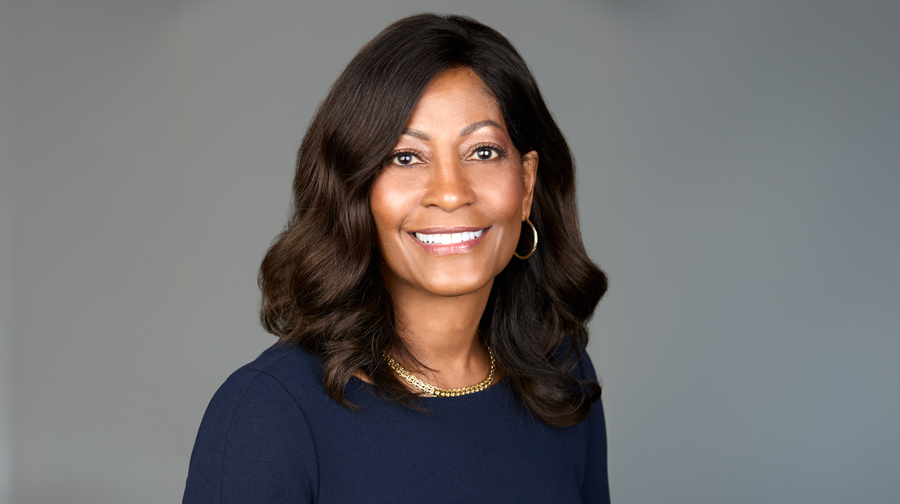
Gladys DeClouet made history as a Black woman in the oil and gas industry in the 1970s, but it’s a part of history that has largely been overlooked. The percentage of women working offshore has stubbornly remained around 3.5 percent for many years; however, in the 1970s, a woman working offshore – particularly a woman of color – was a unicorn (and estimated to be a fraction of a percent of the workforce).
Having so few women in this sector makes it difficult to attract the diverse talent that the industry requires in order to meet the world’s energy needs. One way to do that is to listen to the voices of experience, although they can be hard to come by, something that is evidenced by the fact that the first woman was not inducted into the Offshore Energy Center Hall of Fame in Galveston, Texas, until 2016, and there are only four women who hold that honor – Lillian Espinoza-Gala, Anne-Grete Ellingsen, Sara Akbar, and Eve Howell.
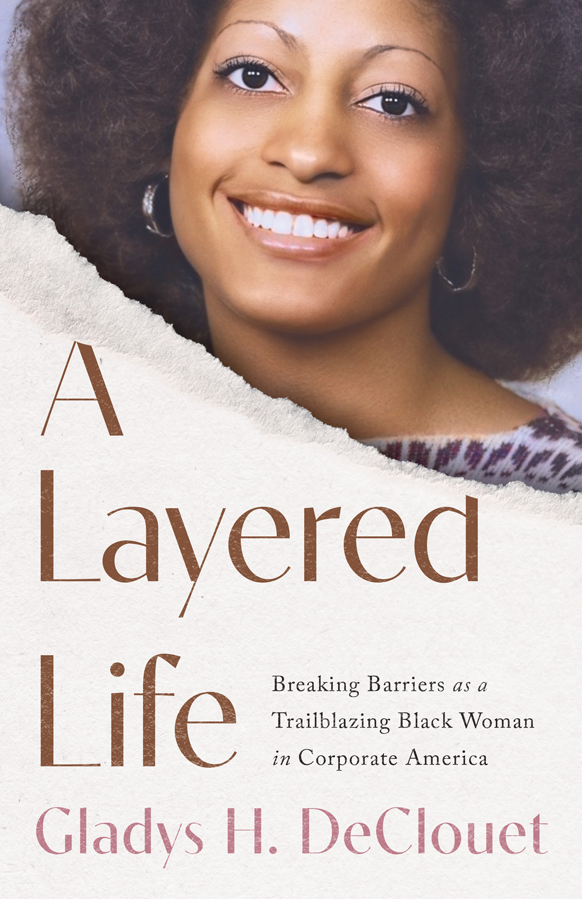
In her recent memoir, A Layered Life: Breaking Barriers as a Trailblazing Black Woman in Corporate America, DeClouet takes her audience back to the late 1970s and what it was like to be the only woman offshore where she was confronted by a “chauvinistic, good old boy network, and a macho man mentality where they wanted to be sure I understood my opinion, my advice, my leadership – nothing – was welcomed or valued. And that’s just the reality.” This, despite – or maybe because of – the fact that she had a Bachelor of Science in mechanical engineering from the prestigious Tuskegee University and would later go on to earn an MBA in finance and investment banking from the University of Wisconsin-Madison.
That’s how I found myself in this world of the chauvinistic macho man in the Deep South in the oil industry.
Having worked for Conoco twice during her summer breaks from college to help pay her expenses, DeClouet had real-world experience on land as well as offshore. The summer before her junior year, she worked at the Conoco Gillis Gas Plant in Louisiana, and the following summer she worked offshore in an internship with Conoco Exploration and Production. After graduating from Tuskegee in 1979, Conoco offered her a permanent full-time position as a production engineer in offshore oil and gas exploration and production in its Lake Charles, Louisiana, office.
Newly married, she accepted the position in Lake Charles, where her husband was originally from and was currently living. “That’s how I found myself in this world of the chauvinistic macho man in the Deep South in the oil industry.”
No stranger to discrimination and harassment, she says the late ‘70s were a time of “a very complex mixture of feelings for me personally. I felt proud to be achieving something that hadn’t been done before – not just by a Black woman, but by a woman – but a lot of the time I felt unwanted, disrespected and not valued.”
To this day, DeClouet can recall the comment that an older foreman made to her face. “I arrived at his terminal to meet him for the first time. This man didn’t know me from Adam. He had no history [with me], but when I went to shake his hand, he wouldn’t shake my hand. He looked up and he said, ‘Another young, college-educated, wet-behind-the-ears whippersnapper who doesn’t know s— from Shinola.’”
And that’s a shortened, sanitized version.
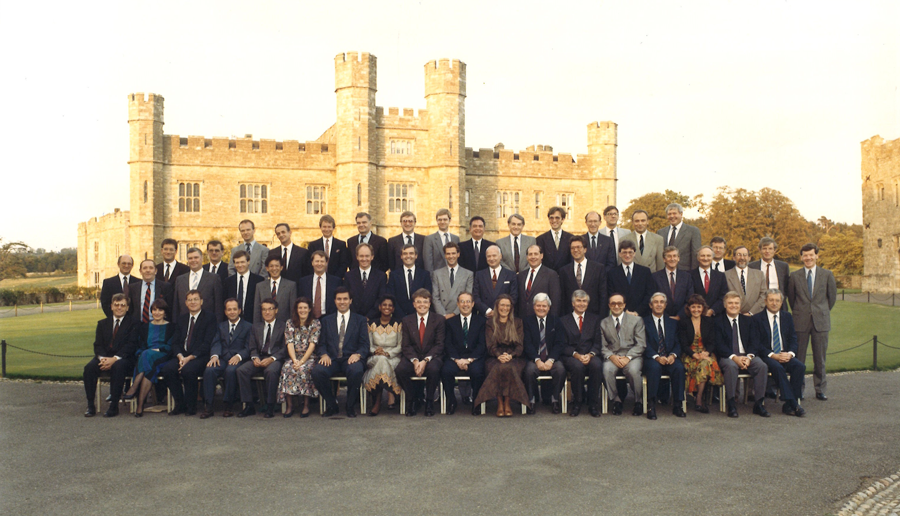
As disrespectful as it was, it’s one of the milder incidences she experienced during her time offshore.
DeClouet readily admits she doesn’t know what conditions are like for women and minorities working offshore today – “because I’m not out there” – but says: “The guys offshore in Louisiana and Texas in the late ‘70s and ‘80s placed a high value on tenure and seniority, so I had four strikes against me: In addition to being a woman and being Black, I was also young and college educated.”
Nevertheless, DeClouet, who had very few role models growing up – aside from teachers and professors in school – but who held strong Black women like U.S. Reps. Shirley Chisholm and Barbara Jordan in high esteem, found it within herself to persevere.
Feeling like a “fish in a glass bowl,” with everyone watching and waiting for her to fail, DeClouet internalized a heavy burden. “I felt I was carrying the weight of my entire gender and my entire race on my back because I knew if I succeeded, I could open the doors for other women and other Black people to travel that same path, but if I failed, those same people would be negatively prejudged and likely excluded from future opportunities. I understood what was at stake. Failure was not an option.”
She found validation through the work itself, enjoying designing the well drilling plans, completing the well safely, estimating the amount of the reserves, and determining the economic feasibility of further development, but, as a production engineer, one of her proudest moments was designing and then supervising the installation of two new offshore production platform facilities.
“It was a good tangible accomplishment. I could touch and feel it. I could point to it, kick it and tell people, ‘See that platform? I designed that,’” she says, laughing.
Once she came onshore, DeClouet discovered bias and discrimination were more covert in the corporate world and often revealed themselves in what she calls “perpetual assumption,” meaning people assumed they knew what she was capable of – as well as what she wasn’t.
“I had to prove myself every second of every day, as opposed to my male counterparts. It was assumed they were capable until they proved they weren’t,” she says.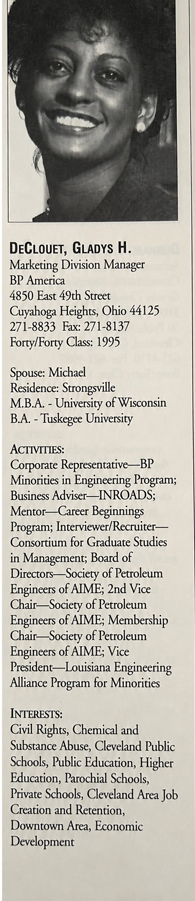
“I believe in speaking the truth. It was what it was, but it’s probably no surprise that I eventually got my MBA and moved on.”
In 1986, DeClouet went to work in the downstream business. She spent 12 years with bp in increasing positions of responsibility and diverse functional roles and business sectors, culminating in her C-suite P&L role as the Cleveland division manager, responsible for sales and operations from all channels of trade, which she refers to as “my glass ceiling breaking position.” She recalls the period of time when she was working as the manager of planning for Air bp Americas, part of the company’s international aviation fuel business, and was assigned to lead the global general aviation strategy, which entailed traveling around the world. Those were heady days and no expense was spared.
“I had a personal plane taking me to various airports and facilities,” she says. On one memorable trip, she ended up in a gold mine in the outback of Australia and later in a VIP room in a casino in Perth.
When the time came to make the presentation to the CEO in order to obtain approval for the general aviation fixed-base operations strategy, DeClouet traveled in a first-class sleeper cabin to London and was picked up by a Mercedes limo, taken to a private bathroom (a far cry from her days offshore when men would “accidentally” barge into the makeshift bathroom she occupied) so she could change before going into the boardroom to make the presentation for Air bp to sign the deal for its first fixed-base operator at the Atlanta DeKalb-Peachtree Airport.
“And it got approved,” she says triumphantly. “It was big money and big fun. That was probably the most exciting time I’ve ever had.”
Reflecting on the 17 years she spent in the oil and gas sector before moving into another male-dominated sector – the fast-food restaurant industry, where she became a senior global executive running multibillion-dollar businesses – DeClouet says, “Before I left, the discussion around gender and race equality in the workplace was gaining momentum in the industry and specifically within bp.”
She attributes this to the leading work of the company’s diversity council, of which she was a founding member. “I always believed in trying to be a catalyst for change, and continued in that mindset in the restaurant industry from higher and even more influential positions.”
She is proud of the fact that the council was successful in achieving corporatewide diversity training as well as implementation of the full culture change initiative commitment around it throughout bp, something she views as a major accomplishment.
“I got to go through the actual diversity training with the senior leaders of bp, with the CEO and president in the room, because I was part of this diversity council, and that’s how we got their commitment to spend the money to roll it out throughout the company.”
Having worked so hard to effect change within her own company, DeClouet finds it “very disheartening to see us going backward and having to fight the same battles that we were fighting nearly 50 years ago when I entered the industry.” She believes the “weaponization” of diversity, equity, and inclusion in the corporate world today will cause major setbacks to the progress that has been made.
“Industry needs its leaders to understand that talent transcends racial, gender, religious or whatever boundaries are out there, and they need to gain a clear understanding that DEI is not about giving certain people an unfair advantage; instead, it is about providing everyone with the same level of support and opportunity based on their performance,” she says. “Those are things they need to be concerned about because history has a way of repeating itself.”
It seems only fitting that by the end of her professional career in 2011, DeClouet had returned to her home state of Florida and settled in Miami – the only major American city founded by a woman.
Reprinted with permission. This article originally appeared in the Winter 2026 issue of NAPE Magazine. It has been lightly edited for this publication.


Rebecca Ponton is the magazine editor at Energies Media and author of Breaking the Gas Ceiling: Women in the Offshore Oil and Gas Industry. She is the publisher of Books & Recovery digital magazine.