
Flames as tall as a 26-story building lit up the coast of British Columbia 45 times over the legal limit, and the promise sitting below them was supposed to be the world’s cleanest fossil fuel bridge
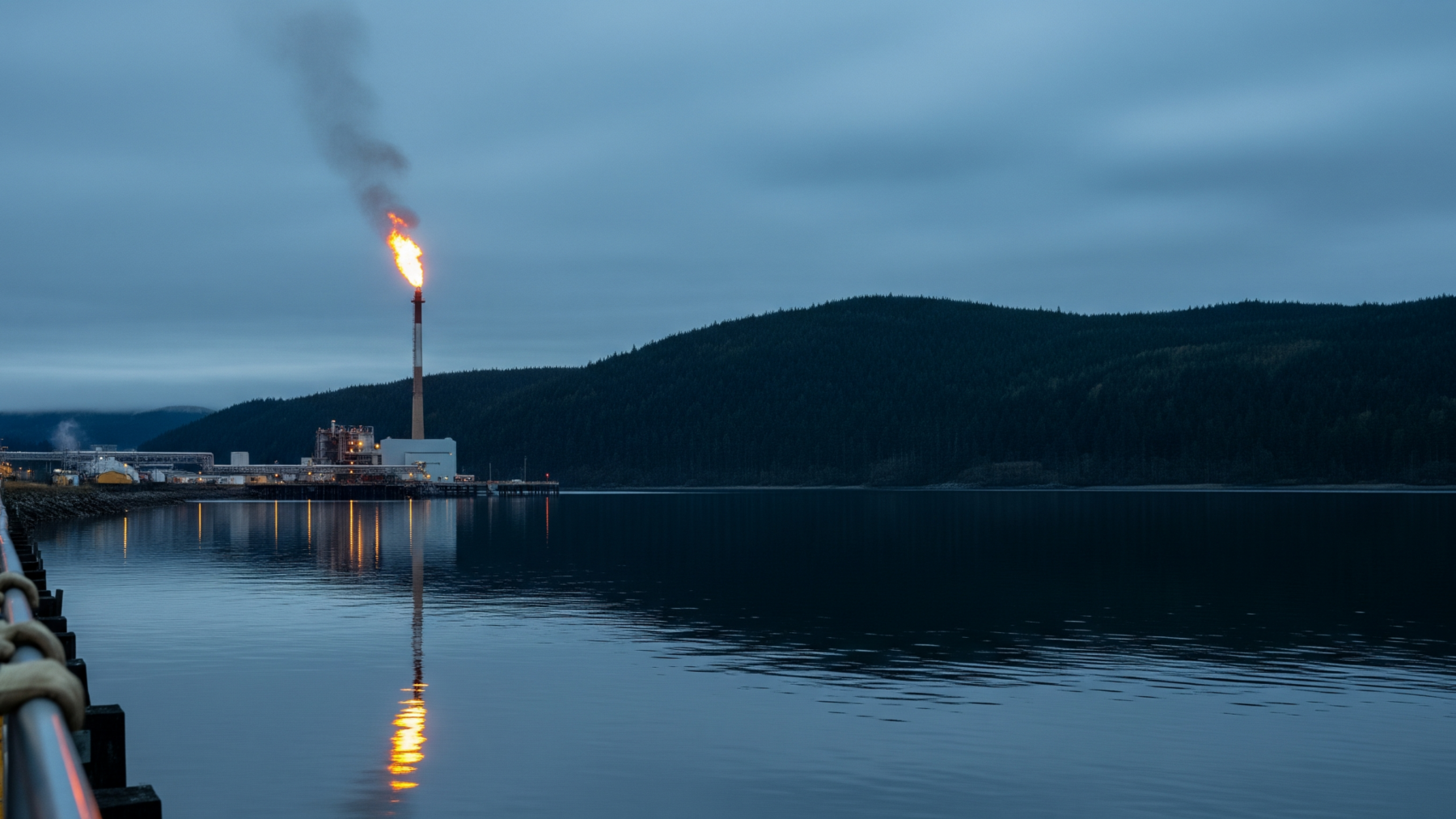
Something strange appeared above the British Columbia coast last winter.
Night after night, residents of Kitimat watched a column of fire rise from the new industrial waterfront south of town.
Not a flicker, not a maintenance blip.
IEA member governments tracking global energy flows have noted that real operating emissions frequently diverge from the projections built into project approvals.
On some evenings the flame climbed as high as a 26-story building, its light doubling on the black water of the Douglas Channel below.
The facility had been open for only months.
And the gas feeding that fire was not supposed to be there at all.
A promise built on cold math
For a decade, the pitch for liquefied natural gas was almost impossible to argue with.
Take gas from deep in the Canadian interior, chill it to minus 162 degrees, shrink it into a liquid, load it onto specialized tankers, and ship it to coal burning Asia.
Coal would go out.
Gas would come in.
The global carbon ledger, the argument went, would come down.
The LNG industry has been heralded as a way to elevate Canada’s status as a stable global energy supplier amid geopolitical turmoil.
At the center of that ambition sat one flagship project on the north coast of British Columbia.
It would be, promoters said, a clean bridge between the coal age and the renewable one.
Inside the liquefaction process, something leaks
Turning gas into a liquid is not gentle work.
It requires enormous compressors, acid gas removal units, and a cascade of refrigeration stages running without pause.
Every one of those systems can produce gas that cannot be safely routed back into the process.
Flaring, the controlled burning of natural gas, occurs at LNG facilities during start up operations, routine maintenance, and emergency situations.
Regulators anticipated some of this and wrote permit limits into the approval, setting a ceiling on how much gas could be burned away.
The rapid global expansion of LNG export facilities has outpaced objective data on actual flaring, complicating estimates of real environmental impact.
In Kitimat, the ceiling turned out to be almost decorative.
The numbers regulators found in the filings
Each month, the plant files air emissions reports to the British Columbia Energy Regulator.
Laura Minet, an air quality researcher at the University of Victoria, obtained those filings through freedom of information proceedings.
During the four month period covered in the filings, warm and wet flares exceeded permitted volumes by 45 times on average.
Cold and dry flares exceeded limits by 40 times, and storage and loading by five times.
Flaring exceeded permit limits by more than 60 times in December alone.
Minet noted that all the numbers were higher than the permits and had been consistently higher since at least the previous September, calling the gap surprising.
The British Columbia Energy Regulator indicated it would take escalating enforcement action in response to ongoing non compliance with permit limits, including those limiting black smoke emissions.
The plant kept shipping cargoes.
LNG Canada’s Kitimat flare and what it lands on
The facility is LNG Canada, led by Shell alongside South Korean, Chinese, Malaysian and Japanese partners, sitting directly beside the Douglas Channel.
The Douglas Channel is one of the great salmon migration corridors on the Pacific coast, carrying humpback whales, Chinook salmon and orca through the tight water between the mountains.
Flaring exceeded permits by 40 to 45 times on average between October 2025 and January 2026, according to documents obtained by Minet and reported in April 2026.
Then, in June 2026, the company moved to rewrite the rules rather than fix the machinery.
The company sought approval to continuously flare twice as much gas as its average routine output between September 2025 and March 2026.
For context, the Costa Azul terminal also began exports this year, tripling Mexico’s LNG capacity overnight.
IEA member governments tracking global energy flows have noted that real operating emissions frequently diverge from the projections built into project approvals.
The bridge fuel and what crosses it first
LNG Canada says elevated flaring is a safety measure during early operations and is not expected to be routine once the plant reaches regular operation.
Independent researchers are less confident the permits themselves were ever realistic.
Minet noted that without information on how LNG Canada modeled flaring for its permits, no comparison can be made between forecast volumes and those actually emitted.
Her research found that LNG facilities worldwide have start up phases with large amounts of flaring lasting two years on average, pointing to a need to account for this in environmental assessments.
The community is already demanding an independent health assessment of the gas industry along the north coast.
The salmon still run the Douglas Channel each autumn.
The orca still follow them in.
And somewhere between the permit application and the startup flame, the bridge to a cleaner future grew a great deal more complicated than the brochure suggested.

Hugo is an engineer with strong technical expertise. Multilingual from an early age, his writing combines technical clarity with a strong interest in science and energy.
