
Marine biologists tagged 64 Atlantic cod at a Dutch wind farm and watched them settle into the concrete pipes dropped on the sand instead of the rock piled around the tower bases
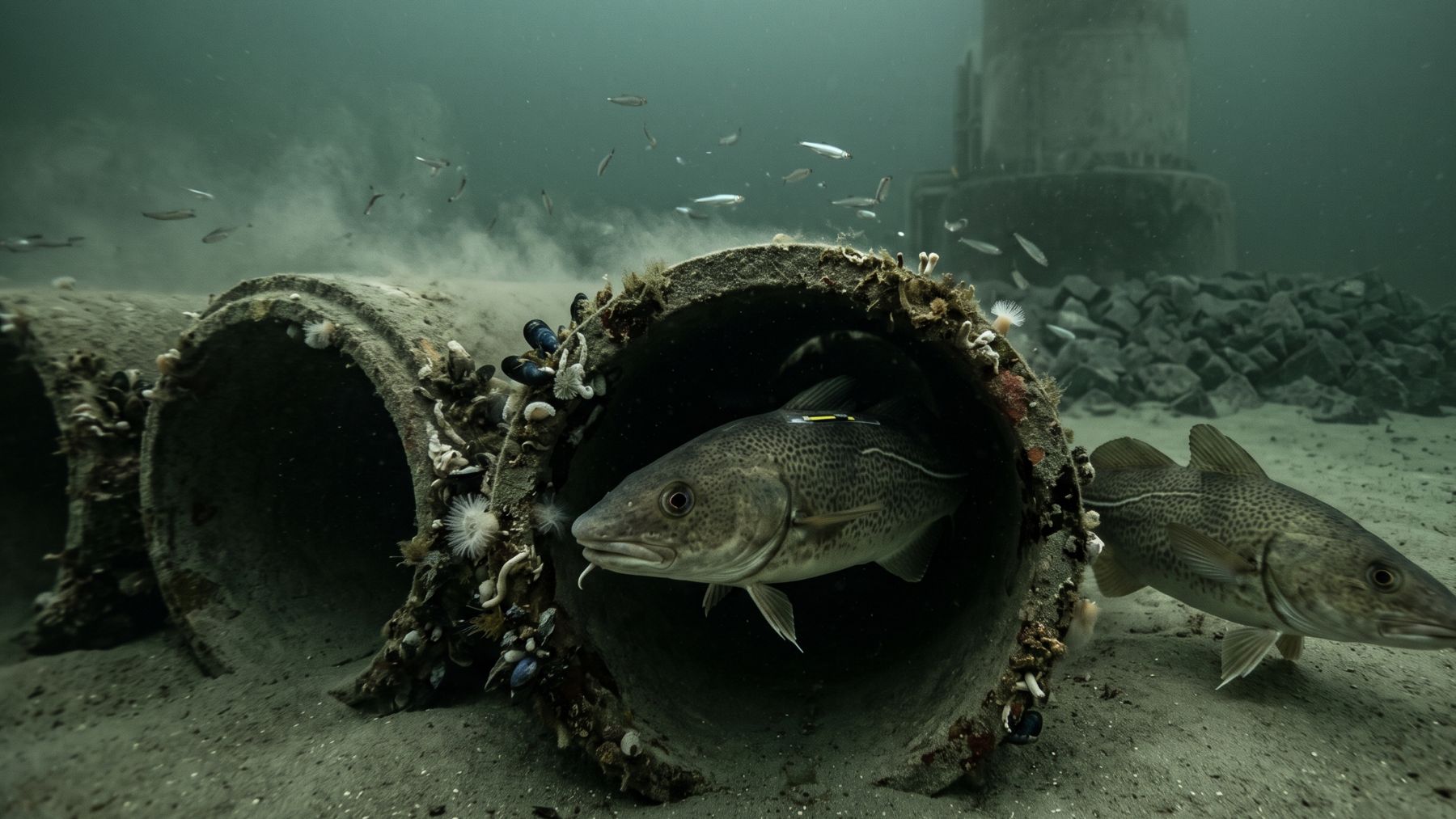
Fourteen miles off the coast of Zeeland, in the southern North Sea, the bottom is sand and almost nothing else.
A Dutch wind farm stands on it, and in among the towers a team lowered stacks of plain concrete pipes onto that sand.
Then they caught 64 Atlantic cod, fitted each one with a small transmitter, and let them go.
But it does mean the cheapest useful thing anyone can set on that seabed is a pipe with ends, and there is already concrete going into the water out there anyway.
The fish found the pipes and moved in.
What they did next says more about the seabed than about the turbines standing above it.
A floor with nothing on it
Because the problem in that stretch of water is not the water. It is the ground.
The southern North Sea is largely a flat plain of sand, swept by current and scraped for decades by bottom trawls.
A fish that depends on cover has nowhere to sit out a tide and nowhere to hide from anything larger than itself.
Cover is not a comfort for that animal either. It is where a cod waits out a current and where it ambushes whatever swims past.
Atlantic cod once worked this area in numbers that supported a whole fleet, and that is long over.
Scientific advisers recommended a zero catch for North Sea cod for the coming year, which is about as blunt as that advice ever gets.
So the question the wind farm raised was a narrow one. Does hard structure alone bring any of them back to a patch of sand.
What went down beside the turbines
And answering it meant putting something there deliberately, rather than waiting to see what grew on the steel.
The operator placed stacked concrete pipes at four spots around a single turbine, in a range of sizes bundled together.
Two of those reefs were set on a bed of granite, the same rock used everywhere out there to stop the current digging a foundation out of the seabed.
The other two sat straight on the sand with no stone underneath them at all.
That difference was the actual experiment, because the working assumption in the industry is that the rock is the part fish care about.
It is also the expensive part, and it goes in at every foundation whether anyone wants a reef there or not.
How to follow a fish into a pipe
Which left the harder half of the job, since a cod sitting inside a concrete tube is invisible to every survey method that works from a boat.
So the team used acoustic telemetry. Each fish carried a tag that pings, and a ring of receivers on the seabed logged every ping it heard.
45 cod were tagged in one summer and 19 more the following spring.
The array ran for about 18 months, which is long enough to tell whether a fish is passing through or living there.
It also returns position rather than simple presence, so the record shows an individual moving in and out of a structure across a single day.
Nobody had watched cod at that resolution around Dutch turbines before, and the array kept listening through a full winter.
What the receivers recorded
Then the pattern came out of the logs, and it was not subtle.
Tagged cod showed strong site fidelity, coming back to the same reef again and again rather than drifting off across the open sand.
Many spent long stretches inside the pipes themselves, using them as shelter rather than feeding along the edge and leaving, as the project set out.
Residency ran for months in a good number of individuals, which is the measure that separates a reef from a rest stop.
The same effect turns up wherever people drop hard structure into soft ground, whether the object is an offshore project or the cleared shoreline beside a coastal solar site.
Structure is the scarce thing down there, not food and not clean water.
The part the industry did not expect
Which brings it round to the comparison the whole thing was built to make.
The two reefs sitting on granite did no better than the two sitting on bare sand, and the fish treated both the same, as the trade press reported.
The pipes also outperformed the ordinary stone protection ringing the foundations, which is the reverse of what the design guidance assumes.
What a cod appears to want is a hole to enter, a cavity with a roof over it, not a heap of loose rock to swim above.
The finding is cheap to act on, which is rare in anything to do with fish and industry.
None of that rescues a species. This was one turbine, four small reefs and 64 fish, and the effect measured is local and tightly bounded.
But it does mean the cheapest useful thing anyone can set on that seabed is a pipe with ends, and there is already concrete going into the water out there anyway.
Hugo is an engineer with strong technical expertise. Multilingual from an early age, his writing combines technical clarity with a strong interest in science and energy.
