
Greenvolt Power opens 200 MW battery storage facility in Poland, one of the country’s largest BESS installations
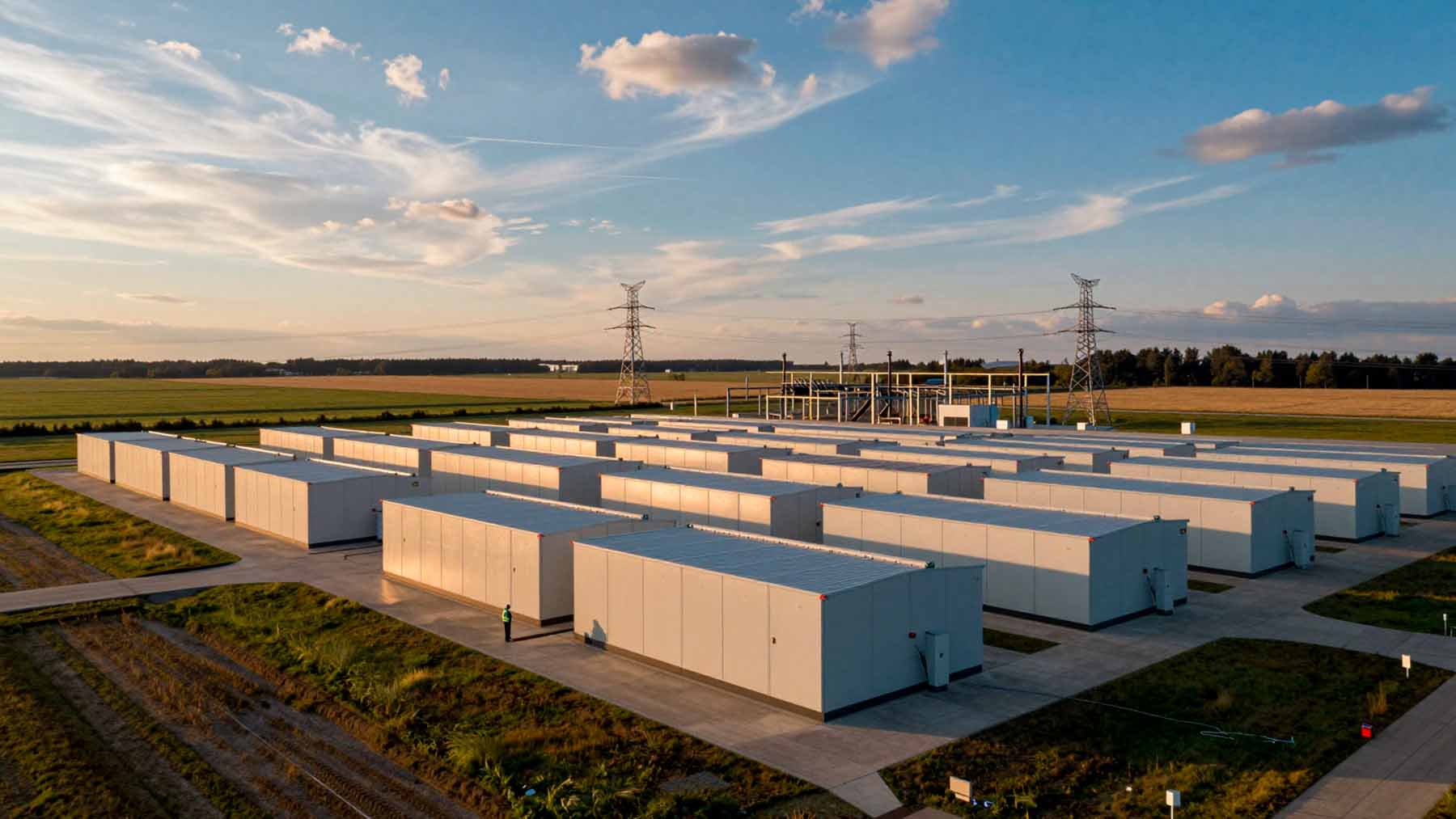 Image generated with artificial intelligence
Greenvolt Power, part of Greenvolt Group, just officially opened the Turośń Kościelna Battery Energy Storage Facility in Podlaskie Voivodeship, near Białystok. It’s one of the largest battery storage installations in Poland, rated at 200 MW with 800 MWh of capacity, connected to the national transmission grid at 110 kV.
Facility inaugurated in Podlaskie Voivodeship
Podlaskie Voivodeship isn’t the first place you’d think of for large-scale energy infrastructure. But the Turośń Kościelna site, just outside Białystok, now hosts one of the most significant battery storage projects Poland has seen.
The numbers are worth pausing on. At 200 MW grid connection capacity and 800 MWh of storage, the facility can discharge at full power for roughly four hours—a scale that puts it in a different category from most storage projects currently operating in the country.
It supports real-time grid balancing through fast-responding LFP technology and will participate in the capacity market from 2028 under a 17-year, 170 MW contract.
The site covers about 376,700 square feet, with more than 269,000 sq ft—over 70% of the total area—kept as biologically active land. That limits the physical footprint on the surrounding environment, which matters considerably when you’re building something this size near communities.
P&Q handled general contracting, and BYD Energy Storage supplied the battery technology. The project also went through environmental and social impact assessments aligned with standards from both the International Finance Corporation (IFC) and the European Bank for Reconstruction and Development (EBRD), covering effects on local communities and how identified risks get managed.
Why the facility was built: Grid flexibility and renewable integration
Poland’s installed solar and wind capacity has grown substantially in recent years. That growth comes with a familiar problem: weather-dependent generation doesn’t line up neatly with demand, and grids need fast, flexible tools to manage the gap.
Turośń Kościelna addresses that directly. It pulls electricity from the grid when supply is abundant—during a sunny or windy stretch, say—and feeds it back when demand climbs, making it a practical instrument for balancing Poland’s National Power System and supporting ancillary services.
Speed is where the LFP battery technology really stands out. The system responds to grid operator signals within seconds, which is significantly faster than conventional power plants—useful for real-time balancing, not just bulk energy shifting.
The project also cuts the risk of curtailment—those situations where renewable generation gets wasted because the grid can’t absorb it. Storing that surplus and releasing it when needed helps make better use of generation that would otherwise go unused.
Capacity market contract and operational specifications
Beyond day-to-day balancing, the facility has a long-term commercial anchor. Starting in 2028, it’ll participate in Poland’s capacity market under a 17-year contract, with a capacity obligation set at 170 MW—85% of the facility’s power rating.
The physical setup is substantial: 196 containerized battery modules and 49 containerized transformer stations. LFP chemistry was chosen for durability, with an expected operating life exceeding 20 years. Full-power discharge runs roughly four hours, long enough to cover the evening demand peaks that often follow periods of strong daytime solar generation.
Supporting infrastructure includes monitoring and protection systems, fire safety solutions, and acoustic barriers to limit noise impact on the surrounding area—a practical consideration when running a facility this size near people’s homes.
Broader context: Poland’s storage market and Greenvolt’s pipeline
Turośń Kościelna didn’t happen in a vacuum. Poland’s capacity market has seen a notable surge in battery storage activity—in the main auction for the 2028 delivery year, 33 electrochemical storage facilities secured contracts with a combined capacity obligation exceeding 1.7 GW. According to Poland’s Energy Regulatory Office, storage accounted for 15% of total contracted capacity in that auction, a meaningful share for a technology that was barely a factor just a few years ago.
Greenvolt Power is moving fast within that market. The company is wrapping up the Ełk project in Warmińsko-Mazurskie Voivodeship, carrying the same specs as Turośń Kościelna: 200 MW and 800 MWh, with commercial operation scheduled for Q4 2026. Together, the two facilities will deliver 400 MW of power and 1.6 GWh of storage.
Further out is the Siedlce project, planned at 600 MW and 2.4 GWh. If it comes together as planned, it would be the largest BESS project in Poland and one of the largest anywhere in Europe.
Greenvolt Power’s total battery pipeline stands at 5 GW across 13 countries. In Poland specifically, as of the end of June 2026, the company’s energy storage portfolio totals 2,595 MW, alongside 657 MW of solar PV projects and 238 MW of wind projects. The company expects to invest approximately $870 million in Polish renewable energy assets through year-end 2026.
A 20-plus year expected lifespan
The Turośń Kościelna facility is a concrete step in Poland’s energy storage buildout. At 200 MW / 800 MWh, it ranks among the country’s largest BESS installations and is now grid-connected at 110 kV and operational.
It supports real-time grid balancing through fast-responding LFP technology and will participate in the capacity market from 2028 under a 17-year, 170 MW contract. A 20-plus year expected lifespan gives it a long operational horizon.
For Greenvolt Power, this is one piece of a larger Polish strategy. The Ełk project comes online later in 2026, and the much bigger Siedlce development is already in the works. With a 5 GW battery pipeline globally and €800 million committed to Poland through 2026, the company is building a serious position in European utility-scale storage.
Kelly is an experienced writer with 15 years of experience exploring the big stories that shape our world, from tech breakthroughs and space exploration to climate, energy, and the fascinating quirks of science. She has a talent for turning complex ideas into sharp, memorable insights that stay with readers long after they’ve finished reading.
