
Paks nuclear station shed 491 megawatts in one July week, and the ancient architectural flaw now stalking reactors across an entire continent turns on a number most people never think about
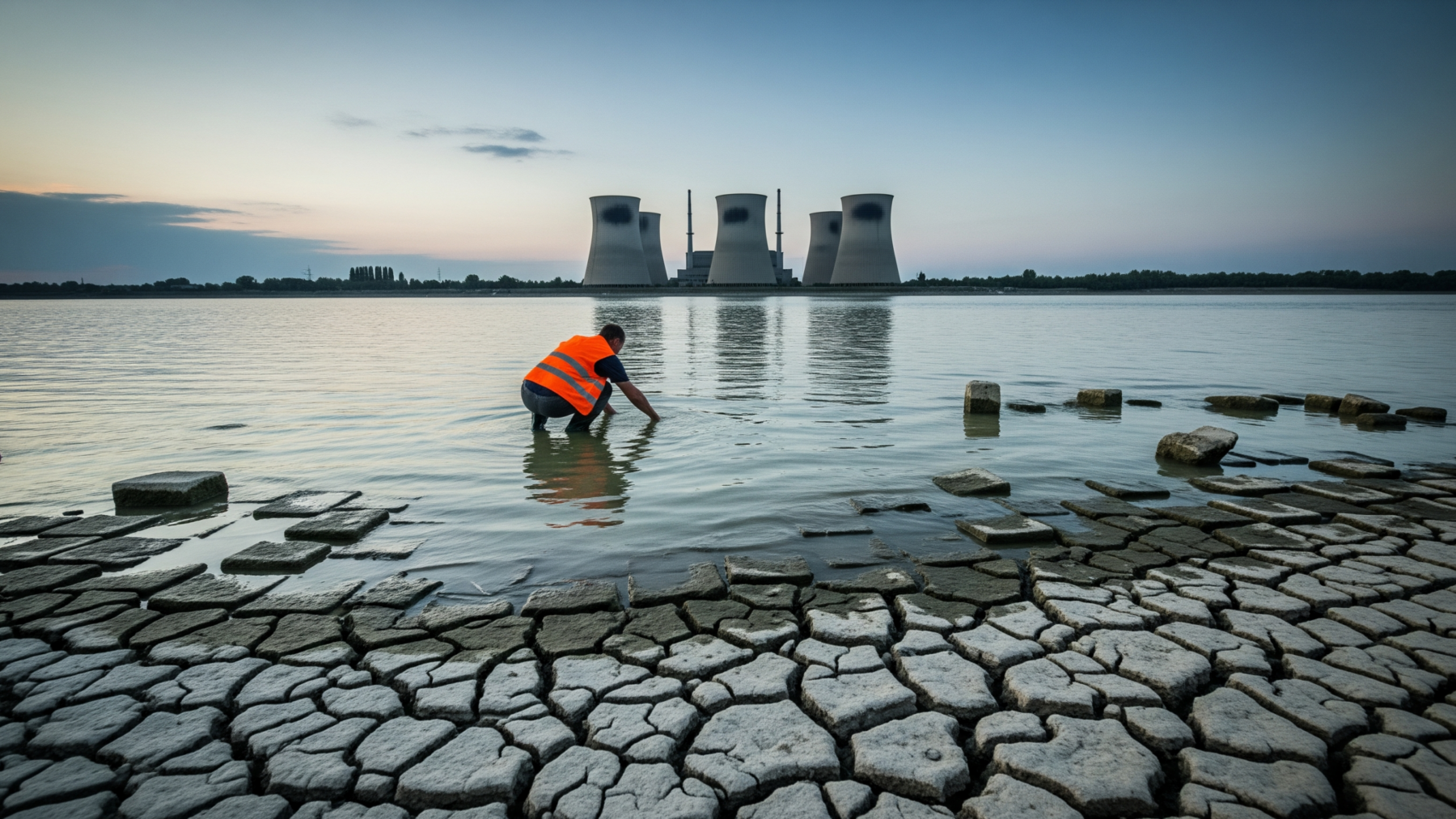
At the end of July 2026, the Danube slid to 31 centimeters in Budapest.
That is not a number most people associate with a power crisis.
It is barely shin deep in places.
But somewhere downstream, inside a control room at one of Europe’s busiest nuclear stations, engineers were watching a different number fall at the same time.
But somewhere downstream, inside a control room at one of Europe’s busiest nuclear stations, engineers were watching a different number fall at the same time.
And the two numbers were connected in a way almost no one outside the industry ever thinks about.
The question is not what happened to the water.
The question is what was depending on it.
A river that shrank faster than anyone planned for
The Danube drought of 2026 pushed the river to its lowest recorded level in Budapest, as Europe’s water crisis intensified.
Rivers have run low before.
But this summer carried something different.
For most infrastructure, a shallow river is an inconvenience.
For a certain class of machine, it is something far more serious.
That machine was not a pump, not a dam, and not a turbine.
It was a nuclear reactor, sitting on the western bank of the Danube, drinking the river every second of every day.
What 50 cubic meters a second actually looks like
Picture an Olympic swimming pool emptying completely in about 50 seconds.
A typical 1,000-megawatt light water reactor withdraws and circulates approximately 50 cubic meters of water per second through its condensers.
That river water never touches the uranium.
It contacts only the condenser in the turbine hall, cooling it before returning to the river.
But it must be cold enough, and there must be enough of it.
When the river runs low and warm, both conditions start to fail at once.
If intake water grows too warm or river levels fall below operational thresholds, the plant must reduce output to avoid equipment overheating or breaching environmental discharge limits.
And that is exactly what started to happen along the Danube this summer.
A design built around a river that no longer behaves as it once did
Once-through river cooling is the dominant architecture at most European nuclear facilities.
It was designed around historical flow rates and temperatures that are now being exceeded.
Rivers were reliable, cold, and abundant when these plants were drawn up.
Recent heatwaves and droughts have led to output reductions or complete shutdowns at reactors along the Rhine, Danube, Rhône, and other rivers, owing to insufficient cooling water and regulatory limits on thermal discharges.
In addition to the water shortage, environmental regulations also played a role: the cooling water returned to the Danube must not raise the river’s temperature by more than 30 degrees Celsius within a 500-meter radius of the discharge point.
In a heat wave, the river arrives already warm, the reactor can add only so much more heat, and the math closes in fast.
Hungary’s Paks station and the 491-megawatt moment
The low water level of the Danube forced the operator of the Paks nuclear power plant to take drastic measures, and for the first time in the plant’s history, a reactor unit had to be taken completely off the grid due to a lack of water.
On Monday, the output of Unit 1 was reduced by 254 megawatts, followed by a reduction of 237 MW for Unit 3 on Tuesday, and on Wednesday afternoon the complete shutdown of Unit 3 began.
Paks is Hungary’s only nuclear station and normally generates roughly 40 percent of Hungary’s electricity supply.
Losing nearly 500 megawatts in a single summer week, in the middle of a continentwide heat wave, sent grid operators reaching for every backup they could find.
Each time, the industry treated the event as an exception.
The 2026 season is making that framing harder to hold.
For readers tracking broader NRC updates on new reactor technologies, the river cooling constraint is exactly the kind of site-specific risk that next-generation designs are being asked to solve from the ground up.
What a fix actually costs, and where the industry goes from here
Dry cooling towers that require no river water exist but are expensive to retrofit and reduce plant efficiency.
They exchange heat into the air instead of the river, but on the hottest days the tower performs worst.
No European government has announced a mandatory retrofit program.
That gap between the known risk and the political response is where the pressure will build.
Advanced reactor designs entering the pipeline today are increasingly sited away from rivers or equipped with passive cooling that relies on physics rather than flow rates.
The DOE campus push reflects exactly that shift, choosing sites with drought resilience and modern cooling in mind from the first planning meeting.
Paks uses Russian-built technology, and construction has begun to expand the plant at the same site.
Whether those units repeat the river cooling architecture or chart a different path is a decision that this July may have made easier to reach.
The Danube will likely rise again.
But the engineers who watched it fall know that next summer is already on the calendar.
Hugo is an engineer with strong technical expertise. Multilingual from an early age, his writing combines technical clarity with a strong interest in science and energy.
