
Beneath 31,000 solar panels at a Polish car factory, 100 animals arrived for a job no machine could do, and what scientists began tracking inside the fence surprised everyone who designed the array
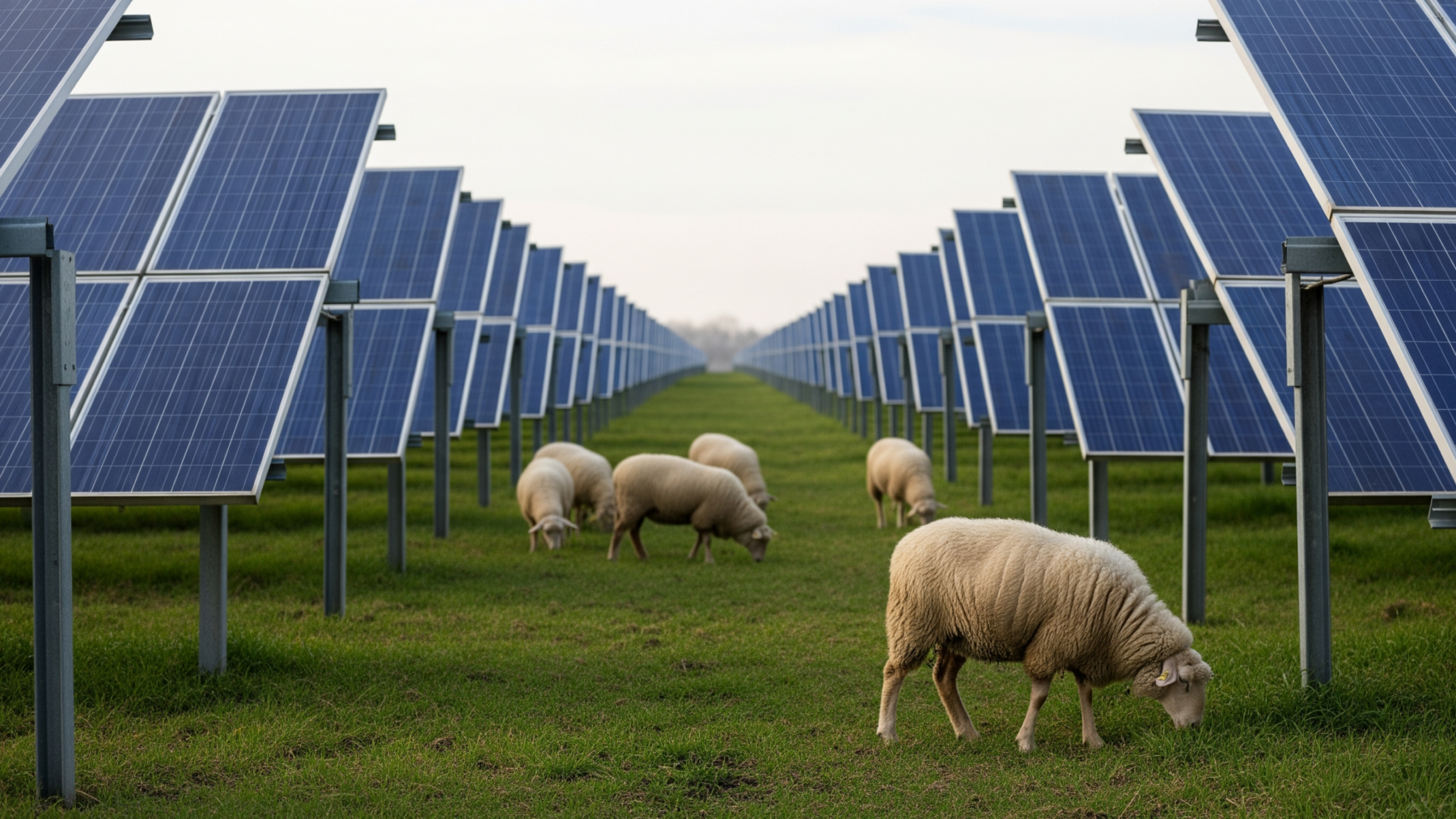
The grass had become a problem nobody anticipated. Inside the steel fence of a massive solar installation in western Poland, vegetation was growing faster than conventional mowers could safely reach it. The rows of panels stood too close together, the steel supports too low, the cables too exposed. Someone needed a different tool. In late April 2026, that tool arrived on four legs, and it was also a rare heritage animal whose bloodline Polish authorities are working hard to protect.
A factory that runs on sunlight, and a field that needs tending
A flock of 100 sheep is now grazing beneath more than 31,000 solar panels that help power Volkswagen’s manufacturing plant in Poznań, Poland, where the company makes the VW e-Crafter commercial van. The site sits about 30 miles east of the city in Września, a modest industrial town that most Europeans could not place on a map.
Built and operated by Quanta Energy, the solar farm covers about 67 acres and carries 18.3 megawatts of generating capacity. On sunny days it can meet the factory’s entire electricity demand; across a full year it supplies roughly 25 percent of the plant’s needs. That is a considerable slice of power for a facility assembling commercial vans at industrial scale, arriving without a gram of combustion.
The sheep grazing project demonstrates that modern industry can work in harmony with nature,” said Marzena Pillich-Grońska, director of Volkswagen Poznań.
Why a lawnmower cannot go where a sheep can
Grass at a solar facility cannot simply be ignored. Tall or woody growth can block access and complicate inspections, while conventional mowers must work around metal supports and live electrical equipment. The constraints are tighter than they appear from outside the fence.
Sheep move through those narrow rows and eat vegetation close to the ground. The gap between panel frame and earth at Września is tight enough to defeat most machinery but wide enough for an animal that weighs about 130 pounds and has been grazing rough ground for centuries. The fit is almost engineered. Shepherds in Britain, California and Japan have been lending their flocks to solar developers for years, yet what arrived in Września alongside the sheep turned a vegetation management project into a scientific one.
A breed carried inside the fence for reasons beyond grass
The animals belong to the Greater Poland breed, developed in the region and now included in a formal genetic conservation program. Bringing them onto the site placed a heritage animal, one whose bloodline is being protected by Polish agricultural authorities, into an entirely new environment and asked scientists to watch what happened next.
That is where the story changed. Flock owner Justyna Nowak-Gajek described the sheep spreading into smaller groups and grazing calmly across the site, saying the animals had “adapted very well to the new conditions.” That behavioral shift, from tightly bunched patterns on open pasture to dispersed feeding under partial shade, caught the university team’s attention almost immediately. The panels were doing something unexpected to the animals living beneath them.
What the scientists are actually measuring
The project is implemented jointly with the Poznań University of Life Sciences, whose researchers are studying the impact of sheep grazing on animal welfare, biodiversity, soil quality, vegetation and the microclimate of the site. Early signs suggest the steel and glass canopy creates conditions where a grazing animal thrives rather than merely tolerates the setting.
“Agrivoltaics allows us to look at photovoltaic farms from a much broader perspective than energy generation alone,” said Dr. Joanna Składanowska-Baryza from the university’s Department of Animal Breeding and Product Quality Assessment. Her team is collecting data through autumn, and the results will contribute to Poland’s emerging body of work on solar coexistence with agriculture.
A 2023 field study cited by the U.S. Department of Energy found that sheep at California solar sites spent more time feeding than animals on nearby open rangeland, a result attributed to shelter from heat and wind. The Września data will be the first to test that finding against a European continental climate and a conserved heritage breed.
A factory floor fed by a pasture, and what comes next
“Today, the photovoltaic farm produces much more than just clean electricity. It has also become a place that supports biodiversity, local agriculture, and scientific research. The sheep grazing project demonstrates that modern industry can work in harmony with nature,” said Marzena Pillich-Grońska, director of Volkswagen Poznań.
That claim rests on evidence still being gathered: the real result will not be that the sheep look comfortable in photographs, but whether data confirms safe animals, effective maintenance and healthier land. The real verdict is still coming.
If the Greater Poland breed proves well suited to the solar microclimate, the conservation program protecting its bloodline gains a new commercial argument, placing heritage sheep as a maintenance tool for the continent’s growing fleet of industrial solar farms. For anyone tracking how living things find their way into the edges of energy infrastructure, the pattern feels familiar, and in Września this summer it is generating data that could reshape how Europe manages its panels for decades to come.

Hugo is an engineer with strong technical expertise. Multilingual from an early age, his writing combines technical clarity with a strong interest in science and energy.
