
Permian Basin drillers pull up to 1 billion gallons of toxic wastewater every single day, and Texas just decided the quail living beside those ponds may hold the answer to whether it can ever safely feed a farm
Every day in the Permian Basin, the oil comes up carrying an uninvited passenger. For every barrel of crude that leaves a West Texas wellhead, roughly four barrels of water follow it to the surface. That water is not the kind anyone would pour on a field without a very long conversation first. Right now, Texas is finally having that conversation.
A flood no driller ordered
Produced water is the industry’s term for the ancient, hyper salty brine trapped underground for millions of years alongside hydrocarbons. When a well is fracked and brought online, the brine surges up with the oil and gas and keeps coming for the life of the well. Texas leads the nation in production, with an estimated 20 to 25 million barrels, or up to 1 billion gallons, of produced water generated daily in the Permian Basin alone.
For decades, the standard response was to pump the brine back underground into disposal wells. Subsurface disposal costs about $0.60 per barrel, while treating the same water for agricultural use can reach $4.00 per barrel. Treatment to potable standards can approach $7.00. The economics of repurposing it have always run uphill.
A March 2025 report by Texas Living Waters estimates that around 50 to 60 percent of produced water is being recycled for hydraulic fracturing in the Permian Basin.
When the ground starts shaking back
The connection between deep disposal wells and man made earthquakes has become too loud to ignore across the Permian, and regulators are now under pressure to find somewhere else for the water to go. Ongoing seismicity concerns and orphan well risks are pushing operators and regulators alike to explore alternatives.
A March 2025 report by Texas Living Waters estimates that around 50 to 60 percent of produced water is being recycled for hydraulic fracturing in the Permian Basin. That is real progress, but it still leaves an enormous volume with nowhere useful to go. The question hardening into policy is whether Texas farmland could absorb what the oilfield cannot.
The hidden chemistry in every drop
The word “water” undersells what this liquid actually is. Produced water contains a complex mix of contaminants including salts, heavy metals, naturally occurring radioactive materials, and chemicals added during drilling. The gap between “cleaner” and “clean enough for a food crop” is where the debate lives.
Technologies such as reverse osmosis, thermal evaporation, and advanced oxidation can clean produced water to high levels, but costs climb sharply once treatment moves beyond frack water quality toward agricultural standards. The cost gap remains the most stubborn barrier in the room. Doing it at Permian scale, within a price that does not collapse a farm’s operating budget, is a very different problem from solving it in a laboratory.
Texas puts the quail in charge
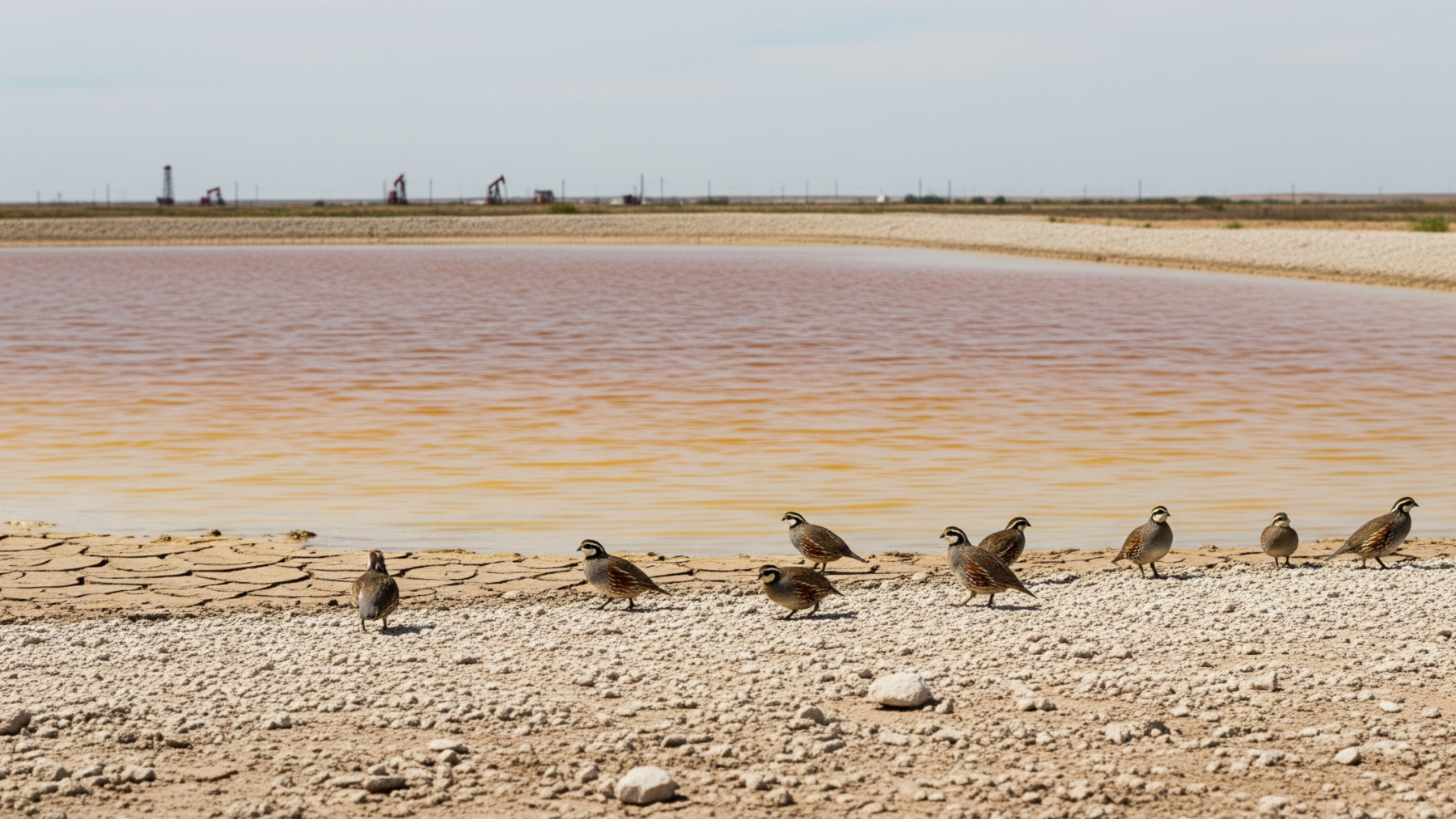
This is where the story turns. The Texas Commission on Environmental Quality held a public hearing in June 2026 on draft rules governing exactly how clean produced water must be before any of it touches a field. As the Texas Tribune reported, two pilot projects starting this summer are examining its use for agricultural irrigation and rangeland restoration while monitoring wildlife impacts, particularly on quail. The bird is a proxy for the whole ecosystem: if the quail thrive, the land is absorbing the water without damage.
The quail are, in effect, the sensors.
That effort gained momentum when lawmakers approved legislation transferring authority over land application permits from the Railroad Commission of Texas to the TCEQ, signaling that Texas now treats this as an environmental question, not just an oil and gas logistics one. “We’re working toward a solution,” said Dan Mueller, an engineer and produced water consultant representing the Environmental Defense Fund. “Just don’t get ahead of the science and move it too quickly to where you end up creating more problems than you solve.”
A desert drought and a reluctant bargain
West Texas is running dry. The Ogallala Aquifer has been drawn down for generations, and the region’s irrigated cotton and sorghum fields are already calculating how many more seasons they have left. Oilfield brine, stripped of its worst contaminants, starts to look less like a problem and more like an accidental reserve.
Zacariah Hildenbrand, a chemist and partner at Medusa Analytical, said the state is suffering from paralysis by over analysis. “We have the data to support this can be done safely,” he said. Critics counter that the draft rules do not prescribe specific treatment technologies or testing for radionuclides, PFAS, or heavy metals commonly found in oilfield wastewater. Laura Lopez, a TCEQ spokesperson, said the agency is “currently developing a regulatory framework for treated produced water” land application permits, with each site evaluated for pollutant limits and monitoring “as necessary to ensure protection of human health and the environment.”
The pilot results are still months or years away, and no regulator is promising a clean outcome. But the scale of what is at stake tips the calculation toward trying. The quail will let Texas know first.

Hugo is an engineer with strong technical expertise. Multilingual from an early age, his writing combines technical clarity with a strong interest in science and energy.
