
A 330 million dollar solar plant in South Carolina started turning out thin film modules at 1.7 gigawatts a year in under 12 months, while the cells inside them are coated somewhere else
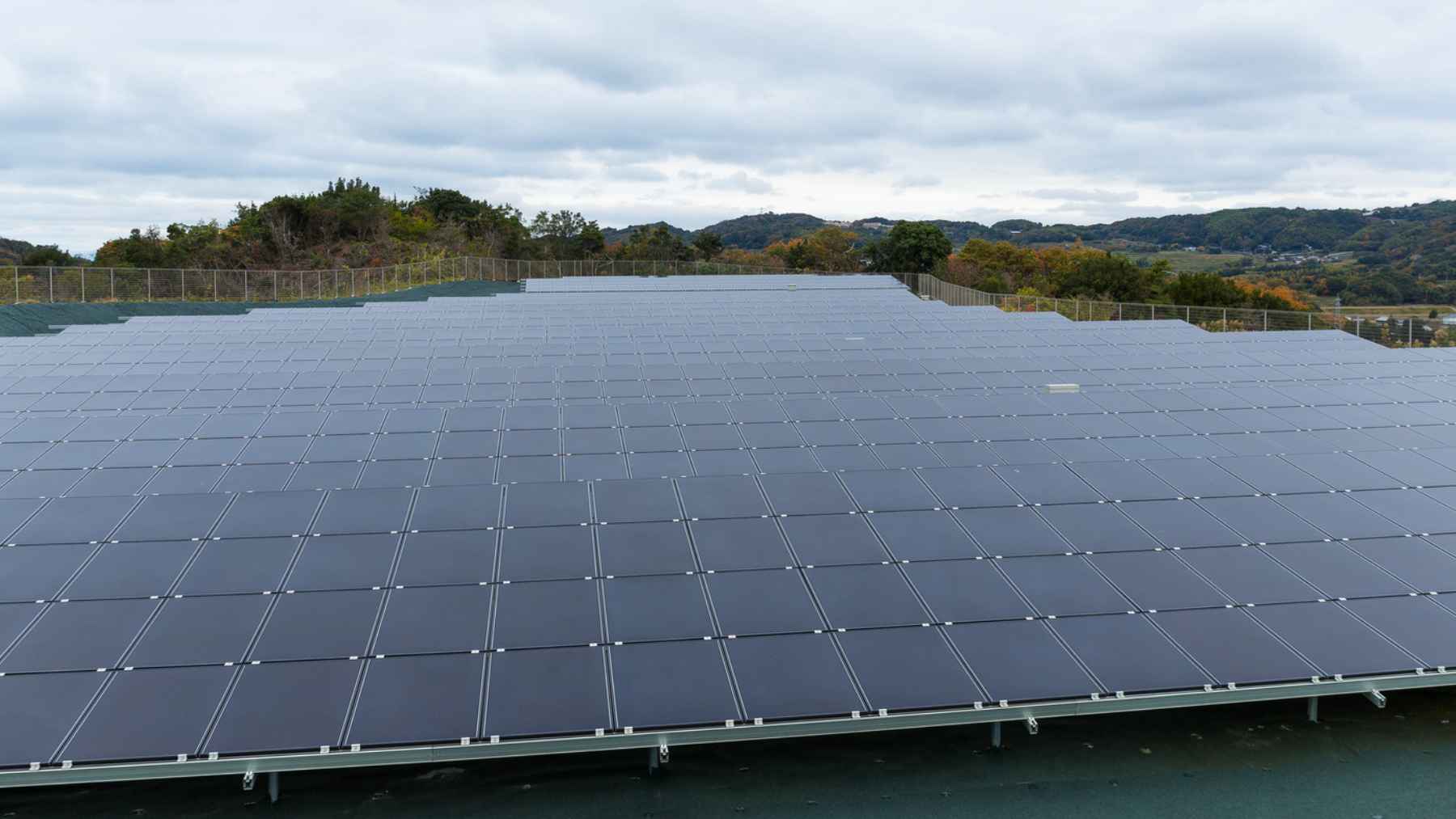
A dark coated glass plate rides a conveyor toward a machine that presses an aluminum frame onto its edge.
Nothing on that line looks like a solar cell. There are no little blue squares and no soldered ribbons.
The plant in Gaffney, South Carolina, was inaugurated on the twenty eighth of October, 2026.
The semiconductor is deposited straight onto a sheet of glass, scribed into strips, and the plate that comes off the coater is already the entire cell circuit.
Its owner picked the site less than a year earlier, which is quick for anything with a roof.
The speed is the first clue. The second is that no cell is made there.
Which leaves the question worth starting from. How do you split one module line in half?
Why 1 glass sheet is already the cell
Because a thin film cell is not an object you can hold.
A silicon cell starts as a sawn wafer. It is a discrete thing, handled individually, soldered into strings and laid between sheets of plastic, and the steps that turn a wafer into a cell carry most of the capital in the building.
A thin film module skips all of that. The semiconductor is deposited straight onto a sheet of glass, scribed into strips, and the plate that comes off the coater is already the entire cell circuit.
What is left after the coater is assembly. Lamination, edge sealing, framing, a junction box and a flash test.
That split has no equivalent on a silicon line. A bare wafer is fragile, oxidizes and cannot usefully be shipped halfway around the world between process steps, so the cell and the module tend to be made in the same country or the same building.
Those last steps are the cheapest part of the plant to move, and they are the fastest to build.
1.7 gigawatts and 500 of nearly 700 jobs
The hardware is large and the numbers are specific.
The facility cost about 330 million dollars, and this first phase carries a nameplate of 1.7 gigawatts a year.
A second phase is due by the middle of next year and doubles that to 3.4, and it is the phase meant to carry the company’s newer cell recipe.
Headcount sits near 500 of the roughly 700 the site expects, and the product is the maker’s Series 6 Plus module.
It is the sixth American plant in the fleet, alongside three in Ohio and one each in Alabama and Louisiana.
The company puts its American manufacturing and research spending since 2019 at over 5 billion dollars.
What 1 phrase in the release covers
Now read the wording, because it is doing real work.
The announcement says the plant onshores the final production processes for modules initiated by the company’s international fleet. The trade account is blunter and says the facility uses thin film cells produced at overseas sites.
So the coated plates arrive. Gaffney laminates, seals, frames, wires and tests them, and ships finished modules.
The sequence matters for what the building needs. A coating line runs vacuum chambers and high temperatures. An assembly line runs presses, robots and an electrical tester, which is why one takes years and the other takes months.
That is a real factory doing real work, and it is also the back half of a process whose front half sits on another continent.
Nothing about that is hidden. It is written in the release, in a phrase most readers will slide straight past.
A module plant and a supply chain are not the same thing.
What 17 gigawatts counts
Here is where the figures need handling.
The chief executive says every module leaving the facility is made without dependence on Chinese crystalline silicon supply chains, in the way that a lab record or an Austin pilot turns into a finished answer.
Read it exactly. The sentence is about crystalline silicon, and this company does not use crystalline silicon anywhere, so it is true and it says nothing about where the coated plate came from, and the company release carries the line in full.
The capacity total moves too. The release targets roughly 17 gigawatts of American module capacity by 2027, while the trade report puts it near 17.7 once Gaffney is fully commissioned.
And the plain numbers are missing. No building area, no site acreage, no module wattage, no cycle time and no word on where the glass comes from.
What is published is the capacity, not the content.
Where the next phase has to add
The useful reading of this opening is narrow and worth having.
Final assembly on American soil is a genuine shift, because it is where the jobs, the freight and the warranty work land.
It is not the same as making the semiconductor here, and the second phase is the one to watch, since a new cell recipe usually means new coating equipment rather than new framing machines.
Until then the honest description of Gaffney is a finishing plant at industrial scale, which is a long way from nothing.
The glass arrives already carrying the physics.
Somebody still has to coat it first.

Hugo is an engineer with strong technical expertise. Multilingual from an early age, his writing combines technical clarity with a strong interest in science and energy.
