
Wind farms built on ridgelines are leaving energy on the table and the hills themselves are to blame
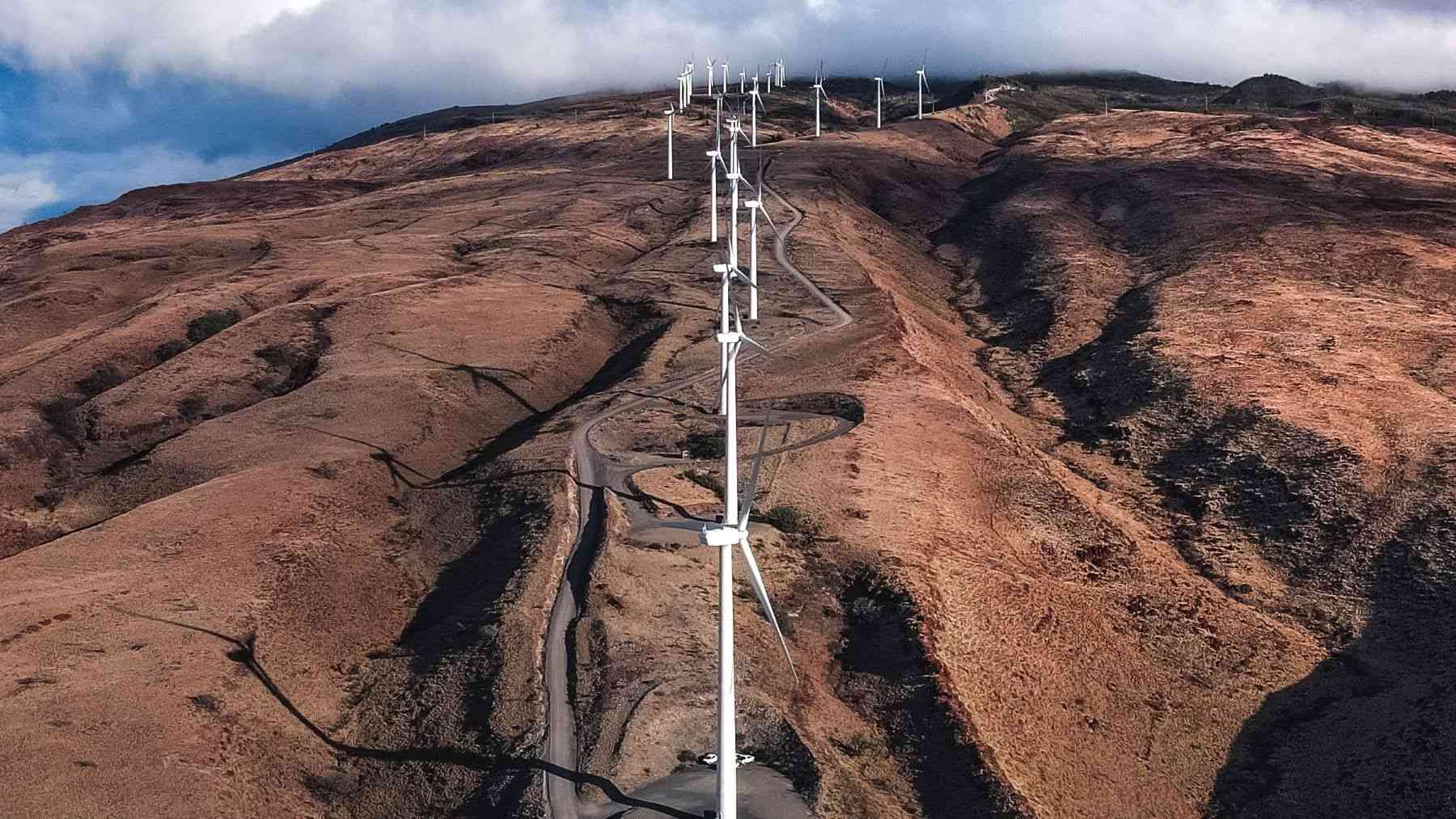
Ridgelines look like obvious choices for wind energy: elevation, exposure, consistently strong winds. Developers have long treated them that way. But a new numerical study suggests the hills themselves may be quietly working against the turbines placed on them.
The research finds that terrain shapes how wakes form and how blockage spreads upstream — in ways that push wind farm and individual turbine efficiency more than 12 percentage points away from flat-ground predictions. Standard industry tools used to forecast energy yield, the study warns, can’t see any of it.
The hidden cost of building where the wind blows hardest
Wind energy assessments typically split into two separate calculations. Freestream simulations map how terrain shapes wind speed across a site — without turbines. Wind farm simulations then model how turbines interact with each other — without terrain. That gap is where the problem lives.
The path forward requires flow solvers that handle terrain, stratification, pressure gradients, and turbine interactions simultaneously — not in separate steps.
Turbine interaction loss — the difference between what a farm could theoretically generate and what it actually produces — is the single largest loss factor in any energy yield estimate. Yet terrain’s influence on that loss has been largely ignored by standard industry practice.
The new study used Reynolds-Averaged Navier-Stokes (RANS) simulations across 35 combinations of terrain, layout, and atmospheric conditions. In one scenario — a two-row farm where the second row sits on the leeward side of a hill — overall wind farm energy conversion efficiency was 12.8% lower than the equivalent flat-terrain case.
How a hill rewrites the rules of wake recovery
The study compared four configurations: flat terrain, a hill with the first row on the windward slope and the second at the crest, a hill with the first row at the crest and the second on the leeward side, and variations across atmospheric stability conditions. In the leeward case, wakes downstream of the first row were dramatically deeper than in either the flat or windward scenarios.
The mechanism is pressure. Hills create streamwise pressure gradients — favorable (dropping) on the windward side, adverse (rising) on the leeward side. Favorable gradients accelerate wake recovery; adverse gradients deepen wake deficits before they reach the next row. Turbulence-based models can’t reproduce this behavior because they lack the pressure term entirely.
A control volume analysis made this concrete. In the leeward case, mean wind speed was 16.1% below freestream just downstream of the first row and 18.3% below freestream approaching the second.
Blockage, gravity waves, and the stratified atmosphere
Wind farm blockage is the upstream slowdown that occurs before wind even reaches the first turbine. The study introduces a Froude number analysis to explain how terrain amplifies this effect. As the local Froude number approaches 1.0, upstream blockage intensifies sharply — the flow becomes increasingly sensitive to any obstruction, including a row of turbines.
Hills generate gravity waves that propagate downstream, modulating pressure fields well beyond the terrain feature itself. Depending on the phase of those waves relative to turbine locations, blockage can increase or decrease. Buoyancy — the result of thermal stratification — is a primary driver.
Turning it off in the model reduced upstream blockage and raised array efficiency, especially when turbines sat at the hill crest. Prior research on terrain and turbines used purely neutral flows, leaving this physical mechanism unexamined.
Individual turbines pay a terrain tax too
Across the simulated cases, individual turbine power coefficient (CP) ranged from 0.408 to 0.477, against a nominal design value of 0.445. That spread — driven entirely by terrain — is large enough to matter in any energy yield estimate.
Terrain-induced pressure gradients alter the size and shape of the near wake behind a rotor, changing how much the approaching flow deflects around the disk. The study found a correlation coefficient of −0.78 between CP and the freestream pressure coefficient measured just downstream of each turbine. Stronger adverse pressure downstream correlates with lower turbine efficiency.
One practical implication: comparing power curves from the same turbine model across sites with different topographies could, in principle, reveal this signal in field data.
Real ridgeline, real stakes
The study also simulated a 94-turbine wind farm along ridgelines using inflow conditions from a weather model under both stable and unstable atmospheric conditions — and results held with the idealized findings. Turbine interaction loss ran roughly 4 percentage points higher in real terrain than in flat-terrain simulations of the same layout. In unstable conditions, predicted loss was 5.3% in real terrain versus 0.9% on flat ground; in stable conditions, 16.5% versus 12.4%. Average CP on real terrain was more than 4% lower than on flat ground across the eight turbines simulated in isolation.
Why standard planning tools fall short — and what needs to change
Engineering wake models used across the industry can’t simulate terrain-induced pressure gradients or the inviscid response of stratified flow to hills and turbine arrays. The study tested two hybrid approaches to approximate terrain-aware results. Neither performed reliably — the multiplicative approach actually reversed the predicted loss trend between the windward and leeward cases.
The deeper issue is coupling. Terrain modifies wakes, those wakes feed back into blockage, and blockage modifies how wakes develop. Treating these as separable problems misses the system-level behavior entirely.
The path forward requires flow solvers that handle terrain, stratification, pressure gradients, and turbine interactions simultaneously — not in separate steps. Without that, the gap between predicted and actual energy yield at ridgeline wind farms will remain largely invisible to the tools developers rely on most.
Reference: Bleeg, J. and Montavon, C.: A numerical study of the influence of terrain on wakes, blockage, wind farm efficiency, and turbine efficiency, Wind Energ. Sci., 11, 2695–2721, https://doi.org/10.5194/wes-11-2695-2026, 2026.

Daniel García is an Editor-in-Chief with strong expertise in structural work and engineering principles. He combines this technical foundation with deep knowledge of energy, spatial design, and emerging technologies, bringing a forward-thinking and analytical approach to editorial leadership.
