
A 344 foot wind turbine tower outside a Swedish town is glued together from spruce panels on site, while the tallest version its maker has certified has never once been erected
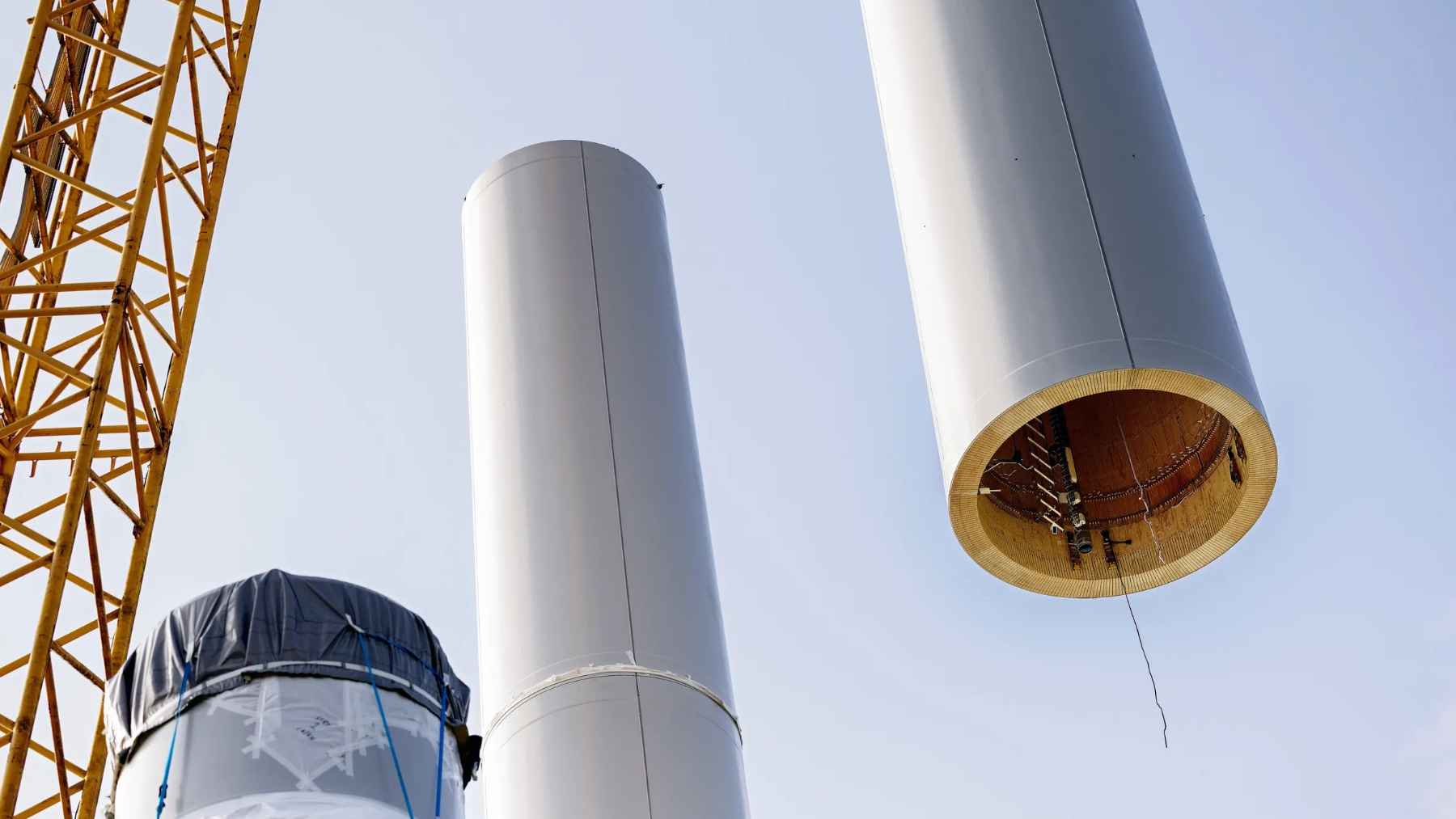
A flatbed trailer pulls onto a site outside a small Swedish town carrying what looks like a quarter of a barrel.
It is a curved wooden panel about fifty feet long, and three more like it are stacked behind the cab.
Crews glue four of them into a ring on the ground. Then they stack the rings.
On the twenty ninth of April, 2026, the company behind that structure was awarded European money to build the first factory that will turn them out in series.
On the twenty ninth of April, 2026, the company behind that structure was awarded European money to build the first factory that will turn them out in series.
Which leaves the question the trailer answers. Why would anyone build a tower out of glued spruce?
It is not about strength.
Why 14 feet decides the whole tower
Because a steel tower is shipped, not built.
A tower is a cantilever with a rotor on top. Make it taller and the bending moment at the base grows, and the cheapest way to carry that is a wider base.
The base is where the trouble starts. A tubular steel section travels on a trailer and has to pass under bridges and through roundabouts, and the trade account puts the practical ceiling at 14 to 14.7 feet across Europe and North America.
Past that width the options get expensive. Thicker walls instead of a wider base, or a base split into bolted panels needing huge numbers of bolts.
Laminated timber sidesteps the whole argument. The panels ship curved and narrow, the ring is assembled on the ground, and the finished diameter is set by the design rather than by the lowest bridge.
344 feet and 28 glued modules
The reference structure stands outside Skara in southwestern Sweden.
It is 344 feet of laminated veneer lumber in 7 tapered sections made up of 28 curved modules, and it carries a 2 megawatt nacelle with 148 foot blades, which puts the blade tip at 492 feet.
The timber is Scandinavian spruce, peeled into veneers and pressed into boards, the same product used in building floors and beams.
It was built for a municipal utility with funding from a European research program, and the maker reports more than 15,000 hours of operation.
The erection year is not clean. The project page lists delivery in 2023 and a certifier described it as being installed that September, while the company’s later releases say 2024.
That is a small inconsistency. It is also the only operating example.
What 210 tons weighs against 300
Now the material numbers, with the caveat they come with.
Laminated timber is roughly a fifteenth the density of structural steel, and the trade account puts the finished tower at 210 metric tons against about 300 for an equivalent steel tower.
Per pound the timber holds its own, which is the whole basis of the design. That comparison also traces back to a secondary write up rather than a published test report.
The carbon side is better documented. A Swedish research institute put the lifetime emissions of a timber tower at 90 percent below a steel tower of the same height and load, and that assessment is the figure the company cites.
A certification body lists the wood volume at 300 to 1,200 cubic meters depending on height and load, holding 240 to 950 tons of carbon dioxide equivalent.
Stored carbon is not the same as avoided carbon, and the two get added together in a lot of coverage.
What 390 feet never built settles
Here is the part the announcements leave out.
The tallest design the company has certified has never been erected, in the way that a blade convoy or a floating fix turns into a finished industry.
That design runs to 390 feet, was signed off for a 6.4 megawatt machine, and exists to prove the structure works at that scale rather than to carry a rotor, and the grant notice puts the first serial factory in western Sweden.
The schedule is public. Full capacity is expected by 2031, roughly 1,500 towers across ten years, and the next design between 525 and 558 feet is due in 2027, and the engineering press reports that no serial line runs yet.
The obstacles are stated openly by the engineers themselves. Tower standards were never written with wood and adhesive in mind, and cheap imported steel sets the price everyone has to beat.
Where the next 200 feet has to come from
Strip the material away and the useful point is about logistics.
Onshore hub heights have climbed because wind speed rises with height and turbulence falls, so every extra hundred feet buys output on the same ground. The engineering is not the hard part.
The hard part is a road network built for other purposes, and the industry has spent two decades working around it with escort vehicles, temporary bypasses and one proposal to fly the parts in.
A wind turbine tower made of glued panels is one answer to that, and it will stand or fall on cost rather than on physics.
Somebody still has to beat the mill price.
Hugo is an engineer with strong technical expertise. Multilingual from an early age, his writing combines technical clarity with a strong interest in science and energy.
