Risk Is a Line Item: The Business Impact of Quality Systems for Gulf Coast Energy Suppliers

Ask the owner of a Gulf Coast machine shop, valve distributor, or fabrication yard about risk, and the conversation usually turns to safety: hydrogen sulfide, dropped objects, hot work. Ask what an unmanaged quality risk costs, and the answer gets vague. The income statement is not vague. The cost shows up as scrap nobody reported, a data book that holds up an invoice, a bid you cannot submit, or an audit finding that puts a license on hold.
The standards that oil, gas, LNG, and petrochemical customers write into their purchase orders have asked suppliers to manage these risks for years. ISO 9001:2015 clause 6.1 asks an organization to determine its risks and opportunities, plan actions, build those actions into its processes and evaluate whether they worked, with actions “proportionate to the potential impact on the conformity of products and services.”[1] API Specification Q1, the quality standard behind the API Monogram, goes further. Its tenth edition requires a documented risk procedure for product delivery and product quality, covering equipment availability, supplier delivery performance, nonconforming product, and the availability of competent personnel.[2]
The rules are also moving. ISO 9001:2026, published September 16, 2026, separates risks from opportunities so organizations act on both.[3] Companies certified to the 2015 edition have until September 30, 2029, to transition.[4]
Availability of competent personnel is a required product quality risk, and a change in key personnel is one of the changes that calls for a new risk assessment.[2]
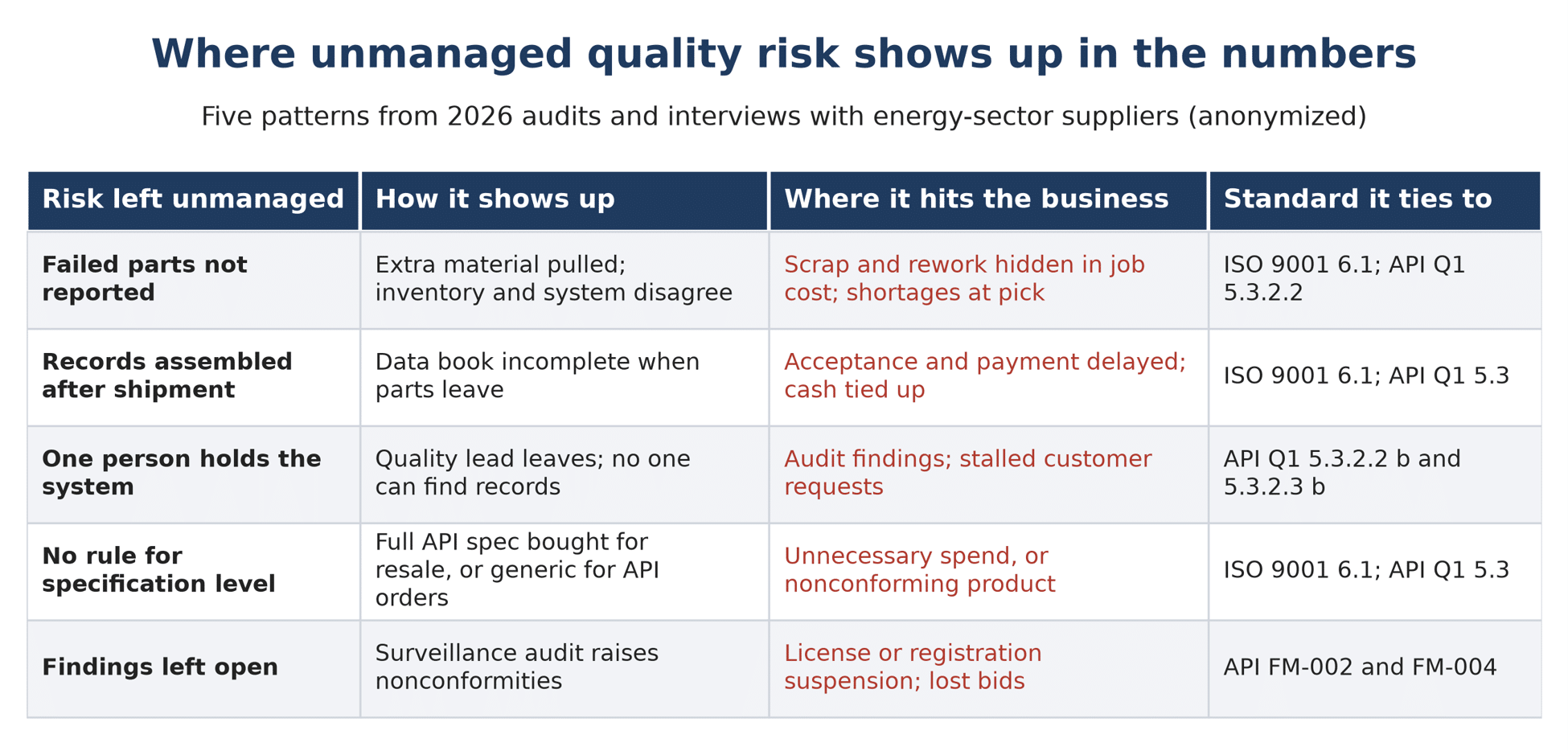
Meeting the requirement is not the hard part. Seeing where risk already costs you money is. Here are five places it shows up, with anonymized examples from audits, interviews, and customer conversations our team recorded in 2026.
1. Scrap and Rework Nobody Reports
A former API lead auditor on our team describes a pattern she sees on shop floors. When a part fails, the operator does not always write it up. Worried about blame or a hit to their pay, they let the bad part disappear and pull more bar from inventory. “You don’t know about it, and the actual cost will be too high,” she said in an interview this fall. The order looks profitable. At year end the owner asks why the company is in the red, and the next pick list sends someone to an empty rack.
ASQ classifies scrap, rework, and waste found before delivery as internal failure costs.[5] Few companies measure them well: in ASQ’s 2025 cost of quality research, only 31% of respondents said they fully understand how quality costs affect their organization’s financial performance.[5]
2. A Shipment You Cannot Invoice
In energy work, the paperwork is part of the product. “Customer will not accept the order, and customer will not pay you unless you prepare all the paperwork,” the auditor said: material test reports, purchase orders, inspection reports, and work orders. When those records are assembled after the parts ship, every day spent chasing a missing inspection sheet is a day of cash not collected. A risk-based system treats “documentation not ready at shipment” as a delivery risk, the same way it treats a late casting.
3. The One Person Who Holds the System
“When you are dependent on one person, that person owns and runs your business, and it’s a risk,” the auditor said in another interview. As an auditor, she has watched owners try to answer audit questions two days after their quality manager quit. API Q1 treats this as a named risk. Availability of competent personnel is a required product quality risk, and a change in key personnel is one of the changes that calls for a new risk assessment.[2]
Anonymized example from a 2026 readiness audit of an oilfield equipment distributor. The organization chart had just been redrawn because three people had left. The auditor asked leadership how risk-based thinking is promoted day to day. The first answer was “Can you reword that?” The second was the morning safety meeting. The company managed safety risk well, but nothing connected the staff change to the quality system. The closing improvement list included risks, contingency plans and mitigations, next to supplier evaluation and a master list of controlled documents.
4. Buying Against the Wrong Requirement
Risk cuts both ways. Anonymized example from a 2026 onboarding session with an oilfield equipment supplier preparing for API Q1 and API 6A. Most of its business was resale, and the same part needed a generic description on some purchase orders and a full API description on others. With no rule, the company either buys the full specification when it is not needed, which the team itself flagged as significant unnecessary spend, or buys generic material for an order that needed a traceable API product. Either way, a risk decision gets made by accident.
5. A License on Hold
The largest costs come from findings. API’s program requirements say surveillance audits can lead to suspension or cancellation, and that registration may be suspended when audits show nonconformance, when audits are delayed or missed, or when valid complaints go unresolved. A suspension is lifted only after the stated conditions are met.[6][7] For a supplier whose customers require API Monogram product or Q1 registration, a suspension means those customers cannot buy.
The auditor saw this from the inside early in her career. She was a quality manager at a large, privately owned valve manufacturer when an API audit ended with its API 6A license and API Q1 certification suspended. For about six months, its largest oilfield service customers could not buy from it. The team rebuilt the quality system from the ground up and got the license back. Afterward, she said, cost per part came down, on-time delivery improved, and the company’s reputation grew.
Unmanaged risk rarely appears as a line called “risk.” It appears as scrap, late cash, lost bids, and audit findings.
What Managed Risk Looks Like
Anonymized example from a 2026 certification audit rehearsal at a small equipment manufacturer. The company kept a short, live list: nine risks and three opportunities, two risks marked critical. Each entry had a likelihood and impact score, actions, an owner, and a review date. Automating a repetitive assembly step appeared as both a risk and an opportunity, to be reassessed as equipment quotes came in. The owner approved the list, and it was reviewed quarterly. None of it was elaborate. It was current, and it was tied to real decisions.
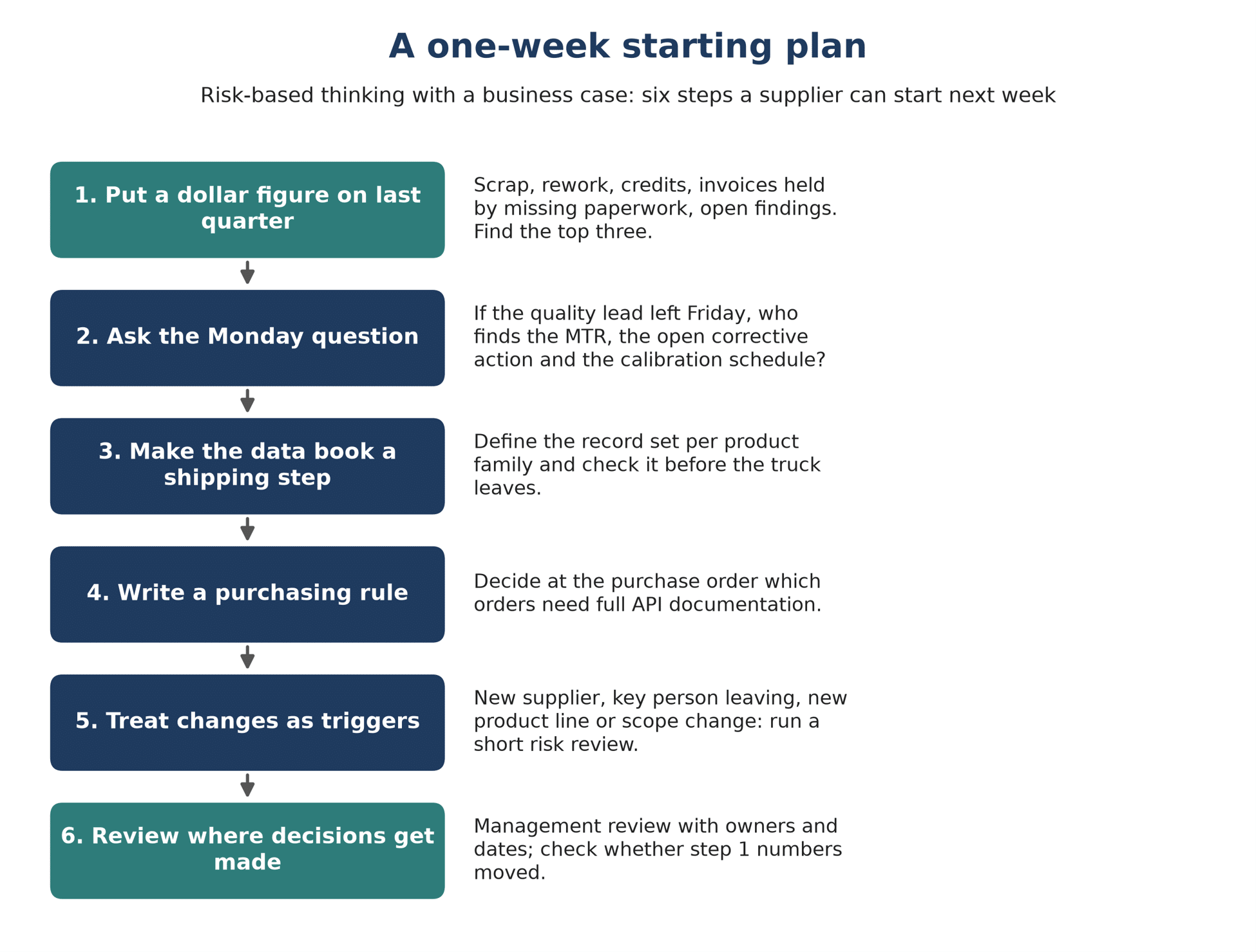
What to Do Next Week
- Put a dollar figure on last quarter. Pull scrap, rework, customer credits, invoices delayed by missing paperwork, and open audit findings. Rough numbers are fine. Find your top three.
- Ask the Monday question. If your quality lead left on Friday, who could find an MTR, an open corrective action, and the calibration schedule on Monday? If the answer is nobody, that is your first risk, and cross-training is its first action.
- Make the data book a shipping step. Define the required record set for each product family and check it before the truck leaves, not after the invoice is disputed.
- Write a purchasing rule for specification level. Decide at the purchase order which orders need full API documentation and which do not.
- Treat changes as triggers. A new supplier, a key person leaving, a new product line, or a scope change should prompt a short risk review, as API Q1 already requires.[2]
- Review it where decisions get made. Bring the short list to management review with owners and dates, then check whether last quarter’s actions moved the numbers from step 1.
The Business Case
Clause 6.1 and API Q1 section 5.3 are often treated as paperwork finished the week before an audit. Suppliers that use them to find where money leaks tend to learn that the risks auditors worry about are the ones already costing the business. With the ISO 9001:2026 transition underway, it is a good moment to take the risk list out of the binder and put it next to the monthly numbers.
References
- ISO 9001:2015, Quality management systems: Requirements, clause 6.1 (6.1.2: “Actions taken to address risks and opportunities shall be proportionate to the potential impact on the conformity of products and services”). ISO record: https://www.iso.org/standard/62085.html. Clause text as quoted at https://iso9001expert.com/blog/iso-9001-clause-6-1-actions-to-address-risks-and-opportunities/
- American Petroleum Institute. API Specification Q1, Tenth Edition (September 2023, effective September 18, 2024), section 5.3, Risk Management (5.3.1 procedure; 5.3.2.1 product delivery; 5.3.2.2 product quality, including availability of competent personnel; 5.3.2.3 changes, including key personnel; 5.3.3 contingency planning). API, “Comparison of API Q1 10th Edition to API Q1 9th Edition,” April 2024: https://mycommittees.api.org/api/documents/download/6c7b2ac4-3d37-447f-afc9-45c50373967a/b!xCp7bDc9f0SvyUXFA3OWeu6ZN7Ra–VAtSIc7c1CppOppSonh_l8QZP6VrndHRce/0135ZUP2NLV3ILBJJ5DZGK7OTYK5TXXSRX?filename=Comparison+of+API+Q1+10th+Edition+to+API+Q1+9th+Edition+-+April+2024.pdf. Edition announcement: https://www.api.org/products-and-services/standards/important-standards-announcements/specq1
- ISO. ISO 9001:2026, Quality management systems: Requirements (published September 16, 2026; edition 6). https://www.iso.org/standard/9001
- Global Accreditation Cooperation Incorporated (Global ACI). “Global ACI Publishes Transition Requirements for ISO 9001:2026,” September 16, 2026. https://global-aci.org/en/news/global-aci-publishes-transition-requirements-for-iso-90012026/
- ASQ. “Cost of Quality (COQ)” (internal and external failure costs; 2025 ASQE Insights on Excellence Cost of Quality Report finding). https://asq.org/quality-resources/cost-of-quality
- American Petroleum Institute. FM-002, API Monogram Licensing Program Requirements, Revision 20, July 23, 2026 (annual surveillance; possible suspension or cancellation). https://www.api.org/-/media/Files/Certification/Monogram-APIQR/0_API-Monogram-APIQR/Advisories-Updates/Updates/FM-002_API_Monogram_Licensing_Program_Requirements_Revision_20_20260723.pdf
- American Petroleum Institute. FM-004, APIQR Registration Program Requirements, Revision 17, July 23, 2026 (section 10, Suspension of Registration). https://www.api.org/-/media/Files/Certification/Monogram-APIQR/0_API-Monogram-APIQR/Advisories-Updates/Updates/FM-004_APIQR_Registration_Program_Requirements_Revision_17_20260723.pdf


Elena Ulanova is co-founder of QMS2GO, an AI-enabled quality management platform for small and midsize manufacturers. She holds a bachelor's degree in engineering and technology in standardization, certification and metrology from Karaganda State Technical University and a master's degree with honors in media communications from HSE University (National Research University Higher School of Economics). At QMS2GO she leads product strategy and go-to-market, pairing her quality engineering training with her communications expertise so the platform reflects what ISO 9001 actually requires and manufacturers can understand and adopt it quickly. Her publications include work on risk-based thinking in ISO 9001:2015. Contact: [email protected]