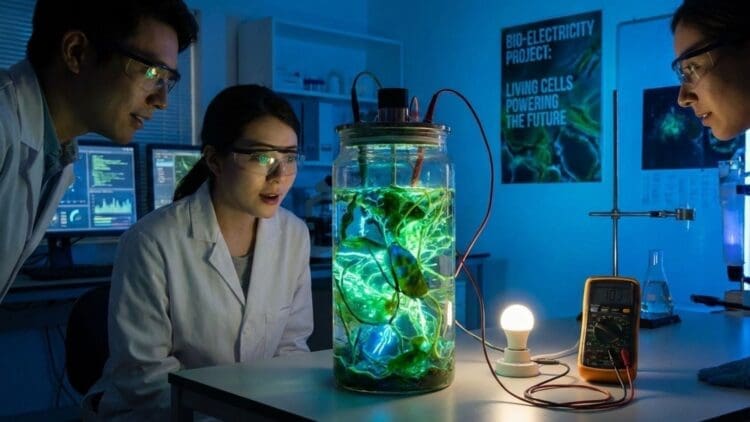

It sounds like something straight out of Avatar: living systems glowing with energy, nature itself producing electricity. A world where power doesn’t come from metal and wires, but from life.
As strange as it sounds, this idea is no longer fiction. Scientists are now showing that electricity can be generated from living cells — using sunlight and processes nature has relied on for millions of years.
The search for cleaner energy keeps getting stranger
Around the world, countries are racing to replace fossil fuels. Solar panels cover rooftops, wind turbines fill open fields, and renewable energy is becoming part of everyday life.
Yet even with all this progress, researchers are still asking the same question: what comes next?
What if clean energy didn’t just sit on the planet — but behaved like it was part of it?

That question is pushing scientists to look beyond traditional technology and toward nature itself.
When power doesn’t come from machines anymore
Most energy systems today are easy to recognize. They are solid, silent, and clearly not alive. But some researchers are now experimenting with a very different idea.
Instead of building bigger machines, they are studying how living systems handle sunlight. Plants, for example, don’t store energy in batteries or wires. They turn light directly into usable energy through natural processes.
The idea sounds simple — and almost too strange to work.
Electricity made the natural way
Living cells already know how to deal with sunlight. When light hits them, tiny particles are released as part of their normal activity. Scientists realized that, under the right conditions, those particles can be guided and collected.
If they move in the right direction, they create something familiar: electricity.
At first, this was just a theory. But recent lab experiments showed that it actually works.
The experiment that made this real
Here’s where the story becomes concrete.
Researchers in India built a small system using living photosynthetic cells — the same kind of cells plants use to capture sunlight. These cells were placed between two simple electrical contacts.
When light was applied:
-
the living cells reacted naturally
-
tiny electrical charges were released
-
the system captured those charges
-
a small but real electrical current was produced
Multiple units were even linked together to increase the voltage. It wasn’t enough to power a city — but it was enough to prove the idea works.
Electricity was generated by living cells, not by silicon or metal panels.
Why this discovery matters
This technology is still early and experimental. It won’t replace solar panels tomorrow. But it opens a new door.
Living-cell energy systems could one day:
-
power small sensors or devices
-
work in remote areas
-
reduce the need for rare or toxic materials
-
create energy systems that grow instead of being manufactured
Unlike traditional technologies, these systems are based on materials that are renewable by nature.
A future that looks more alive
The idea of electricity coming from living cells may sound unusual today — just as solar power once did decades ago. But history shows that energy breakthroughs often start with ideas that feel strange at first.
By learning from nature instead of trying to overpower it, scientists are rethinking what clean energy can look like. Not louder. Not bigger. Just smarter — and more alive.
So yes, it may sound like Avatar.
But this time, the science is real.