

Renewable energy no longer has to be a static force of nature.
Solar power may be the poster child of sustainability, but its visual performance and appeal are subpar at best.
Fortunately, an architect has given solar an innovative makeover to help bring the artistic side of its production to life.
Will the next generation of advanced renewable energy technologies focus more on the theatrical side of clean power generation?
How the visibility gap in the green transition is getting bigger
The global transition away from fossil fuels is more than a debate.
This change has become a mechanical necessity that can or should no longer be ignored.
Modern solar and wind technologies have become undeniably efficient, yet they face a “PR problem.”
For an audience consisting of average observers, renewable energy is largely invisible. Some arrays lifelessly perform on rooftops or hide behind industrial fencing in remote fields.
In contrast, fossil fuels are visible to the public eye. Smoke is seen, heat is felt, and the massive scale of the machinery is unmissable.
Without a “performance” to watch, the public remains disconnected from renewable energy, especially solar.
This creates a lack of transparency where misinformation can thrive. Inevitably, clean energy becomes a plain, practical intrusion rather than a dynamic community benefit.
But how can the solar experience be transformed into more than just a line item on a utility bill?
The reputation gap and AI’s hunger for greater production
The urgency to bridge the visibility gap in 2026 is severe.
The global energy sector is under significant pressure due to the explosive growth of AI and data centers. To relieve the immensely strained power grid, renewable systems are needed.
However, the “not in my backyard” (NIMBY) sentiment from locals makes vital expansion difficult.
To feed the digital revolution’s “hunger” for record-breaking power, green energy must be reinvented.
Researchers and designers worldwide have been exploring ways to make solar power more aesthetic.
A German company sensed that solar panels required a new, colorful coat. Their photovoltaic design completely reimagined solar energy into red, green, blue, and even purple.
However, just as “clothes do not make the man,” the same can be said of colorful panels.
One architect realized that functionality had to provide a tangible “return” on energy. One that onlookers can see, use, and celebrate.
Setting the stage for a reinvented solar performance
The California-based architect, Michael Jantzen, treats renewable energy as a performance rather than a utility.
He realized that solar power does not have to be flat and boring. His first approach to challenging this belief entails the Solar Electric Sculptures.
These designs serve as interactive community landmarks by doubling as public charging stations. People can thus literally plug into the art and receive a “tangible return” from solar energy.
However, this only set the stage for Jantzen’s greatest solar reinvention.
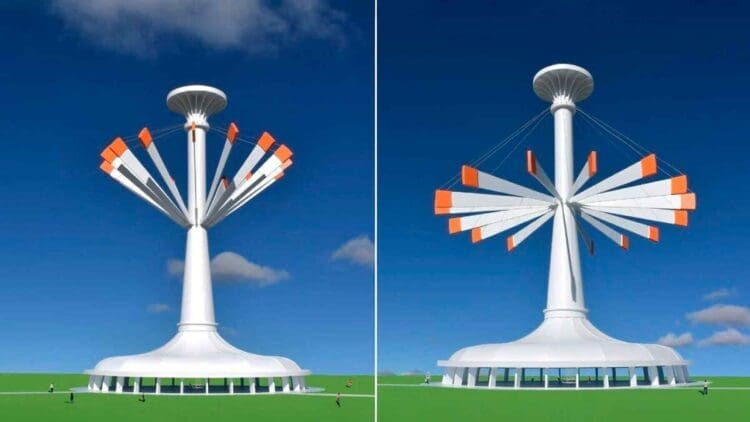
Jantzen’s Solar and Gravity Powered Art and Science Pavilion
A kinetic physics structure with a central tower supports 16 long steel arms that serve as a visible “battery.”
In daylight, solar-powered winches lift the arms, fighting gravity to store energy. At night or peak demands, the arms are released.
The gravitational descent drives 16 generators to produce electricity. The choreography thus represents a visible and powerful green performance.
Thanks to Michael Jantzen’s innovative designs, the green transition no longer has to be invisible to the world.
The transformation of static utilities into public spectacles provides a solution the NIMBY cannot ignore.
As AI and data centers continue to grow, theatrical infrastructure could help meet high demands while boosting civic pride.
From living, breathing solar-powered trees to dancing solar sculptures, the options for the next generation are truly endless.


