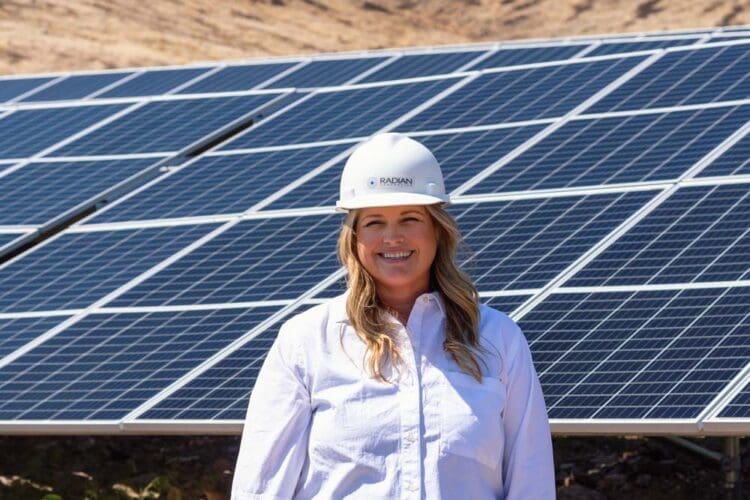

Energies Media: What inspired you to pursue a career in renewable energy?
Kellie Macpherson: I was drawn to renewables because of my background in NERC compliance for traditional generation. I was fascinated by the challenge of bringing renewable facilities online in a compliant manner. At the time, you couldn’t imagine a renewable facility being more than 75 MW. Today, modern large renewable facilities range between 100 MW and 1,000 MW.
What really hooked me was sitting in rooms full of finance professionals who were focused on getting renewable projects across the finish line without truly understanding energy operations or how their projects would impact the electrical grid. I had a pivotal moment on a project in Fresno, California, a voltage-constrained area, where developers were trying to circumvent interconnection requirements. I realized they didn’t understand why these upgrades were necessary – it is all about grid reliability.
That’s when I knew I could bridge the gap between the traditional operations world and renewables. I’m passionate about helping people understand how impactful renewable projects truly are and how they’re changing the grid for the better, making it more reliable.
EM: Can you describe your current role and how it contributes to the energy transition?
KM: I spend a lot of my time bridging the gap between renewables and traditional generation, helping people understand how compliance and security in renewables benefit grid stability and growth.
To meet growing energy demands from data centers, AI, and our expanding economy, we need renewable energy. It’s the fastest way to get electrons onto the grid. A nuclear power plant takes five to six years to build, while battery storage, solar or wind projects can be deployed much faster.
Renewables can also be incredibly reliable because you’re building from scratch. You can specify the voltage schedule, operational requirements, and commissioning equipment to meet exact grid needs. Compare that to aging traditional facilities that can’t change old equipment settings and are prone to breaking down. Many simply can’t meet the dynamic demands of today’s grid.
Recent events in Texas proved this point. During extreme heat and record electricity demand, battery storage paired with renewables delivered more than 6 GW of power during peak hours, helping prevent blackouts. ERCOT reported that the risk of rolling blackouts dropped to just 0.3 percent, down from 12 percent the previous year, largely due to expanded battery storage and renewables.
If we’re going to achieve energy dominance and independence in the United States, we’re going to have to lean on renewable energy. My job is figuring out how to do that without breaking the electrical grid.
EM: How have your career experiences brought you to where you are today?
KM: When I was 19, I interned at the California Independent System Operator during the brownouts. I sat in the control center observing life-or-death decisions about generation adequacy. I witnessed operators deciding which of two hospitals to trip offline during supply shortages. That experience gave me a deep understanding of how critical reliable power is.
The energy industry doesn’t always appreciate how interconnected and pivotal renewables are to reliable power. Take the Desert Star substation in Southern California. It’s in a voltage-constrained area where renewable energy first took hold. If that substation blacked out, L.A. would go dark. It’s not just about generating electrons; it’s about operating reliably with proper protection system settings that keep the substation operational.
I don’t think people fully understand the importance of renewables in these critical situations, and that’s where my operational background helps me communicate the bigger picture.
EM: Have you witnessed changes in the sector that have launched more women into leadership positions?
KM: Traditional generation and utility industries have historically been male-dominated and can have a bit of an “old guard” mentality, but renewables started with a more inclusive culture.
We’ve seen women step into leadership positions much faster than in traditional utility spaces. We have more women in engineering roles compared to utilities, and we’re more willing to put women in technical positions.
We have great organizations like Women of Renewable Industries and Sustainable Energy (WRISE) that support and empower women in renewables.
EM: What are some of the biggest challenges that you’ve faced as a woman in the renewable energy industry and how have you overcome them?
KM: The renewable industry generally focuses on the value people bring to the table rather than on gender. However, impostor syndrome affects women regardless of industry.
As a mentor, I often see women questioning whether they deserve a seat at the table or feeling unworthy of being there. It’s crucial to have all perspectives represented, and women need to have confidence in their contributions.
The key is recognizing that diverse perspectives are essential for solving complex challenges, and women bring unique viewpoints that strengthen decision-making and innovation.
EM: How important are diversity and inclusion to the success of renewable energy projects and companies?
KM: Diversity is absolutely critical. You can’t go to school and get a degree specifically in what we do; everything is built on people with varying education, skills, and experience. In compliance work, you might have a power systems background, SCADA experience or numerous other specializations that all contribute to the solution.
Since everything we’re doing is new, we need people who are creative problem-solvers, flexible, and willing to adapt. That’s a personality type, not an education credential, or specific gender, or even a geographical constraint. The more variability we have, the more creativity we have as an industry. We won’t meet growing energy demands without being creative, flexible, and open to every idea.
EM: What advice would you give to young women who are interested in joining the renewable energy sector?
KM: Find a great company with people whose mission excites you, then go for it. Don’t hold too tightly to specific position titles or job descriptions.
I see this particularly with women and junior employees – there’s often a feeling that you need permission to be empowered. But the power comes from showing up, saying yes, and then figuring it out. That’s how many of us advanced in our careers.
Focus on your network and reach out to people. LinkedIn has become a powerful platform for building relationships and communities with senior professionals who are willing to invest in your growth.
EM: Where do you see the future of women in renewable energy and sustainability?
KM: Women in our industry are already doing incredible things, holding important roles, and leading multi-billion-dollar companies. This trend will continue as the industry grows and evolves.
Women are often hungrier and fight harder to get ahead, and they tend to care deeply about the importance of their work and are truly passionate about the bigger picture.
EM: How do you stay updated on the latest developments in the renewable energy field? And what resources would you recommend to others?
KM: Staying plugged into your community is essential. I subscribe to several newsfeeds, including PV Tech, Canary Media, and Utility Dive, for industry updates.
I actively follow WRISE, and industry leaders like Jessica Lawrence-Vaca, CCO at Array Technologies, and Abby Hopper, CEO of the Solar Energy Industries Association, on LinkedIn.
In my compliance role, I use SCIP daily for real-time updates on NERC regulatory notices; it’s essential for my team. I also encourage everyone to check out the Navigating the Grid podcast to stay current on the impact of news and trends in our industry.
For more information, see the Radian Generation website.