
Planted in 132 megawatts of Atlantic water 35 miles off Long Island, 12 steel towers drew a crowd that no construction permit ever mentioned, and the creature pressing hardest against the steel turns out to be one the fishing industry has been losing for decades
About 35 miles east of Montauk, the Atlantic floor is almost perfectly flat.
There is nothing to hide behind, nothing to climb.
For the fish and invertebrates that evolved alongside reefs and rocky outcrops, that featureless sand is effectively a desert.
Researchers studying the Dutch North Sea found cod showing strong site fidelity to reef structures near monopiles, meaning the fish did not just visit: they stayed.
Then, sometime in 2023, something changed the geometry of that desert forever.
Twelve steel cylinders arrived, each one driven deep into the seafloor, and the water above them was never the same again.
A desert floor gets its first hard surface
Engineers designed the foundations for one job: hold up wind turbines.
Each monopile is a massive steel tube, wide enough to swallow a truck, hammered down through soft sediment until it locks into the rock beneath.
Around the base, crews packed boulders and cobbles to stop the tide from eroding the sand.
Nobody in the project’s permitting files wrote the words “artificial reef.”
But on a flat sandy seabed, even a single hard vertical surface is an event.
A reef effect is what happens when hard substrate appears in a soft bottom environment: life rushes in.
Invertebrates colonize first, predators follow the invertebrates, and the chain builds fast.
The transformation can begin within weeks of installation, before any turbine blade ever turns.
That speed surprised even the scientists assigned to monitor the site.
The foundation that began to breathe
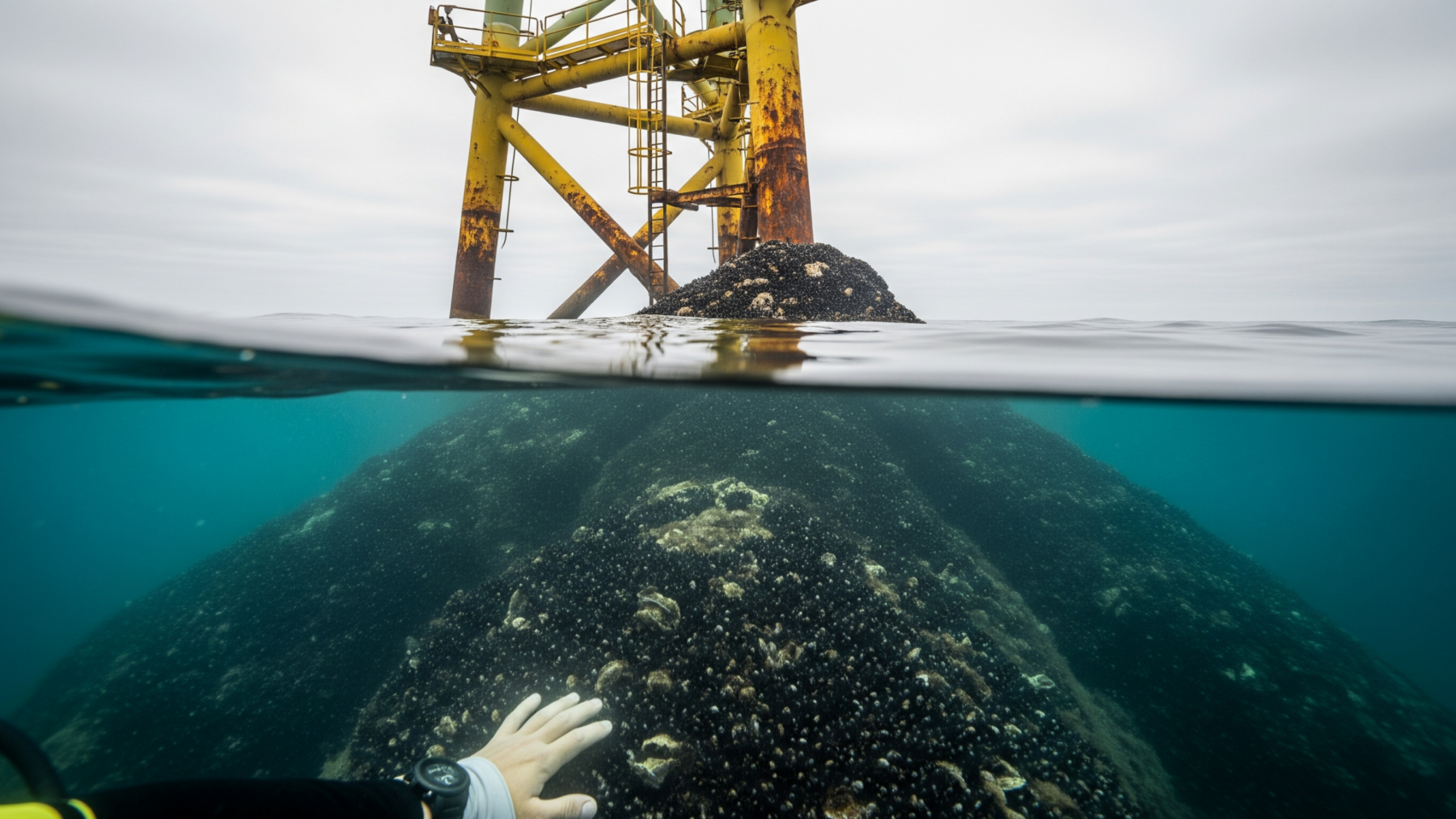
Within months of installation, the steel was no longer bare.
Mussels arrived first, stitching themselves to the metal in long vertical rows.
Barnacles followed, then bryozoans, creatures that look like pale lace, encrusting every crevice.
Monopile structures provide vertical surfaces where invertebrates readily attach, forming the base of new marine food chains.
The scour protection boulders added horizontal complexity, creating small caves and overhangs at the seafloor.
Those overhangs became shelter, and shelter became a signal.
Sea stars and small crustaceans moved into the rock gaps within the first season.
Juvenile fish appeared in survey footage before the turbines generated a single kilowatt-hour.
Something in the water was reading that signal and turning toward it.
What the survey cameras found in the dark
Scientists and divers did not have to wait long for evidence.
Ørsted, the developer behind the project, commissioned formal benthic visual surveys to count what was actually living on and near the foundations.
Surveyors worked their way from the seafloor upward, photographing and recording everything they encountered.
Between 2023 and 2024, scientists observed a shift from bare concrete and rocks to functioning artificial reefs, with lobster and black sea bass appearing in and around the structures.
Species counts at the foundations exceeded anything recorded in surrounding sand flats during the same survey period.
The density of organisms on the steel itself rivaled counts from natural hard-bottom sites miles away.
The offshore wind farm was doing something nobody designed it to do.
South Fork Wind’s unplanned tenants
The project is South Fork Wind, a 132-megawatt offshore wind farm built by Ørsted and Eversource southeast of Block Island, Rhode Island.
Its 12 turbines began commercial operation in early 2024, making it the first commercial-scale offshore wind farm to deliver power to New York State.
Black sea bass are a fish that commercial fishermen and recreational anglers along the Northeast coast have watched become harder to find in nearshore waters over recent decades.
Here they were, pressing against the steel legs of a wind turbine.
Peer-reviewed studies of North Sea wind farms have documented significant increases in species richness on turbine structures.
Researchers studying the Dutch North Sea found cod showing strong site fidelity to reef structures near monopiles, meaning the fish did not just visit: they stayed.
A caveat, and an argument for smarter design
The reef effect at South Fork is real and documented, but it comes with a fair qualification.
The evidence that turbine fields grow overall fish populations, rather than simply concentrating them, remains contested.
Concentrating fish can sometimes make them easier to catch in one spot while depleting them elsewhere.
Researchers have also noted that monopile foundations with rock protection attract significantly more fish than those with sandbag protection, which suggests design choices matter enormously.
Decisions about scour protection material, pile diameter, and surface texture can all be made with marine life in mind.
Future projects could go further, incorporating textured steel coatings or pre-seeded substrate panels designed to accelerate colonization from day one.
Twelve towers built to harvest wind off Long Island may not have set out to restore a corner of the Atlantic.
But on the floor of that featureless desert, 35 miles from shore, a black sea bass found something worth staying for.
That is not a bad outcome for a construction permit that never once mentioned the word “reef.”

Hugo is an engineer with strong technical expertise. Multilingual from an early age, his writing combines technical clarity with a strong interest in science and energy.
