
Boston’s harbor and rivers could become the engine of a citywide heating revolution, and the first projects are already underway
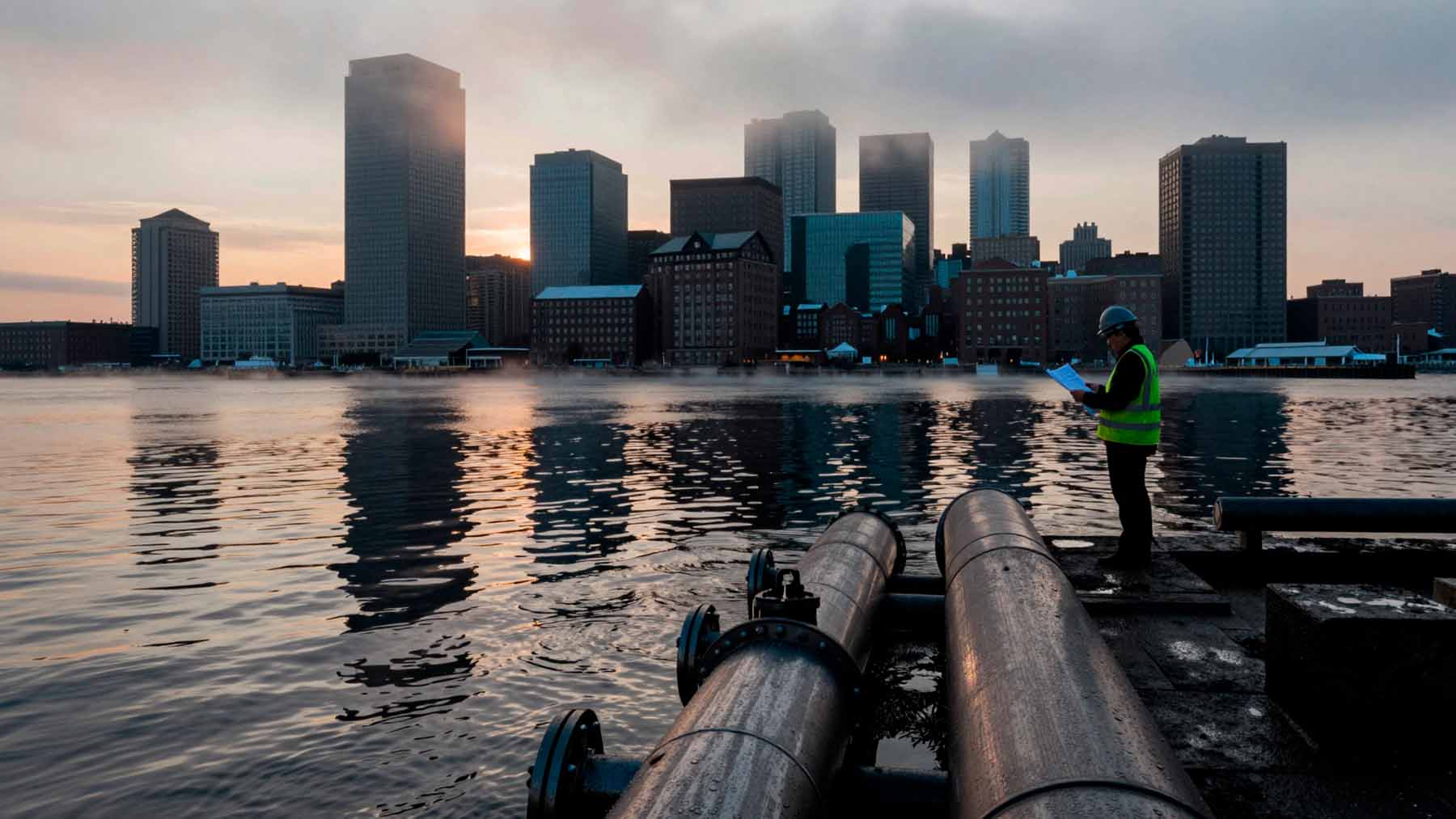 Image generated with artificial intelligence
Boston’s unique urban geography presents a major challenge for clean energy planners attempting to decarbonize the city’s building sector.
The metropolis is dense, historic, and largely constructed on fill material dumped over tidal flats across several centuries. This crowded, fragmented subsurface makes installing conventional ground-source geothermal systems extremely difficult or cost-prohibitive in many neighborhoods.
To solve this heating crisis, researchers and city leaders are turning their focus to the vast bodies of water surrounding the city.
While individual buildings have long utilized this technology, scaling it to power interconnected district energy networks represents a major technical leap forward.
Why Boston is looking underwater for heat
Water offers an exceptionally practical thermal alternative to traditional underground drilling. Harbor and river temperatures fluctuate far less than ambient air temperatures, staying cooler in summer and warmer in winter.
This temperature stability allows water-source systems to operate with far higher efficiency across every season.
Furthermore, ocean currents and human-caused thermal accumulation have created a massive energy reservoir right off the coast. Researchers at HEET calculated that Boston Harbor contains enough stored thermal energy to heat approximately 2.4 million households annually. Because ocean currents refresh the harbor’s water every two to ten days, it represents an essentially inexhaustible energy source.
Three projects, one shared ambition
Major institutions across the city are launching initiatives to tap into this immense thermal capacity.
The Boston Area Thermal Energy Network, or BosTEN, led by the Boston Green Ribbon Commission, is currently evaluating district-scale deployment. Technical teams are analyzing extraction limits, distribution routing, customer demand, and permitting requirements, with final recommendations due in 2027.
UMass Boston is already advancing its own coastal system. Having used seawater for campus cooling since the 1970s, the university is installing equipment to reverse the process to heat 12 campus buildings.
Once operational, this upgrade will cut campus natural gas consumption by 82 percent.
Simultaneously, Vicinity Energy is retrofitting its district system with a massive 35-megawatt heat pump. This unit will draw thermal energy directly from the Charles River to serve central urban buildings.
How water-source heat pumps actually work
The underlying physical principles of water-source heat pumps have been understood for over 150 years. Instead of burning fuel to generate new heat, these systems transfer existing thermal energy from one medium to another.
In winter, liquid refrigerant absorbs heat from water, which is compressed to higher temperatures and piped into buildings. In summer, the system runs in reverse, absorbing heat from interior building spaces and discharging it back into the water.
While individual buildings have long utilized this technology, scaling it to power interconnected district energy networks represents a major technical leap forward. UMass Boston’s ongoing project serves as a key near-term test case for large-scale municipal deployment.
Europe already did this—Boston is paying attention
Boston’s district-scale thermal initiatives draw heavy inspiration from successful European infrastructure models. Cities across Europe have demonstrated that municipal waterways can reliably heat large urban centers for decades.
For example, Glasgow, Scotland, utilizes a district heating network powered by the waters of the River Clyde.
In Malmö, Sweden, municipal systems recover waste heat directly from treated wastewater discharges. American energy firms are adapting these field-tested European designs to fit dense coastal cities in the United States. This approach provides a proven blueprint for metropolitan areas where underground drilling is blocked by dense infrastructure.
What comes next—and what could slow it down
Despite the immense potential, deploying subsea and riverbed energy infrastructure involves complex environmental and regulatory approval processes. Permitting delays and underwater construction challenges represent the primary hurdles for district energy developers.
Planners envision a phased rollout starting with large institutional anchor customers along the waterfront before expanding outward. Broad coalitions of universities, hospitals, environmental nonprofits, and government agencies are already aligning to support the transition.
If successful, these municipal projects will demonstrate how coastal cities can convert local waterways into sustainable thermal utilities.
More than 250 years after colonists threw tea into cold harbor waters, a very different kind of disruption is unfolding. Boston’s harbor and rivers could become the engine of a citywide heating revolution, and the first projects are already underway.
Kelly is an experienced writer with 15 years of experience exploring the big stories that shape our world, from tech breakthroughs and space exploration to climate, energy, and the fascinating quirks of science. She has a talent for turning complex ideas into sharp, memorable insights that stay with readers long after they’ve finished reading.
