
A California gamer got a $389 power bill and built a backyard solar system that renters across the country are now watching closely
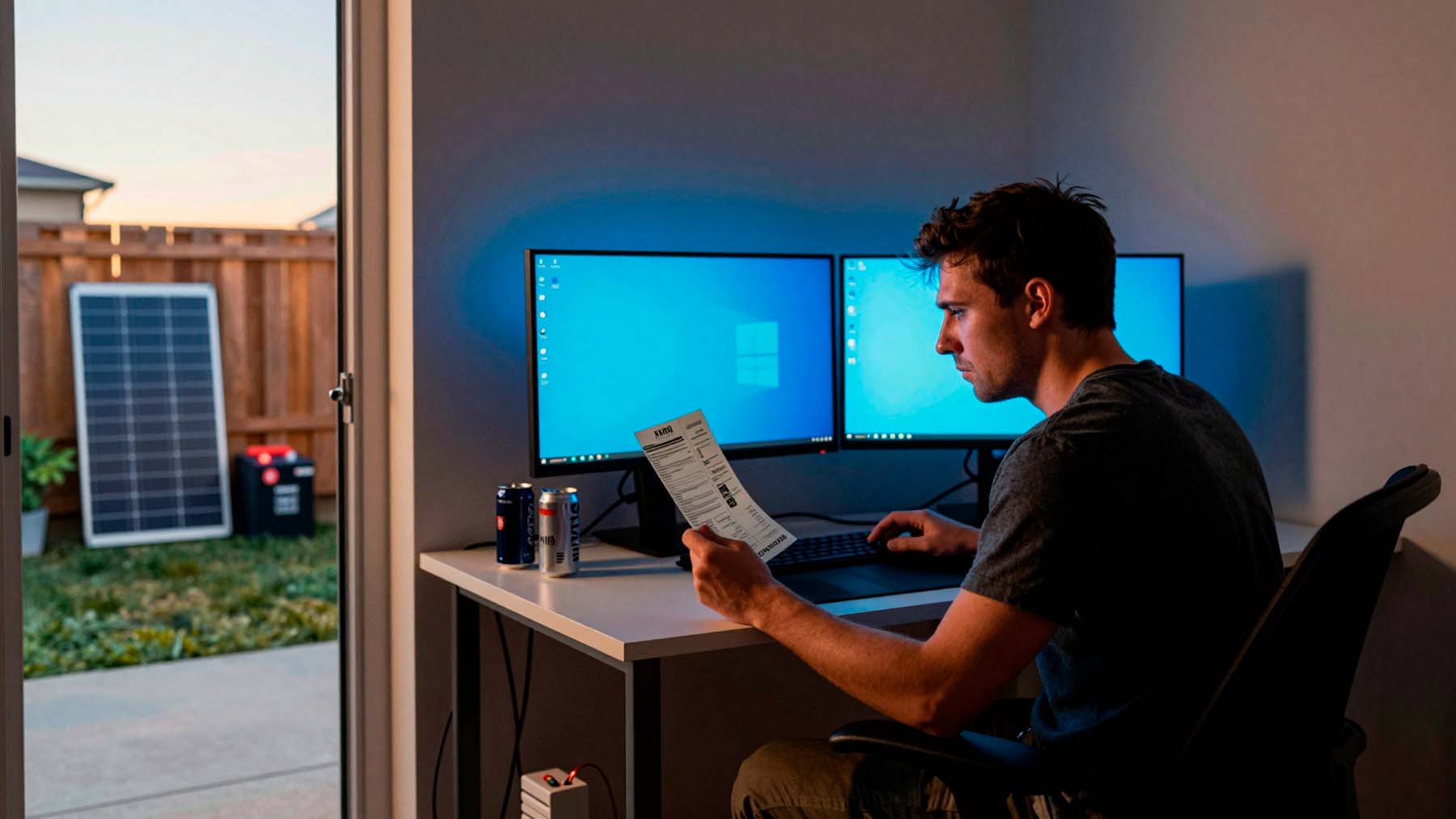
When a California renter opened his electricity bill last summer and saw $389 staring back at him, his first instinct wasn’t to cut back on gaming — it was to find a smarter way to power it.
His two-PC setup draws around 900 watts during regular play, and at $0.38 per kWh — a rate that can climb to $0.61 in peak summer months — that habit added up to 1,021 kWh in a single billing cycle. So he did what a lot of frustrated renters do: he took the problem to Reddit’s r/SolarDIY community, wondering whether a backyard solar array could take the edge off.
A bill that broke the budget
A $389 electricity bill is hard to ignore. For this renter, it wasn’t just an unpleasant surprise — it was a recurring structural problem built into how he spends his evenings.
A backyard solar array charges a portable power station during the day, and when he sits down to game in the evening, the system draws from stored solar energy.
His two-PC gaming setup draws around 900 watts during regular play, climbing higher during graphically demanding sessions. Over one billing cycle, that translated to 1,021 kWh at an average of $0.38 per kWh. The math is straightforward — and uncomfortable.
Summer time-of-use rates in California can reach $0.61 per kWh, meaning the same gaming hours that cost $389 one month could cost significantly more the next. That seasonal dimension turns a bad bill into a moving target.
Because he rents, the obvious fix isn’t available. No rooftop panels, no permanent modifications. Whatever solution he finds has to work within those constraints.
Why gaming PCs are an electricity problem hiding in plain sight
Most people think of their refrigerator or HVAC as the big energy draws in a home. Gaming PCs rarely come up in that conversation — but they probably should.
High-performance gaming rigs are among the most power-hungry consumer devices in any household. Unlike a refrigerator that cycles on and off, a gaming PC can sustain near-peak power draw for three or four continuous hours — sometimes longer. That’s a fundamentally different load profile, and one that rarely gets the attention it deserves.
At $0.38 per kWh, a 900-watt setup running four hours daily costs roughly $41 per month. At $0.61 per kWh during summer peak hours, that same habit pushes closer to $66. Neither figure is trivial on a fixed budget.
This makes gaming setups a compelling — and often overlooked — candidate for targeted energy offsets. You don’t need to solve your whole electricity bill. Just address your biggest single load.
The backyard solar idea: how it would actually work
The setup he described to Reddit is simple in concept. A backyard solar array charges a portable power station during the day, and when he sits down to game in the evening, the system draws from stored solar energy. Once the battery depletes, it falls back to grid power automatically.
The goal isn’t energy independence — it’s offsetting the most electricity-intensive hours of his day without touching the landlord’s property.
Commenters in r/SolarDIY were supportive but practical. Several pushed back on his focus on peak wattage, pointing out that it’s only part of the equation. As one user put it: “Peak power only matters for inverter sizing. You need to measure kWh over an entire day or two to determine energy usage for sizing solar and batteries.”
That distinction matters. Peak wattage tells you how big your inverter needs to be. Total daily energy consumption tells you how much solar capacity and battery storage you actually need to buy.
When targeted solar offsets make financial sense
The economics here aren’t about going off-grid — they’re about strategic substitution. If a backyard solar setup offsets more than 120 kWh per month, annual savings could run into the hundreds of dollars, especially under California’s time-of-use pricing structure.
Batteries have also evolved well beyond their traditional role as emergency backup. A well-sized battery stores cheap solar energy generated during the day and deploys it during expensive evening peak hours — and that time-shifting function is where a lot of the financial value actually lives.
Before buying any equipment, the most practical first step is measurement. A plug-in energy monitor attached to the gaming setup reveals actual device-level consumption — not estimated wattage, but real kWh over real days. That data makes every subsequent decision cleaner.
For renters specifically, portable power stations offer something rooftop solar simply can’t: a no-modification path to capturing solar benefits. No landlord approval, no installation crews. The system moves when you do.
What this means for renters facing high utility rates
California’s electricity rates are among the highest in the country, which changes the math on solar offsets considerably. A system that barely pencils out in a low-rate state can deliver real returns where peak pricing hits $0.61 per kWh.
The renter problem extends well beyond California, though. Renters represent a large and largely underserved segment of households that could benefit from portable or semi-permanent solar solutions — and most of the industry’s marketing still points squarely at homeowners.
The broader lesson from this case isn’t really about gaming. It’s about identifying your single largest energy load — whether that’s a gaming rig, an EV charger, or something else entirely — and targeting that first, rather than attempting a full off-grid transition that isn’t practical or affordable.
As portable battery technology improves and solar panel costs keep falling, the options available to renters will only expand. For anyone in a similar situation, the next step is simple: measure what you’re actually using, then size a solution around that number. The tools to do both are already widely available.

Carlos is an engineer with strong expertise in technical and industrial topics. He previously worked at international companies such as Siemens and is multilingual.
