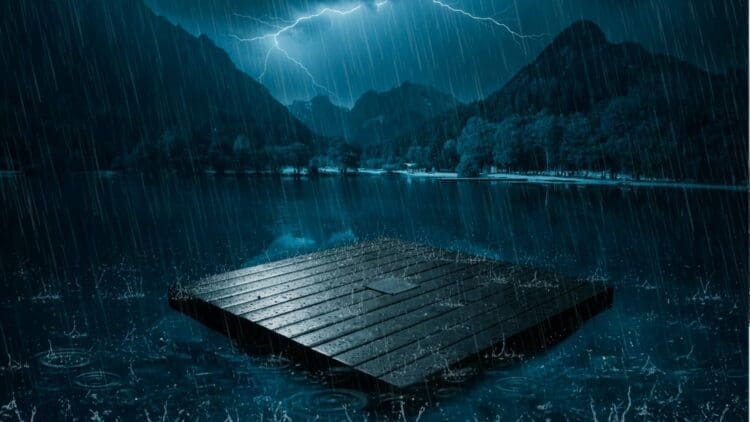

China has long been known as the global leader in the renewable energy industry. In September last year, the country neared a total installed renewable capacity of 2,200 GW. While its main installations revolved around solar and wind, it also developed a device designed to turn storms into electricity, harnessing the power of chaos to showcase its true potential. This device uses an entirely different approach to generating clean electricity, and it may be the drive behind the clean power revolution we have been seeking.
China presents a device that turns storms into electricity
2025 was a successful year for China. Achieving an additional 2,200 GW in renewable installations in a short period is no easy feat, but China has shown the world that even the impossible is truly possible. According to a report by Renewable-Energy-Industry.com, China almost doubled its solar and wind capacity in the first half of 2025, with newly installed output capacity reaching 290 GW.
Now, while this achievement is significant by itself, it seems as though there is no rest for the wicked when it comes to the Chinese. The Nanjing University of Aeronautics and Astronautics (NUAA), with assistance from the Chinese state and provincial funding and programs, manufactured a floating device that showcases the potential of harnessing the chaotic power of a storm.
Harnessing the chaotic power of a storm
As China starts its preparations to add 120 GW of new wind capacity annually from this year onwards, NUAA researchers have also been studying ways to benefit from the unused energy of droplets. This was done through their floating droplet electricity generator (DEG), which turns droplets’ kinetic energy into clean electricity. While there are other existing DEGs, this one stands out as it utilises water for structural and power production elements.
The researchers believe that this device is more advantageous compared to traditional DEGs, as it is:
- Lightweight
- Easily scalable
- Requires fewer heavy (87% material weight reduction)
- Requires fewer expensive elements (50% cost savings)
- More sustainable
- Power output is similar to traditional DEGs
- Great durability in varying environments
The NUAA researchers developed and tested their DEG on China’s Donghua Lake in Nanjing. The device’s entire design performance showcased interesting results, which were published in the November 2025 issue of the National Science Review.
This is how the floating device works
Traditional DEGs generate electricity when droplets fall on a dielectric film on a fixed base, which has a metal electrode underneath it. The NUAA researchers addressed the issues faced by traditional designs by designing their device to float on water. Water then serves a dual purpose as the ‘fixed’ base, as well as the conduction electrode.
The water’s surface tension, incompressibility, and charge-carrying ions allow the floating DEG to produce maximum output of nearly 250 volts per droplet. Furthermore, the researchers added drainage holes, which remove water levels and droplets that may affect the electrical performance of the DEG. Their findings indicate that the floating DEG maintained its operation during a range of salt levels and temperatures.
It also continued to function during exposure to natural lake water, which contains biofouling. This durability can be attributed to:
- A dielectric layer
- The resilience of its water-based structure
The NUAA researchers’ floating DEG is still in the research and development stage, as there are a few challenges to be addressed, including the varying speed and size of droplets. Nonetheless, the system itself can open a new door to innovative ‘hydrovoltaic’ systems without requiring valuable land. Prof. Wanlin Guo, the study’s corresponding author, added that it could serve as a valuable complement to other renewable technologies, such as China’s wind and solar. In other news, China also plans on mining 500,000 tons from the air with powerful turbines.
Disclaimer: Our coverage of events affecting companies is purely informative and descriptive. Under no circumstances does it seek to promote an opinion or create a trend, nor can it be taken as investment advice or a recommendation of any kind.