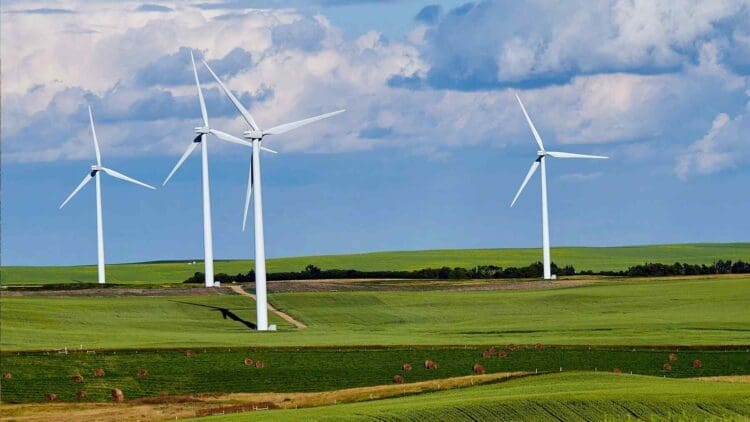

EDF Renewables and Hydro-Québec have secured a financing milestone for Madawaska wind development in Québec. The Canadian clean energy landscape is as lively as that of the United States, mainly because the two countries are closely associated and somewhat close in proximity. As such, companies based in both nations are able to develop large-scale facilities back and forth between the two countries. As the U.S. wind energy landscape was going through a period of controversy, Canada continued to expand its portfolio with the end goal of reducing carbon emissions.
Major collaboration shakes up Canada’s wind energy landscape
When two companies decide to combine in pursuit of establishing an energy facility, there is immediate attention on that project simply because people connected to both entities bring their own observers. Collaborations have been a constant occurrence in 2026, and the primary reason for this is that companies are deciding to set their differences aside and partner for the betterment of the environment.
Additionally, collaborations lessen the burden and the responsibility of a single company having to manage the costs and progress of an initiative on its own. On that note, EDF Renewables and Hydro-Québec have reached a major financial milestone in advancing the Madawaska wind project in Québec.

On the one hand, EDF Renewables is a leading global renewable energy company and a subsidiary of the French utility EDF Group. Its primary focus is developing, building, and operating wind, solar, and battery storage projects. Hydro-Québec is a Canadian entity recognized as one of the world’s largest hydropower producers.
The two firms were able to complement each other perfectly, which is why they have reached such a massive milestone.
Gaining a deeper insight into EDF Renewables and Hydro-Québec’s milestone
Briefly put, the achievement of both entities means unlocking full-scale development of the large onshore wind facility in the Bas-Saint-Laurent region. While most of the attention has been centered on the developers involved, Québec deserves credit for adopting a strategy to expand wind capacity and meet rising electricity demand sustainably.
The milestone has been a long time coming. Still, people can finally celebrate that the Madawaska wind project has officially reached financial close, enabling construction to move forward after years of planning and approvals. The 274-megawatt (MW) project is being developed through a partnership between EDF Renewables, Hydro-Québec, and the Alliance de l’énergie de l’Est.
So what exactly was the breakthrough in the progression of the initiative? A consortium of major financial institutions, such as Canadian Imperial Bank of Commerce, National Bank of Canada, Desjardins Group, and KfW IPEX-Bank, will all be important in providing the financing package. For the government to be fully behind the initiative shows Canada and the world’s high confidence in wind energy facilities.
Understanding the significance of the Madawaska wind project to Canada
The two entities have received tremendous credit for the role they played in the project’s materialization. Hydro-Québec has reinforced that developments of this kind are pivotal to its goal of adding 10,000 MW of new wind capacity by 2035. Now that financing has officially been secured, construction activities can progress.
All in all, the project is expected to generate more than 300 jobs during the construction phase. The Madawaska wind farm itself will possess 45 wind turbines with a total installed capacity of 274 MW.
Delving deeper into the features of Québec’s Madawaska wind farm
The facility is undoubtedly one of the more significant onshore wind developments in Québec. For instance, the turbine configuration includes 20 units rated at 6.2 MW and 25 units rated at 6 MW, supplied by Vestas. Once operational, the facility will generate enough electricity to power more than 44,000 homes per year.
The Madawaska project is built to deliver major economic benefits to local communities. During its lifespan, approximately CAD $181 million (approximately US$134 million) will be distributed among regional stakeholders.
Communities such as Dégelis and Saint-Jean-de-la-Lande will receive more than $25 million from the initiative. Canada has one of the most unique wind initiatives of 2026.
Disclaimer: Our coverage of events affecting companies is purely informative and descriptive. Under no circumstances does it seek to promote an opinion or create a trend, nor can it be taken as investment advice or a recommendation of any kind.