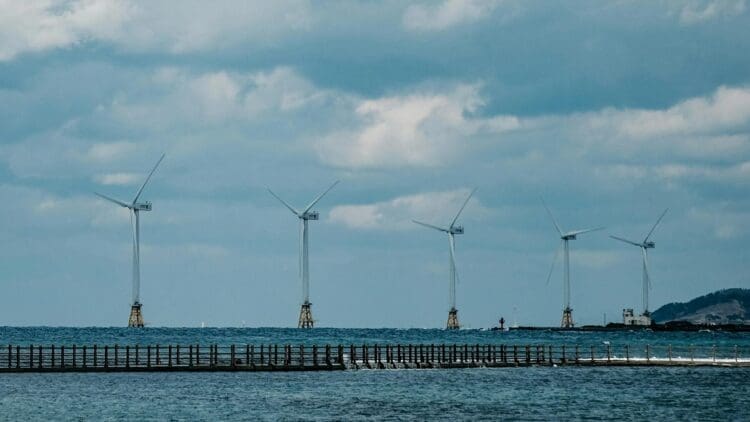
Even though the energy industry enthusiasts are commending Poland for the amount of progress that it is making in executing projects flawlessly, the European nation is not slowing down anytime soon. In the latest events that unfolded, ENGIE finalized project financing for Poland’s first utility-scale offshore wind development. This development was well-received as it signals Poland’s commitment to generating clean energy.
ENGIE and EDP Renewables joint venture to develop Poland’s offshore wind farm
One of the most standout features of Poland’s offshore wind development is that ENGIE and EDP Renewables spearhead it. ENGIE is a French multinational electric utility company with headquarters in Paris, France. The corporation is renowned for its development of low-carbon energy projects that are contributing toward cleaner energy worldwide. On the other hand, EDP Renewables is a Spanish-based company that manages the renewables assets of EDP Group.
The two companies have engaged in a 50/50 joint venture after securing an estimated €2 billion (US$2.7 billion) in project financing for the BC-Wind offshore wind farm with the support of multiple lenders that include the European Investment Bank (EIB), Spain’s Instituto de Crédito Oficial (ICO), and 13 commercial banks. The involvement of so many financial groups means that there is greater certainty that the projects will come to fruition without facing any major hurdles.

The unexpected partnership of ENGIE and EDP Renewables: Should Poland be worried?
Some parts of the Polish population questioned why it took a Spanish and French company to develop its first utility-scale offshore wind farm. However, this is a common trend in the energy industry that Polish people should not be overly concerned about.
The joint ventures that arise in the energy industry aim to assist countries and corporations in managing the expenses and complex nature of energy projects, which one company cannot handle on its own. Thus, Poland will be able to benefit from ENGIE and EDP Renewables’ involvement by sharing risks and gaining access to technologies that are not currently available in Poland. The energy industry is one that is not competitive but is collaborative because all countries have the same objective, which is reduce carbon emissions on earth.
Assessing how Poland strategically collaborated with its financial partners
When a country works on energy projects as large as the one coming in Poland, they meticulously plan every detail to the tee. This is also the case in how Poland has approached its wind farm. The EIB is expected to contribute around one-third of the total investment, placing it at the heart of the project and aligning BC-Wind with the overall EU climate goals. The fact that institutions like the ICO and banks are involved in this development signals not just Poland’s but Europe’s full commitment to creating a cleaner environment.
The economic impacts of Poland’s BC-Wind development
Once fully operational, the facility will provide electricity for 500,000 Polish households, which is massive for the country considering its current reliance on fossil fuels. In the construction phase led by P & Q, many Polish residents are expected to receive employment opportunities. Various other corporations will be involved, such as Tele-Fonika Kable, which will supply and install cables, and Świnoujście and Gdańsk, which will assist with marshalling and turbine assembly.
The BC-Wind development is set to be one of the most critically acclaimed projects of 2026 after securing about €2 billion (US$2.7 billion) in financing. For Poland, this is a massive moment that is going to bring its first utility-scale offshore wind farm. The European nation is already working on a few energy projects in 2026, but this one will be among its most important ones and one of the most important in the entirety of Europe.