
When extreme weather hits, power grids lose both energy and forecasting accuracy at once, and a new model is learning to prepare for the errors ordinary forecasts miss
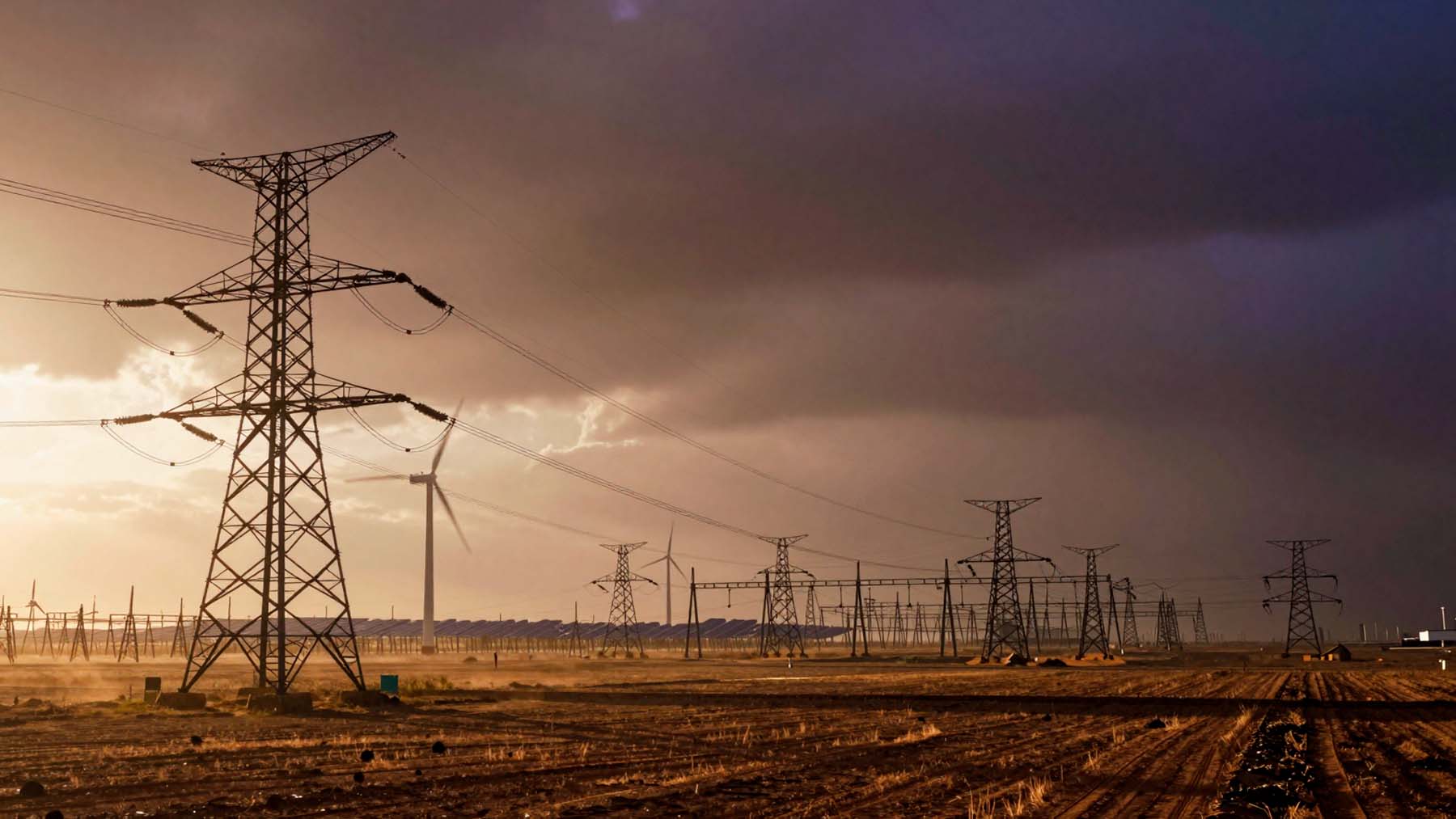
When a heat wave or major storm hits, power grid operators face a problem that compounds itself: demand surges at the same moment that solar panels dim and wind turbines slow. The two sides of the supply-demand equation swing in opposite directions — precisely when getting the balance wrong matters most.
What makes this harder is that the forecasting models operators rely on tend to break down under exactly these conditions. Extreme weather doesn’t just stress the grid; it degrades the tools used to manage it, leaving planners to make high-stakes decisions with estimates they can’t fully trust.
When forecasts fail at the worst moment
Modern power grids are increasingly built around wind and solar energy. That shift brings real benefits — lower emissions, distributed generation, reduced fuel costs. But it also introduces a structural vulnerability: both sources are intermittent by nature, and their output can swing sharply within minutes.
One way to address this is to move away from point forecasts toward prediction intervals — ranges that express likely outcomes at a given confidence level.
Extreme weather makes this worse in two directions at once. A heat wave spikes electricity demand while simultaneously reducing solar panel efficiency. A major storm suppresses wind generation precisely when heating or cooling loads are climbing. Supply uncertainty and demand uncertainty amplify each other at the same moment.
The deeper problem is how grid operators model that uncertainty. Most scheduling systems are built around average forecast errors — the typical gap between predicted and actual output on an ordinary day. Those models assume errors cluster neatly around a central value, following something close to a bell curve. Extreme weather breaks that assumption entirely.
The errors it produces are larger, rarer, and distributed differently — what statisticians call “fat tails.” Standard models smooth those outliers away rather than accounting for them properly. When a dispatch decision is built on a flawed picture of uncertainty, operators may under-prepare for shortfalls or over-prepare by holding expensive reserves that aren’t needed.
A smarter way to measure what you don’t know
One way to address this is to move away from point forecasts toward prediction intervals — ranges that express likely outcomes at a given confidence level. That range reveals how uncertain a forecast actually is, not just what the most likely number happens to be.
The researchers used a method called adaptive bandwidth kernel density estimation, or ABKDE. The idea is to let the error data shape its own distribution rather than forcing it into a predetermined mold. Standard kernel density estimation uses a fixed bandwidth — a smoothing parameter that stays constant across the entire dataset — which tends to over-smooth the tails, exactly where extreme-weather errors live. ABKDE adjusts the bandwidth locally instead, using narrower smoothing where data points are dense and wider smoothing where they’re sparse.
Rare, large errors get properly represented rather than diluted. Compared with standard interval estimation methods, ABKDE reduced the combined coverage-width criterion index by between 8.64% and 13.33% across wind power, solar, and load forecasting.
Balancing profit against risk in real time
Better uncertainty estimates are only useful if the scheduling model can act on them. The researchers paired their improved error modeling with a multi-objective optimization framework designed to balance two goals that often pull against each other: maximizing economic benefit and minimizing operational risk.
The economic side accounts for revenue from consuming renewable generation, income from selling surplus electricity back to the grid, hydropower operating costs, and the cost of purchasing power from the wider grid when local generation falls short. The risk side tracks load shortfalls and renewable spillover — with load shortfalls weighted more heavily because they affect end users directly.
To help operators navigate the tradeoff, the framework introduces a single indicator called the unit risk economic benefit ratio, denoted γ. When γ exceeds 1, the plan tilts toward higher risk tolerance; below 1, it favors caution; at 1, the two objectives are balanced. Time-of-use electricity pricing shapes the day-ahead schedule — cheaper overnight grid purchases fill storage, while distributed sources carry more load during peak-price hours.
A hybrid algorithm that avoids getting stuck
Solving a multi-objective scheduling problem across a complex energy mix is computationally demanding. The researchers used Particle Swarm Optimization as their base algorithm — a method that performs well on nonlinear global optimization problems and converges relatively quickly. PSO has a known weakness, though: it can lock onto a locally good solution and stop searching, missing a better answer elsewhere.
To counter this, the team grafted a Tabu Search mechanism onto the PSO framework. Tabu Search maintains a memory of recently visited solutions and steers the algorithm away from them, forcing continued exploration. PSO provides speed and broad coverage; Tabu Search supplies the local escape capability PSO lacks on its own.
The hybrid approach outperformed standard PSO on both objectives. Economic benefit improved by 2.38%, and the operational risk index fell by 2.22%. The resulting schedule satisfied all feasibility constraints: maximum power balance deviation stayed below 0.01 MW, line flows remained within 95% of their rated limit, and ramp rates stayed within 80% of the allowable maximum.
What this means for grids under climate pressure
The gap this research addresses — between how scheduling models characterize uncertainty and how uncertainty actually behaves during extreme events — is likely to grow. As climate change increases both the frequency and intensity of extreme weather, the conditions that break standard forecasting assumptions will occur more often, not less.
The researchers are candid about limitations. ABKDE depends on the quality of historical data. If conditions shift significantly from what the training data captured — a phenomenon called data drift — the error distributions the model learned may no longer reflect reality. The authors flag several directions for future work, among them distributed robust scheduling, multi-timescale optimization, and demand-response integration that lets consumption patterns adapt alongside supply.
As renewable energy makes up a larger share of the grid, the safety margin that once came from dispatchable fossil fuel plants shrinks. What replaces it must come from better decision-making under uncertainty — making improved uncertainty quantification a foundational requirement for running high-renewable grids safely.
The complete study is available here: Li T, Tian Y, Chen Z, Zeng H and Deng F (2026) Optimal scheduling of a new power system when considering extreme weather disturbances. Front. Energy Res. 13:1682767. doi: 10.3389/fenrg.2025.1682767


Carlos is an engineer with strong expertise in technical and industrial topics. He previously worked at international companies such as Siemens and is multilingual.
