
Beside a runway in Frankfurt 37,000 panels stand bolt upright and edge on to the noon sun, while the solar fence they form delivers a morning hump and an evening one instead of a single midday peak
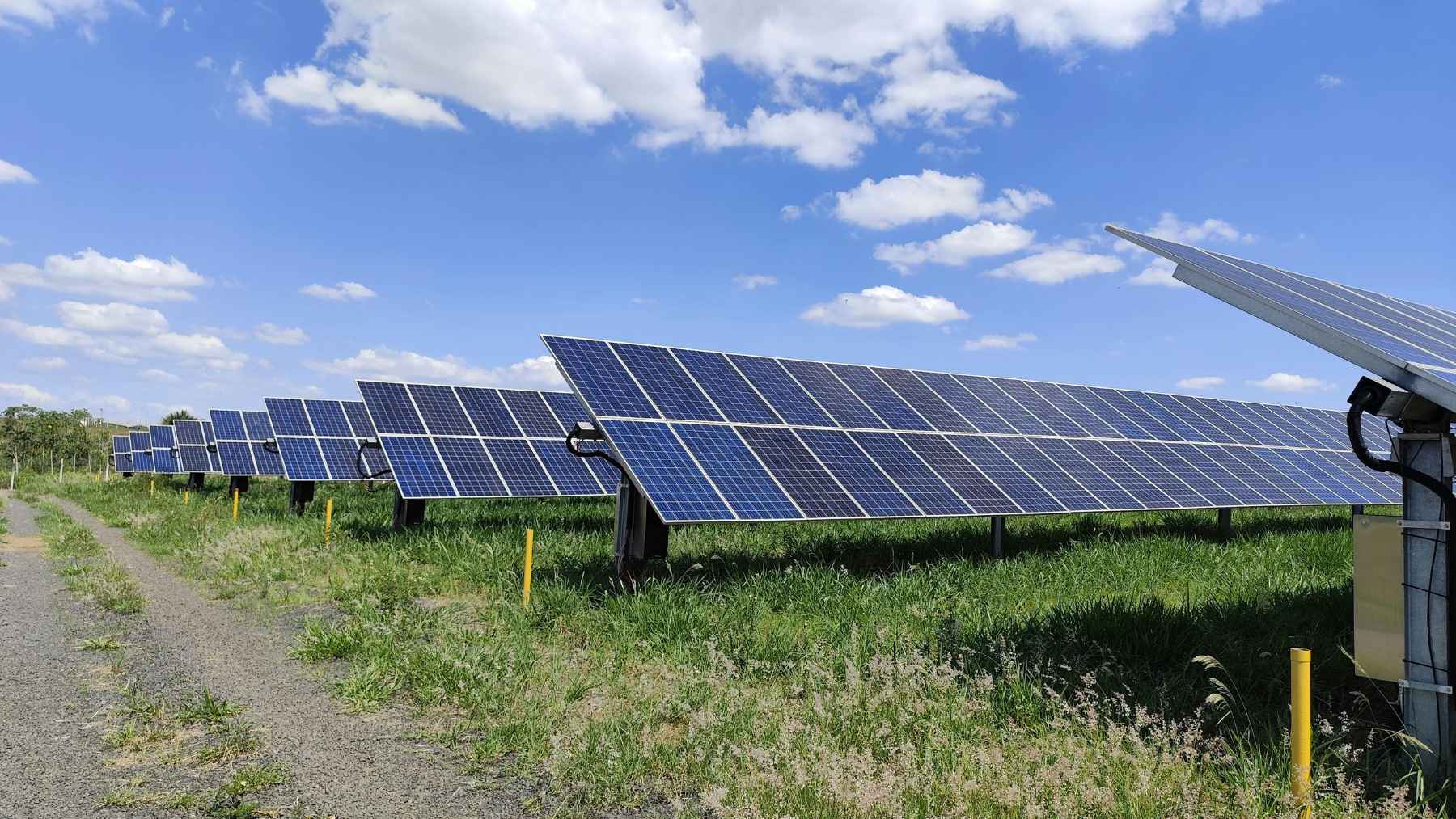
Walk to the western edge of the field and the first thing you notice is what is missing.
There is no tilt.
Rows of dark glass run away from you in parallel lines, every sheet turned to exactly ninety degrees, none of them leaning toward the sky.
The 37,000 modules stand in parallel rows spread across about 76 acres of airfield grass, running roughly 9,200 feet alongside Runway 18 West.
At twelve o’clock the array nearly disappears, because seen from straight above there is almost nothing there.
Which is a strange thing to build, and it was built that way on purpose. So what does a sheet of glass turned sideways to the strongest light of the day actually collect?
What a sheet of glass turned sideways still collects
A conventional array leans south at roughly the latitude of the site.
That aims it square at the sun in the middle of the day, which is where the light is strongest and where the wattage is.
The cost of that aim is the shape it produces. One tall spike around noon, and very little at either end of the day.
Turn the panel upright and rotate it a quarter turn and the noon sun meets only the thin edge of the glass. The spike is gone.
What arrives instead is the low sun.
At sunrise the east face takes it square on. At sunset the west face does the same.
These modules carry glass on both sides rather than a backsheet, so neither face is an idle face, and each one also picks up light bouncing off the grass behind the other.
The result is a curve with two humps and a shallow dip between them, which lands exactly where a rooftop array is weakest.
Not one fence but 76 acres of glass on edge
The picture in most people’s heads is a single wall running the length of the runway.
It is not that.
The 37,000 modules stand in parallel rows spread across about 76 acres of airfield grass, running roughly 9,200 feet alongside Runway 18 West.
Each row sits on slim posts driven into the ground, and less than 1 percent of that land carries any structure at all.
The grass stays. Rain reaches it, light reaches it between the rows, and the mowing crews drive down the lanes.
Building was scheduled around breeding and nesting seasons on the airfield, which is not a detail a rooftop job ever has to think about.
17.4 megawatts and the day it switched on
The array is rated at 17.4 megawatts and is expected to make about 17.4 million kilowatt hours a year, which the airport puts into terminal cooling and into charging its electric ground fleet.
It began with a demonstration string of only 8.4 kilowatts in 2022.
Construction of the full array started in early 2024.
It went into service on 30 October 2025, not in 2024, and it is the largest vertical photovoltaic plant built anywhere so far.
Roughly 90 percent of the airport’s electricity already comes from renewable sources, and a supply contract starting in the middle of 2026 is meant to close the last tenth.
Where the claim is thinner than the glass
The number that travels furthest is not the capacity. It is the price.
The installer says vertical output earned about 87 percent more per unit than the German solar market average between January and May of this year, because morning and evening power sells into a market that is not flooded with it.
That figure deserves its qualifiers. It comes from the company that sells the system, it covers five months of one year, and it depends on a spread that widens or narrows with every new array built the same way.
The airport’s own numbers are capacity and yield, and the operator is not the one making the price claim.
A second qualifier is the site. An airfield brings obstacle clearance limits and glare rules that most ground is free of, but it also brings a customer next door and a fence line nobody wanted to farm, as the trade coverage noted.
The same trade off runs through arrays that share the land with crops and through floating solar on water nobody was using.
What the format opens up past the airfield
A vertical row takes almost no footprint, which is the whole argument for putting one anywhere a boundary already runs.
Rail corridors, motorway verges, the edges of industrial sites.
The airport’s chief executive said the advantages make solar fences attractive beyond airports, for public infrastructure generally, and that he sees room to expand the approach across the airfield itself.
Whether that happens depends on something nobody can settle yet.
Two more years of metered output will show whether the morning and evening curve keeps its value once a great deal more of it exists, and the airport has the instrumentation to find out.
Hugo is an engineer with strong technical expertise. Multilingual from an early age, his writing combines technical clarity with a strong interest in science and energy.
