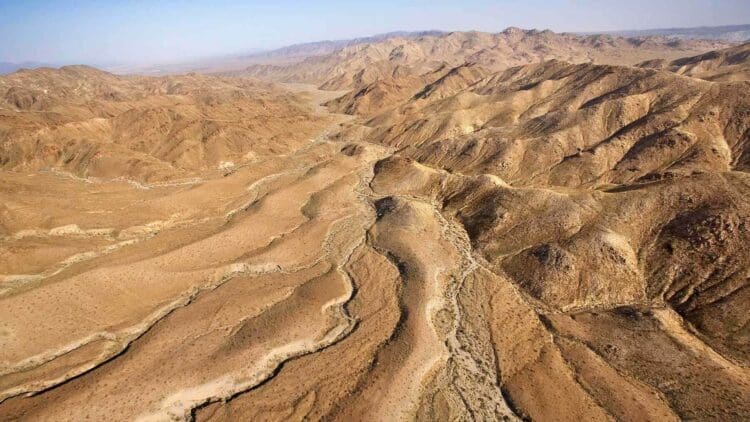

The people living on the western edge of the United States tend to become accustomed to the way earthquakes behave in their area. The recent seismic research by some researchers concerning low-frequency earthquake tremors revealed a problem with the typical earthquake pattern in Northern California. While it was very small, it was odd and raised an unspoken question: What else has been occurring beneath Northern California without our knowledge?
Low-frequency tremors indicate something bigger
Geologists who have monitored the San Andreas Fault and the Cascadia Subduction Zone have thought that they had an overall good understanding of how the region behaves. They knew the Mendocino Triple Junction (where three large tectonic plates intersect) in terms of concept, although they did not know all of the details.
In fact, recent studies using a series of thousands of minuscule or low-frequency earthquakes, which can only be detected by highly sensitive equipment and cannot be felt at the surface, indicate that there is a more complex relationship of movement than a simple three-plate model would suggest. This type of earthquake indicates the existence of important information about the tectonic activity occurring at great depths.


By utilizing a high-resolution grid of seismometers located across the Pacific Northwest to track these minute vibrations, researchers identified many patterns that do not exist within existing earthquake models. These included earthquakes occurring at greater depths than researchers had previously anticipated, and earthquakes appearing in clusters that appear to outline previously unmapped geological structures. Individually, the two phenomena suggest that the tectonic architecture of the region is more complex than what the established three-plate model suggests.
A hidden network under the coastline
As the number of low-frequency tremors grew in the data, geologists realized that the underlying system of the region is comprised of at least five different moving parts rather than three. The additional parts consist of fragments that had gone undetected for years because of the way in which they slid quietly beneath the surface and moved in ways that were too subtle to detect using conventional instrumentation.
A part called the Pioneer Fragment is sliding beneath the North American Plate and is being pulled along by the Pacific Plate. A second part consists of a previously unknown fracture line within the North American Plate that is currently being pulled down into the sinkhole created by the subduction of the Gorda Plate.
This additional structure will help explain earthquakes that had previously stumped researchers, such as a significant earthquake that occurred in 1992 at a much lower depth than researchers had anticipated. The faults in this zone do not always occur at the predetermined boundaries of the subducting slabs. Instead, the faults branch, overlap, and move based upon the previous movements of the now-buried fragments of the Earth’s crust.
Collectively, these findings show a more dynamic seismic environment than previously thought.
Where does the real hot spot emerge?
The additional insight is based upon the recognition of what each of these small earthquakes individually indicates collectively: the existence of a new seismic hot spot centered around the Mendocino Triple Junction – an area that has historically experienced significant amounts of activity, but has been demonstrated to be significantly more fractured.
Researchers have successfully illuminated hidden faults and moving plate segments through the mapping of the seismic behavior that had been obscured for decades.
These low-frequency earthquakes do not signal a catastrophic event. It represents a more accurate and realistic interpretation of how the energy of stress is distributed along the western coast. As researchers continue to identify and map the various deep-rooted structural components of the region, new questions arise regarding how long the fragments have been moving and what additional secrets remain hidden beneath the surface.
If you want to learn more about this discovery, you can check the full study here David R. Shelly et al., Low-frequency earthquakes track the motion of a captured slab fragment.Science391,294-299(2026).DOI:10.1126/science.aeb2407.