

Floating new, innovative approaches to increase global solar capacity expansion.
Globally, energy demands are increasing on a daily basis, making the push to adopt renewable energy solutions greater than ever.
Unfortunately, as solar power quickly rose in popularity, the available space to accommodate the jocks of sustainability is becoming limited.

Will the world have to find completely new clean energy sources, or could it rethink how existing ones are used?
How the MVP of sustainability is running out of room
Nations worldwide are competing to see who has the most installed renewable capacity.
In this global renewable transition “game,” solar has been the reigning MVP for some time.
It is celebrated for its declining costs and advancing efficiency, making it the most popular kid on the block.
However, with the rise in popularity comes a few growing pains. For solar panels to be powerful and effective, they require substantial room for growth.
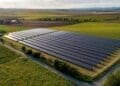
Unfortunately, land is finite and a premium resource. This means that massive solar projects often compete with agriculture and urban expansion.
Top athletes also require adequate environments and often face physical constraints. In the case of solar arrays, the more sunlight they absorb, the hotter they become.
On land, the heat is more intense, constraining efficiency. This means these jocks need to work extra hard to maintain peak performance.
Fortunately, experts are exploring ways to help them thrive.
Conditioning solar to improve its performance
Efficiency is the key factor that sets photovoltaics (PVs) apart.
This particular factor has come a long way since the world’s very first solar cell. Scientists have been actively seeking ways to improve it.
Fraunhofer has proven that solar panels are nearing their theoretical limit. All we need is the correct PV material to achieve it.
Some are even convinced that this will help increase solar adoption, as it makes the jocks of sustainability more worthwhile.
Others, on the other hand, believe changing the entire design will make them more attractive as a power solution.
India has reimagined solar power in urban settings by planting living, breathing solar trees.
However, altogether, this does not solve the overheating constraints faced by PV arrays. That is why India decided it might be a good idea to change the arena instead of the athlete.
Peak performance spotted floating from space
In the state of Madhya Pradesh, India, a record-breaking transformation has taken place. The vast and once-empty blue expanse of the Narmada River has become home to giant floating jocks.
The Omkareshwar Reservoir is now hosting the Omkareshwar Floating Solar Power Project.
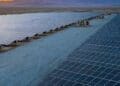
The strategic shift is so big that it even caught the attention of NASA’s Landsat 9 satellite. The latest imagery shows the reservoir’s northeast and southeast arms flexing massive, bluish rectangles of glass and silicon.
New room for solar growth with brains and brawns
Floating solar panels are gaining traction worldwide, with the U.S. already investing in its first artificial photovoltaic island. And it is no wonder, as India’s project shows how fluid the engineering is.
It simultaneously saves land space and water while cooling the panels to maintain energy efficiency.
The 216 MW project uses “flexible mooring” to ensure productivity despite the seasonally fluctuating 800,000 acre-feet of water.
The Omkareshwar Floating Solar Power Project proves that even the most seasoned MVPs can improve with a change of scenery.
By making these jocks “swim,” India bypassed land-use conflicts and heat-related efficiency constraints.
This goes to show that we are much closer to a smarter, more resilient future than we think.
All we need to do is reimagine the way we approach it by investing in the next generation of solar.