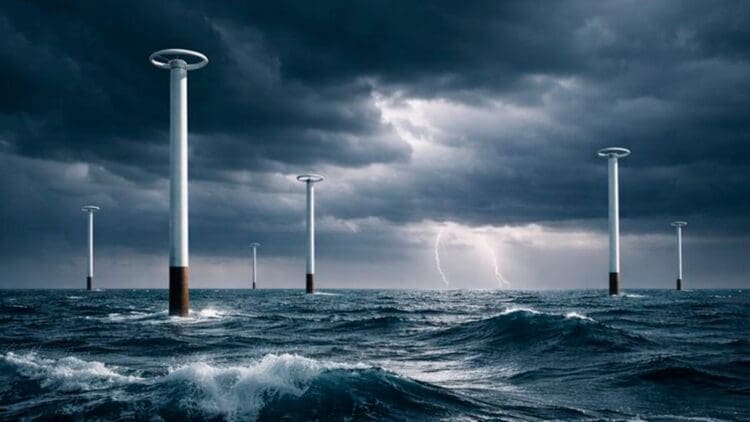

The Land Down Under has been in the spotlight for all of the right reasons. The nation has enjoyed significant renewable energy capacity growth in recent years, and it seems this growth is expected to continue at the same rate. Now, one of the country’s regions will feature a unique wind power project that thrives in typhoons to provide power for major cities. However, some experts have raised concerns about this giant project’s potential impact on natural tidal flows.
Australia’s rapid renewable capacity growth
The Australian Government’s Department of Climate Change, Energy, the Environment, and Water (DCCEEW) has recently legislated a new commitment, adding to its concise climate goal of achieving zero carbon emissions by 2050, which is:
- Decreasing emissions by 62-70% compared to 2005 levels by 2035
The DCCEEW has identified five key areas that will enable the country to achieve its goal. These five key areas are:

- Boosting clean power capacity
- Promoting electrification and energy efficiency
- Increase clean fuel usage
- Speeding up the development and adoption of new technologies
- Boosting environmental net carbon elimination
This has led to a rapid growth in renewable energy capacity in Australia, with the country achieving a remarkable milestone in 2025/2026. In the fourth quarter of 2025, over half of the country’s power was supplied by renewables. Now, a new, unique project has entered the game that will turn a natural disaster into power for entire cities.
From natural disaster to power for entire cities
The Pilbara in Western Australia will soon be home to a unique wind power project, with construction having officially started. Fortescue Metals is behind the project, as it will help to keep its carbon footprint as low as possible during iron ore production. The project is officially known as the “Nullagine Wind Project,” and it will be powerful in more than one sense.
Western Australia is rapidly expanding its wind energy capacity, with Vestas being contracted for the 108 MW Waddi wind project. However, the 133 MW Nullagine Wind Project particularly aligns well with the DCCEEW’s goals, as it will incorporate smart technology and Nabrawind’s “self-erecting tower system.” In this case, Envision Energy will supply 17 turbines specially designed for the Pilbara’s extreme environmental conditions.
According to Fortescue’s website, these turbines can operate in extremely low wind speeds (which hasn’t been publicly confirmed) and continue operations during cyclones, also known as typhoons. Furthermore, an AI system will enhance operations and system management.
These wind power projects could be game-changing, but some face one problem
According to the CEO of Fortescue, Dino Otranto, the Nullagine Wind Project will be the first of many in the Pilbara region. Otranto added that the project’s low-cost, clean energy will help the company remain competitive and enable the electrification of drills, plants, trucks, etc.
However, not everyone is convinced that all solar and wind projects will benefit the Pilbara region. Sussan Ley, the Federal Environment Minister, rejected the planned Asian Renewable Energy Hub in the region, which would have generated green hydrogen with wind and solar. According to a department spokesperson:
“The Minister found the marine component of the infrastructure corridor would disrupt tidal movements and processes, and this would seriously impact the habitats and lifecycle of the native species dependent upon the wetland and, accordingly, the ecological character of the Eighty-Mile Beach Ramsar site itself.”
Ley’s decision has sparked significant debate on whether the Australian government is indeed doing enough to promote the development and adoption of renewables and clean fuels. While others continue the debate, Fortescue continues working towards its own climate goals, expecting the Nullagine Wind Project to be completed by 2028. Western Australia is not the only one planning on exploiting the power of typhoons, as Japan’s “Typhoon catcher” proves that 179 mph wind unlocks true power.
Disclaimer: Our coverage of events affecting companies is purely informative and descriptive. Under no circumstances does it seek to promote an opinion or create a trend, nor can it be taken as investment advice or a recommendation of any kind.