
Countries and companies increasingly pursue offshore wind projects because wind energy is one of the most reliable sources of energy. The nations that invest in wind energy projects have a consistent amount of energy throughout the year. Japan is the leading nation attempting to benefit from wind energy development after Goto City’s offshore wind project was announced to have entered full commercial operations.
How did we arrive here? A general overview of Goto City’s wind project
The continent of Asia is renowned for its wind energy facilities, as it is the region where the world’s biggest producer of wind energy, China, is located. Thus, it is not surprising to learn that Japan is continuously seeking to replicate the success of its Asian counterpart. Situated off the coast of Goto City in Nagasaki Prefecture, the wind farm is Japan’s first commercial floating offshore wind facility certified under Japan’s Marine Renewable Energy Sea-Area Utilization Act.
After the announcement was made public, many people missed the fact that the project had been in the works for multiple years and, through meticulous planning, has morphed into the masterpiece that it is today. Ultimately, the Japanese government expects the facility to serve a greater part of its population and generate power for the people.



Groundbreaking infrastructure: Combining floating technology and commercial ideas
Floating technology is something that has not always existed in the energy industry but has now become the core of many developments. It is the infrastructure designed to generate and store energy while floating on water instead of being fixed on the seabed or land. In most cases, it is incorporated into wind and solar energy as it allows developments into the deep waters.
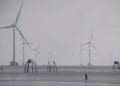
According to reports, the Goto Offshore Wind Farm has a generation capacity of 16.8 megawatts, which it can generate through eight 2.1 MW wind turbines mounted on hybrid spar-type floating foundations. The turbines are designed and built by TODA Corporation in such a manner that they combine a steel upper section with a concrete lower section. Ultimately, this allows them to support deep water deployment.
Interestingly, this is the first commercial floating offshore wind farm in Japan and the world’s first commercial usage of hybrid spar-type floater technology. This makes Japan a massive part of wind energy development moving forward, as its name will forever be etched in history for opening doors that many other countries may enter.
Unpacking the potential impact of the Goto city wind development
Goto Floating Wind Farm LLC has been tasked with managing the project, which is a massive responsibility considering what’s at stake for the Japanese people. Reports suggest that there were many local companies that were involved in the construction phase of the project. This means that it had a positive impact on the people by creating employment opportunities. The contemporary industry is filled with countries collaborating with foreign companies rather than relying on local ones, but Japan has completely gone against the grain in its groundbreaking development.
Looking ahead: How the Goto facility can transform Japan’s energy landscape forever
Goto City has presented a strategy on how companies can collaborate and manage the costs of executing a large-scale project. Thus, Japan can apply the model to developing other types of energy projects in 2026. The power generated from Goto will be ¥36 per kilowatt-hour (about US$0.23 per kWh).
One important thing to note is that Japan’s upcoming facility did not materialize flawlessly. Instead, the involved companies made a collaborative effort to overcome every challenge that emerged. The Asian nation has an objective to achieve 10 GW by 2030 and 30-45 GW of wind energy capacity by 2040. The upcoming Goto will play a key part in assisting with that objective in the long run. Still, in the short run, it represents the Asian continent’s desire to dominate in wind energy generation.