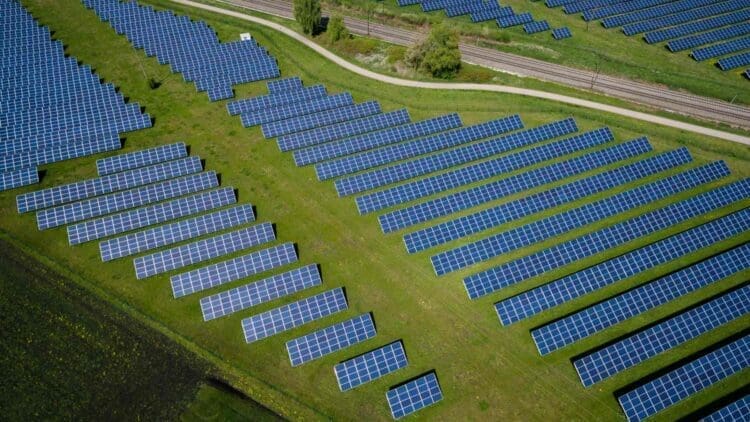

The Hambach opencast mine has spent decades as one of Europe’s most visible symbols of fossil fuel extraction — a vast wound in the Rhineland landscape, dug deep for lignite. Now, rows of solar panels are spreading across its edges, covering an area the size of 20 football pitches, while the ground below still waits to flood into a future lake.
RWE is repurposing the terrain it once mined, and the transformation is already underway.
A mine in motion: from lignite to light
Hambach has long been shorthand for Germany’s coal dependency. Carved into the Rhineland over decades, the opencast mine became a flashpoint for climate protests and a recurring image in debates about the country’s energy future. Germany has committed to phasing out coal, and Hambach’s operational life is winding down — but the land itself isn’t sitting idle.


RWE’s approach treats the mine’s gradual closure as an opportunity rather than a gap. As the excavated terrain slowly floods over the coming decades to form a future lake, the company is identifying suitable, approved areas along the edges for renewable energy development — threading new infrastructure into a landscape still mid-transformation.
The broader Rhenish lignite region is paying close attention. Local governments, energy planners, and surrounding communities have staked real ambitions on maintaining economic and energy relevance through the transition. Hambach is emerging as a test case for what that can actually look like.
Manheimer Bucht: the newest solar addition
The latest addition to the site is the “Manheimer Bucht” solar park, located within the mine’s boundary in the municipality of Kolpingstadt Kerpen. Construction is already underway: the first substructure sections and some modules are in place, with 25,300 solar panels being installed across roughly 20 football pitches.
When completed — expected by the end of 2026 — the park will carry a capacity of 16.5 megawatts peak (14.8 MWac), enough to supply around 5,000 households annually with climate-friendly electricity.
The location carries longer significance. Manheimer Bucht will eventually form the southern shoreline of the future Hambach lake, but that flooding is still decades away. That gap is precisely why RWE is building here now — using the interim period to generate clean power from land that would otherwise sit unused.
Battery storage: making solar power available on demand
A solar park alone captures energy only when the sun cooperates. To address that, RWE is pairing Manheimer Bucht with an 80 MWh battery storage facility on the same site. Construction is scheduled to begin in summer 2026, with commissioning planned before the year ends.
The battery system stores surplus electricity generated during peak solar hours and releases it back to the grid when demand rises or generation dips — directly targeting one of solar power’s core challenges: intermittency. By co-locating storage with generation, RWE can offer something closer to dispatchable power, electricity that can be called upon when the grid needs it rather than only when conditions allow. The facility is specifically described as contributing to grid stability, which matters increasingly as Germany’s renewable share grows and flexible balancing capacity becomes harder to come by.
A growing portfolio — and a community partnership
Manheimer Bucht isn’t a standalone experiment. RWE already operates three solar farms and one battery storage facility at the Hambach site, with a combined capacity of 61 megawatts peak. Across the wider Rhenish region, the company runs nine large solar parks in total — so the new project lands in an existing portfolio that’s been building steadily, not as a one-off announcement.
What also distinguishes the Hambach projects is the structure of local involvement. RWE operates these facilities in collaboration with NEULAND HAMBACH GmbH, an inter-municipal company representing six surrounding communities: Elsdorf, Jülich, Kerpen, Merzenich, Niederzier, and Titz. Under this arrangement, the municipalities have the option to participate financially in the Manheimer Bucht project — giving local governments a direct stake in the energy transition’s economic returns, not just its physical presence.
What this signals for post-coal landscapes
The Hambach model raises a question worth watching: can former extraction sites become templates for renewable development elsewhere? Across Europe, aging coal regions face similar pressures — land that was economically central for generations, now requiring reinvention. Hambach offers one answer, though its specific conditions, including the decades-long flooding timeline, are genuinely unusual.
RWE’s position is also worth noting. The company is simultaneously winding down coal operations and scaling up renewables on the same terrain. That dual role is complicated. It also gives RWE both the land access and the regional relationships to move quickly where approvals allow — an advantage that’s hard to replicate from scratch.
As Lars Kulik, RWE Power’s board member responsible for the lignite division, put it: the goal is ensuring the region remains an energy hub through the transition, not after it. With Manheimer Bucht under construction and further lake-edge areas still years from flooding, more projects in this mold seem likely. The question isn’t whether Hambach will change — it already is. The question is how far the model travels.