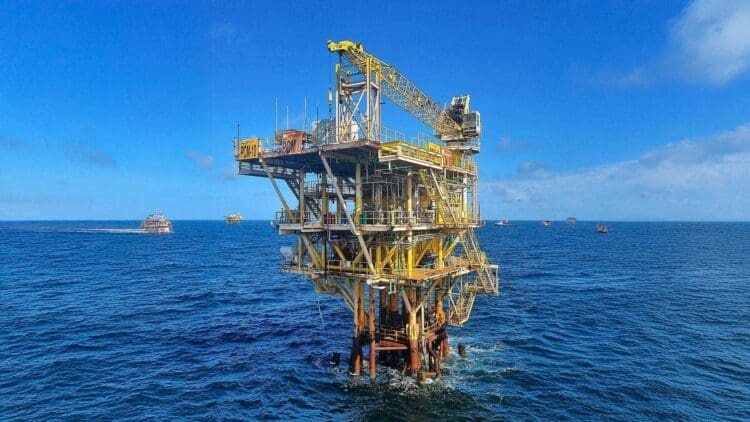
Harbour Energy has taken over as the operator for the Zama offshore development in the Gulf of Mexico, advancing the project into a new upstream development stage. The region in and around the Gulf of Mexico is awash in natural energy resources, and thanks to the new Zama offshore project, it will continue to play a vital role in the international upstream market, especially as oil reserves become harder to access.
Mexico’s latest upstream development has reached a critical milestone
The Zama offshore oil project has become strategically important for the nation as it offers new opportunities for upstream oil production. The Zama project is one of the largest shallow-water discoveries in recent memory anywhere in the world and paves the way forward for the Gulf of Mexico to play a vital role in increasing upstream production.
The 750 million barrels of oil equivalent will boost Mexico’s upstream output capacity as the nation aims to develop its market to meet increased demand for oil, as the global market attempts to fill the gap left by the Russian energy companies.



Front-end engineering and design (FEED) is expected to be completed this year ahead of a Final Investment Decision. As with most upstream energy developments across the international market, the project features several partners that all have a vested interest, namely:
- Harbour Energy with 32.22%
- Pemex 50.4%
- Talos Energy Mexico (17.35%)
The Zama project is expected to cost the partners an investment of around $4.5 billion, with an additional $4.5 billion being allocated for operating expenses and costs. The Zama project is located in the Sureste Basin in the Gulf of Mexico and will play a vital role in strengthening Mexico’s domestic upstream market.
“The Gulf of Mexico is a very big ocean. The amount of volume of oil and dispersant we are putting into it is tiny in relation to the total water volume.” – Tony Hayward
Harbour Energy has taken over the development of the Zama project
Harbour has recently announced that, thanks to the partners on the Zama project, it has taken over operatorship and will develop the project this year. The Zama oil field was discovered in 2017 and successfully appraised in 2018.
It is expected to contain 750 mmboe of gross recoverable resources that will drastically boost Mexico’s upstream output capacity. Harbour was selected as the new operator by the project’s partners and has received the go-ahead from the Mexican Ministry of Energy.
“Harbour’s appointment as operator of the strategically important Zama project is testament to the trust that the Mexican government, including Pemex, places in Harbour and our partners, Grupo Carso and Talos Energy. Once onstream, Zama will contribute materially to Mexico’s domestic energy supply and to Harbour’s production levels.” – Gustavo Baquero, Managing Director, Mexico
As the global upstream market enters the new year, the reality is that the current situation in South America has placed the international upstream sector in peril of not meeting increased demand. Market analysts have pointed to the fact that 2026 may be a challenging year for energy companies as capex cuts become a reality across the international market.
Can the world develop the upstream market to fill the gap left by Russia
That is the real question that needs an answer. Since Donald Trump met with Putin last year to try to negotiate a peace deal with Ukraine, and the inevitable defiance by Russia, Trump implemented new sanctions on Russian energy companies. This has left a sizable gap in the market and forced buyers to search furiously for a non-Russian supplier. While Europe sees several new oil and gas developments picking up momentum, the Gulf of Mexico is set to see a new era of upstream production.