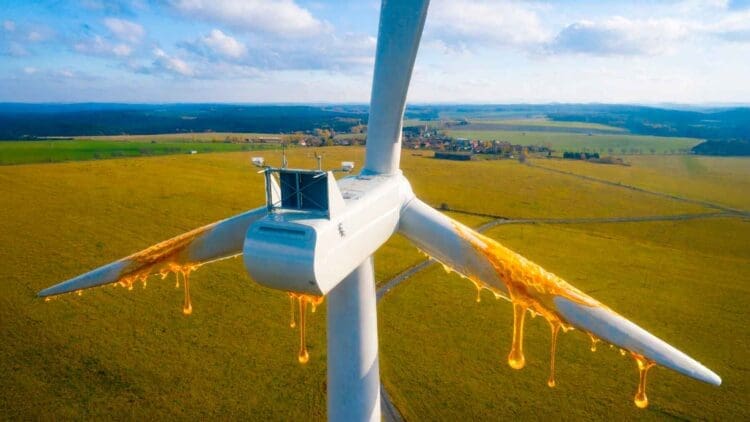

For the world, a wind turbine is disruptive and unpleasant, but Turkey unveiled its sweeter side.
Giant towers rise to the heavens to provide mankind with clean power, but their invisible footprint is bigger than anticipated.
As a result, the promise of complementary clean electricity is no longer enough to win over society.


However, will the sweet surprise of wind power’s environmental impact change the world’s opinion for the greater good?
How the invisible footprint is stepping on wind power’s reputation
Renewable energy technologies gained significant traction globally as clean alternatives to fossil fuels.
Wind farms were seen as the ultimate green revolution, providing complementary power to the grid in times of need.
However, in recent years, it has become clear that wind turbines have been hiding a secret or two.
Slowly but surely, it became evident that they had a significant footprint after all, leaving a bitter taste behind.
Wind turbines are towering eyesores, their presence mocking surrounding communities from afar.
Beyond its physical footprint stomping on valuable land, its presence also causes an invisible disruption, i.e., noise pollution.
However, the invisible cost of wind power is more than aesthetic and peace.
Their manufacturing costs are taxing on bank accounts and the environment, near and far.
With so many cons to consider, could it still be truly worth it to expand wind capacity?
Nature also pays the price of wind turbines
Humanity is not the only one affected by the costly impacts of wind energy.
Turbine production is highly reliant and heavy on:
- Neodymium
- Praseodymium
- Dysprosium
- Terbium
- Copper
- Aluminum
- Nickel
- Molybdenum
- Manganese
These all fall under the “critical mineral” category, minerals that the U.S. and the world are low on. Their extraction is also extremely carbon-heavy, which means wind farm footprints are significant even before turbines start spinning.
Wildlife is also highly sensitive to these white giants.
Bats and bird mortality rates reached new heights in wind farm regions. Turbine vibrations also disrupt breeding and hunting areas, affecting species survival even further.
Critics believe that wind power is essentially “stepping on” the very environments that the world is attempting to save.
It seems the disadvantages certainly outweigh the advantages, making the industry’s future uncertain.
However, a recent study may sweeten the deal, tipping the scales in favor of wind energy.
The sweet secret turning wind farms into safe havens
In the Aegean region of Turkey, local beekeepers stumbled upon this “sweet surprise.”
The secret lies in the study “Green energy’s sweet surprise: unraveling the hidden links between wind farms and honey production” published in the Journal of Cleaner Production.
This study found that accidental synergy turned wind farms into “safe havens” for bees. As a result, hives were thriving.
The synergy between wind farms and thriving beehives
The land used by wind turbines is restricted and thus protected from harmful pesticides and urbanization.
This meant that plants and wildflowers could grow freely, attracting and serving bees and other pollinators.
The spinning blades also generate a microclimate beneficial for “supercharged” nectar production.
Turkey’s wind farms thus became the ultimate symbiotic circuit for bee-keepers and wind power.
It definitely “sweetens” the future outlook for both agriculture and the green energy transition.
While some animals in the kingdom may be disturbed by wind turbines, the positive impact on bees is highly noteworthy.
Nearly 40% of invertebrate pollinators, which include bees, face an increased risk of extinction.
Without these essential pollinators, ecosystems and food security are threatened.
This means that wind power not only promises clean, complementary electricity, but also helps protect species crucial for our survival. Perhaps increasing investment in large-scale wind farm projects is not so bad after all.