
Hoover Dam’s hydropower output is expected to fall 40 % and the Colorado River system has been sliding toward this moment for decades
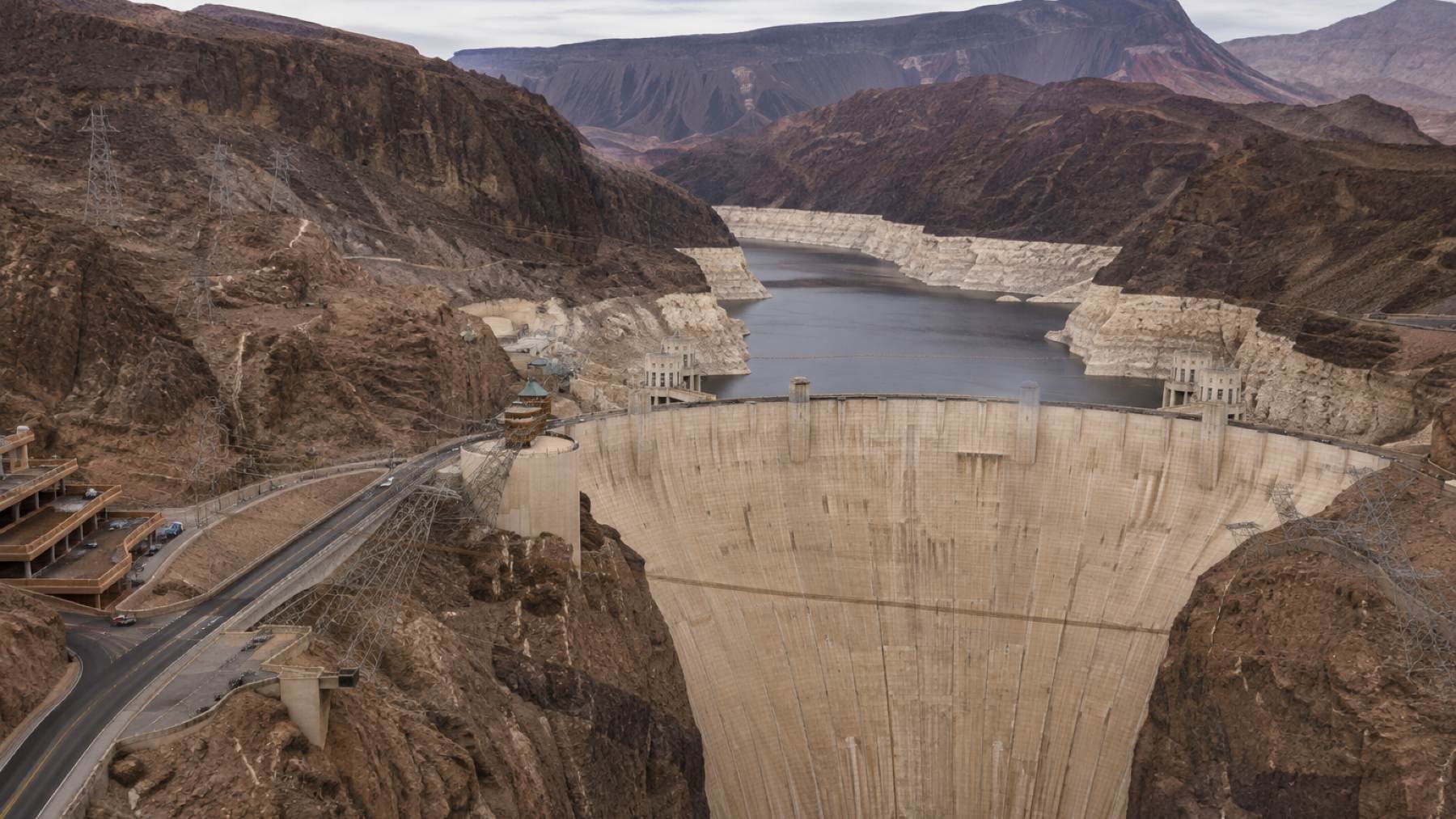 Image generated with artificial intelligence
Standing at the rim of Lake Powell, there’s nothing to warn you. No gauge on the canyon wall, no alarm, no visible sign that one of the most consequential machines in America is quietly running out of room to operate. The water stretches wide and blue, and the dam holds — for now.
But engineers are watching a number. And that number has been falling for a long time.
A river reengineered — and the system built to tame it
Before any dam touched it, the Colorado River was unpredictable. It flooded violently, ran dry in summer, and carved through desert rock on its own terms. That changed on October 9, 1936, when Hoover Dam’s generators first turned the river’s force into electricity. Glen Canyon Dam followed in 1963, adding a second massive reservoir upstream. Together, they became anchors of a 14-dam network designed to store, control, and deliver water and power across a region that couldn’t otherwise support large populations.
Temporary shortage-management guidelines agreed to in 2007 are now expiring, and states have already missed key deadlines for replacing them.
The system now serves roughly 40 million people. “Hydropower revenues are what paid for all of these dams,” says Douglas Kenney, director of the Western Water Policy Program at the University of Colorado. Without the promise of electricity revenue, many of these dams would never have been built.
Two decades of megadrought — and a system built for more water than it gets
Since 2000, a persistent megadrought has steadily pulled water levels down in both Lake Powell and Lake Mead. Climate change has intensified the trend, making the region hotter and drier in ways that are increasingly hard to reverse.
Some of the trouble is structural. The 1922 Colorado River Compact divided the river’s water among seven basin states during an unusually wet period — allocating more than the river can now reliably supply. In 2026, a weak snowpack combined with an extreme heat wave pushed the basin deeper into crisis. Temporary shortage-management guidelines agreed to in 2007 are now expiring, and states have already missed key deadlines for replacing them.
The thresholds that matter: minimum power pool and dead pool
Engineers are watching two specific numbers. The first is 3,490 feet above sea level — what the Bureau of Reclamation calls “minimum power pool.” Below that elevation, Lake Powell’s water drops beneath Glen Canyon Dam’s penstocks, the tubes that spin its turbines, and electricity generation stops entirely.
As of June 2026, Lake Powell sits at approximately 3,528 feet — only a few dozen feet above that line. Below minimum power pool comes a grimmer threshold: dead pool, at 3,370 feet, where gravity could no longer move water through the dam’s existing infrastructure at all. A mechanical risk called cavitation compounds the danger. “When those water bubbles collapse, they send off shock waves, and those shock waves can destroy concrete and metal,” says Jack Schmidt of Utah State University’s Center for Colorado River Studies.
Emergency triage: what the Bureau of Reclamation is doing right now
In April 2026, the Bureau of Reclamation moved to stabilize Lake Powell. It announced plans to release 660,000 to 1 million acre-feet from Flaming Gorge Reservoir upstream while withholding roughly 1.48 million acre-feet that would otherwise flow to Lake Mead — pulling from one part of the system to protect another.
The downstream consequences are already visible. Hoover Dam’s hydropower output is expected to drop to 40 percent of its maximum capacity in 2026. Some utilities aren’t waiting for conditions to improve. Lincoln County Power District in Nevada, which once relied on Hoover Dam for all of its electricity, is now investing heavily in solar — a logical pivot in one of the sunniest regions in the country.
Long-term fixes: engineering workarounds and the harder answer
The Bureau of Reclamation has considered several modifications to Glen Canyon Dam: new tunnels, rerouted outlets capable of generating power at lower water levels, or a bypass tunnel around the dam entirely. Estimates range from $500 million to $3 billion, and any fix would take years.
Smaller-scale adaptation is already underway. Phoenix is expanding its Cave Creek water reclamation plant, expected to produce 7 million gallons of purified drinking water daily by 2027. Farmers are experimenting with low-flow nozzles and drought-resistant crops. But experts increasingly argue that engineering alone can’t solve what is fundamentally a demand problem — a point Schmidt makes with characteristic directness: “If next winter is also dry, then we’re in a five-alarm fire drill.”


Carlos is an engineer with strong expertise in technical and industrial topics. He previously worked at international companies such as Siemens and is multilingual.
