
Engineers rerouted just 8.4% of a wind turbine’s power through a hydraulic loop, and it may eliminate the component that fails most often
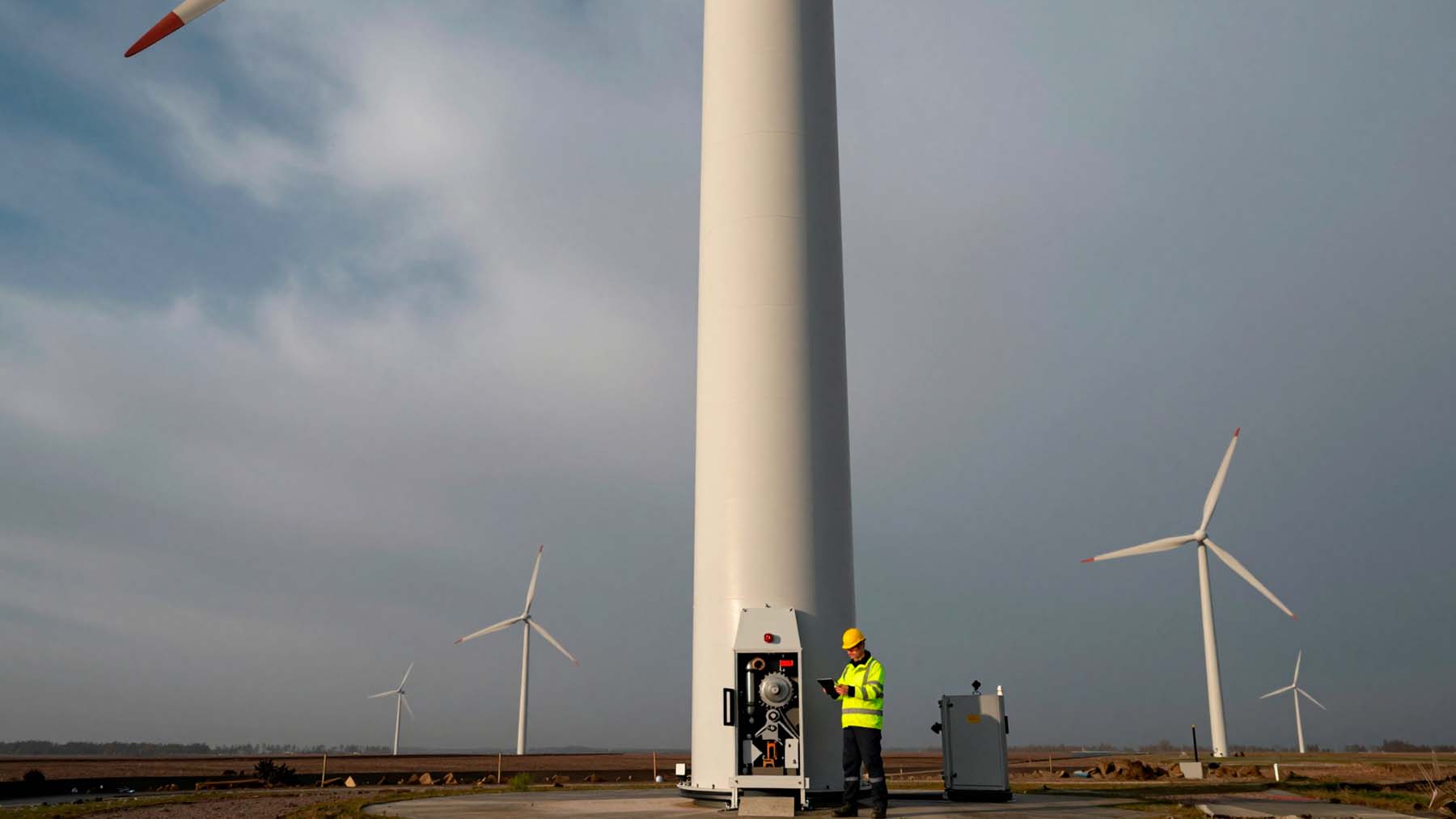 AI-made
Every massive wind turbine dotting our hillsides and shorelines holds a dirty little secret: the very part responsible for generating clean electricity keeps breaking down.
Wind turbines need to spin at variable speeds to catch changing breezes. However, the electrical grid demands a strict, rock-solid frequency. To bridge that gap, engineers have relied on an electronic component called a frequency converter. It solves the speed problem, but field data shows it triggers up to a full fault per turbine every single year. Nearly half of all turbine repairs stem right back to this single, fickle piece of hardware.
Now, a German research team thinks they have found a clever way to eliminate it entirely—and all it takes is shifting a tiny fraction of the turbine’s power into a fluid loop.
While partial-load efficiency drops to 71%, low-wind power output is already small to begin with, meaning the actual energy loss is minor over the course of a year.
The problem with today’s wind turbine drivetrains
To get maximum juice out of a breeze, a turbine’s blades must speed up or slow down with the wind. But the power grid wants its electricity delivered at a steady pulse.
Enter the frequency converter. This power-electronics package sits between the generator and the grid, decoupling rotor speed from grid frequency. It works, but it fails constantly. Industry field data reveals that frequency converters account for 0.45 to 1 fault per turbine each year. They are easily among the most failure-prone components in the entire machine.
What about skipping the electronics altogether? Engineers previously tried fully hydrostatic drivetrains, using a massive hydraulic pump and motor to handle all the power transfer. That got rid of the converter, but it crushed efficiency. Every full-hydraulic prototype fell well below the 89% to 94% efficiency typical of standard geared drivetrains. None ever made it past the test bench.
So, engineers started looking for a middle path: a power-split architecture. The idea is simple: route most of the energy through a normal mechanical gearbox, and use a variable secondary system to tweak just a fraction of it. Farmers have actually used this since 1996, when Fendt introduced power-split tractor transmissions. Applying it to a massive wind turbine, however, takes a much sharper engineering pencil.
How the HyDrive concept works
The German team’s concept, called HyDrive, starts with a tweaked three-stage gearbox. In the third stage, the ring gear is freed from its static position and hooked up to a hydraulic motor. By spinning that ring gear faster or slower, engineers can continuously change the transmission ratio, instantly adapting to shifting rotor speeds.
A small hydraulic pump steals a tiny slice of energy from the main drive shaft, runs it through a fluid circuit, and feeds it back into a planetary summing stage. Because the hydraulics handle speed adjustments, the generator can lock directly onto the electrical grid. For a standard four-pole-pair machine on a 60 Hz American grid, that means a locked, smooth, continuous 900 rpm (or 750 rpm on a 50 Hz European setup). No frequency converter required.
How much power actually moves through the fluid loop? At the optimum setting, the hydraulic circuit carries just 8.4% of the turbine’s total rated power.
Because that hydraulic load is so light, engineers don’t need custom-built, ultra-expensive high-power hydraulic units. Off-the-shelf industrial pumps will do the job.
Simulating efficiency across wind conditions
To test their idea, the researchers built a detailed computer model based on a giant 10-megawatt reference wind turbine. They mapped out loss levels using real-world data from Parker axial piston units.
The simulations revealed a wide efficiency range. In light breezes, hydraulic efficiency drops to around 20% because the pump runs under low pressure and low speed. But as wind speeds pick up toward full capacity, the hydraulic workload drops near zero. Overall drivetrain efficiency shoots up to 94%, totally dominated by the smooth mechanical gears.
Averaged across all weather, the model showed a mean overall efficiency of 86%. While partial-load efficiency drops to 71%, low-wind power output is already small to begin with, meaning the actual energy loss is minor over the course of a year.
When does HyDrive match — or beat — a conventional turbine?
Location is everything. In areas with high average wind speeds of about 22 mph (10 m/s), the HyDrive matches a conventional geared turbine’s total output. In windy offshore zones averaging above 27 mph (12 m/s), HyDrive actually wins. That is because the turbine spends most of its time running at full capacity, where mechanical efficiency dominates and the hydraulic penalty vanishes.
On land, where average winds hover between 11 and 15 mph (5 to 7 m/s), the picture changes. HyDrive yields a few percentage points less total energy than standard designs. Still, operators might gladly take that minor energy hit if eliminating the converter saves them millions in offshore repair calls.
Grid support, reliability, and the hydraulic fluid question
Plugging the generator directly into the grid brings another massive perk: physical inertia. When grid frequencies wobble, the heavy spinning mass of the mechanical drivetrain naturally stabilizes the power flow. Converter-based turbines lack this natural physical resistance.
Removing the electronic converter cuts out a primary source of downtime. Standard hydraulic systems in heavy industrial trucks have proven extremely reliable over decades.
However, running a fluid circuit in a massive wind turbine comes with trade-offs. A 10 MW HyDrive turbine needs over 500 gallons (2,000 liters) of mineral oil. That is roughly the same fluid volume as a standard gearbox, requiring full fluid swaps every year or two. Maintenance crews must also prevent leaks and manage fire risks, particularly out at sea.
What comes next for this concept
For now, HyDrive exists entirely inside computer simulations and 3D CAD models. No physical hardware has been built yet. The next crucial steps involve constructing a physical test rig and testing how the drivetrain reacts to dynamic, real-world wind gusts.
Engineers are already exploring ways to boost low-wind efficiency, such as using slow-rotating radial pumps or shutting down individual hydraulic units during light breezes.
Ultimately, HyDrive’s real-world success boils down to a classic engineering trade-off. Will saving a turbine from its most fragile electronic part make up for adding a fluid loop? The answer lies in a startling calculation: the cost of repairing a broken turbine far offshore—where giant crane ships cost up to $300,000 per day just to swap out a fried converter—can easily outweigh a minor drop in low-wind efficiency.
The full study is available here: Seifermann, P., Schaaf, J., Störtenbecker, S., Dam, A., and Dalhoff, P.: Design and simulation of a continuously variable hydraulic power-split drivetrain for wind turbines, Wind Energ. Sci., 11, 1733–1750, https://doi.org/10.5194/wes-11-1733-2026, 2026.
Kelly is an experienced writer with 15 years of experience exploring the big stories that shape our world, from tech breakthroughs and space exploration to climate, energy, and the fascinating quirks of science. She has a talent for turning complex ideas into sharp, memorable insights that stay with readers long after they’ve finished reading.
