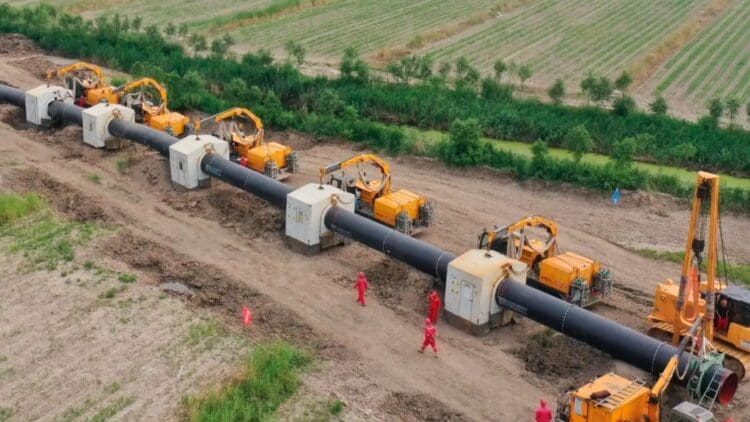

China was once at the start of the Silk Road, but now, it is at the start of the Hydrogen Road. For the first time, China’s new corridor will be transporting hydrogen across provinces through a dedicated pipeline. China is shifting to more renewable energy, which will give it the ability to operate on clean energy. In its early phases, it will transport hydrogen blends.
The first interprovincial pipeline for China to support the hydrogen corridor
Beijing is now able to capture the green hydrogen produced in Inner Mongolia, which is one of the best locations in the country for green hydrogen. This is because the region has great potential for wind and solar resources. This and other renewable resources will allow China to create hydrogen without the use of carbon, which is exactly what China needs to decarbonize.
Given the current level of development in the first phase of the project, the pipeline is expected to start functioning at almost 100,000 tons of hydrogen output in a year. Nonetheless, the pipeline has been designed with the ambition of attaining considerable operational scalability.
The hydrogen corridor is strengthening in Asia as Inner Mongolia grows into a hub
With additional renewable-powered electrolyzers coming online in Inner Mongolia, the completion of the compression facilities, and the storage facilities along the route, the corridor will eventually be able to accommodate 500,000 tons a year. This will be the first major operational change of many in an extensive scaling-up project, thereby making the route the largest hydrogen pipeline in the world.
That much hydrogen has the potential to be used in industries, heavy transport, and even power generation, and would be enough to offset large volumes of fossil fuel use, which makes it a big step toward the 2060 carbon neutrality goal of China.
Clean hydrogen is rapidly being identified as the crucial missing piece in the clean energy portfolio
Solar and wind power supply the majority of the energy, but hydrogen is able to supply energy to the hard-to-electrify sectors. That includes long-haul transport, chemical production, and even steelmaking. China is overcoming one of hydrogen’s biggest obstacles, which is transportation, by constructing specialized pipelines.
Hydrogen is really inefficient and costly to transport by truck or ship, but it can be transported quickly and cheaply through a pipeline. That makes it more affordable and competitive as a fuel when it’s used in its final form.
This corridor may be a domestic project, but there is a lot more on the line than just being a national concern. The construction of hydrogen infrastructure allows China to become a primary actor in the possible future hydrogen economy, affecting the flow of trade and energy for Asia.
The potential of the Hydrogen Road: What is possible?
Like the Silk Road, the Hydrogen Road has the potential to flow clean, environmentally friendly energy across borders and promote trade and the positive changes needed for the environment.
However, scaling the project to its goal of 500,000 tons is no small task. Massive investment in renewable electrolyzers and storage infrastructure will be a hurdle for many to overcome. In addition, the hydrogen component of the Energy Mix will be determined solely by the size of China and Market arrangements for hydrogen to be a viable alternative.
The Inner Mongolia to Beijing pipeline hydrogen project is the first of many to set the standard for the rest of the world. If fully completed, the project will demonstrate to the world what can be achieved when a country is determined and focused on the future. From the Silk Road to the Road of Hydrogen, and now with the addition of sustainability, China is remolding global trade and connectivity once more, but this time with molecules, not merchants.