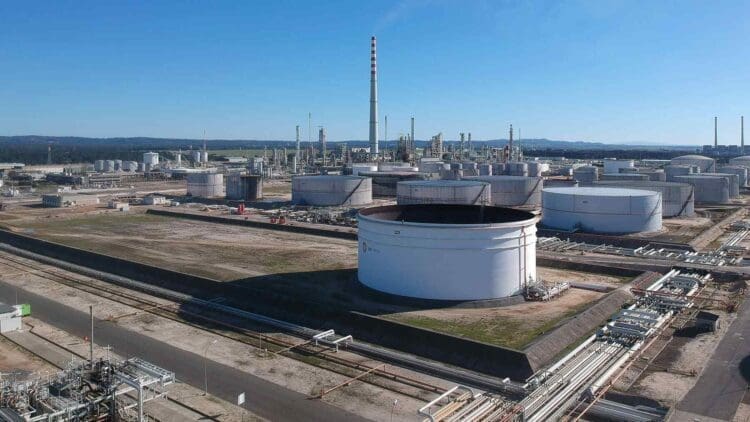

Refining is generally viewed from the perspective of how much production is occurring; the true measure typically resides outside of this. According to Imperial Oil’s (IO) 2026 Outlook, IO views the primary measurement of success in 2026 as operating its facilities as efficiently as possible, versus attempting to maximize production.
A familiar target with unfamiliar implications
Behind the simplistic utilization target for each of the facilities is a detailed and carefully coordinated maintenance ScheImperial Oil sets refinery utilization goal of 91–93% supported by planned 2026 maintenance program that indicates how IO foresees the downstream segment of the oil & gas industry developing.
Imperial Oil has established a targeted range of 91-93 percent for its Downstream Refinery Utilization for 2026, while averaging approximately 395,000 to 405,000 barrels per day throughout its refining system. From a visual perspective, IO’s objectives appear consistent with past performance standards. However, IO emphasizes in its guidance how the throughput averages will be achieved, not simply the outcome.


Unlike many companies that delay maintenance activities for the purpose of maximizing short-term production levels, IO is committed to conducting substantial turnaround activity at select Canadian-based refining facilities during 2026. This will allow IO to maintain a high degree of reliability over time, regardless of whether this is achieved at the expense of reduced availability for some period of time.
Maintenance as strategic choice: Two facilities are central to IO’s Downstream strategy
During 2026, IO plans to conduct major turnarounds at both of its remaining Canadian-based refineries: the Strathcona refinery located near Edmonton, Alberta, and the Sarnia refinery located in Ontario. At Strathcona, IO will focus on performing maintenance on the main crude unit since the facility recently achieved a record ten-year continuous operation run-time milestone, thus extending its scheduled maintenance cycle.
Management does not describe these planned turnaround events as reactive or emergency measures to correct equipment problems. Rather, management describes the planned turnarounds as deliberate actions taken to increase operational run-lengths, provide greater flexibility in processing capabilities, and prepare their assets to meet future changes in regulatory requirements and/or marketplace conditions.
As such, maintenance should become more of an investment in predicting when/what problems may arise, versus a pure cost.
Why utilization remains high: Illustrating how IO seeks to achieve a balanced position
First, although IO will continue to experience planned downtime due to maintenance activities, the company expects utilization rates to remain higher than 90%. Such a rate would place IO’s refineries among the top performing in terms of consistency within the geographic area. Second, forecasted capital and exploration expenditures for 2026 are estimated to total between $2.0 billion and $2.2 billion, with all of the Downstream spending allocated towards improving logistical services, enhancing digital platforms, and increasing feedstock options and flexibility, as opposed to expanding capacity.
Together, these two sets of data support a model where reliability provides the foundation upon which utilization is built. Through deliberate scheduling of planned downtime, IO hopes to mitigate against unplanned shutdowns resulting from failures or other unexpected issues.
The message embedded in guidance
There is a deeper underlying message contained in IO’s downstream refinery guidance related to their confidence in their current asset base. Establishing a utilization target of 91-93% in conjunction with their previously mentioned aggressive maintenance programs clearly communicates that IO believes their refineries will continue to perform well into the future without requiring extreme operating pressures.
IO’s positioning represents a larger industry-wide realization; stable operations generally yield better returns over longer periods of time than do continually optimized operations. Through alignment of their maintenance schedules with their utilization targets, it appears that IO is further solidifying its Downstream Operations as a reliable source of generating cash flow despite volatile commodity prices and increasingly stringent regulations affecting their operations.