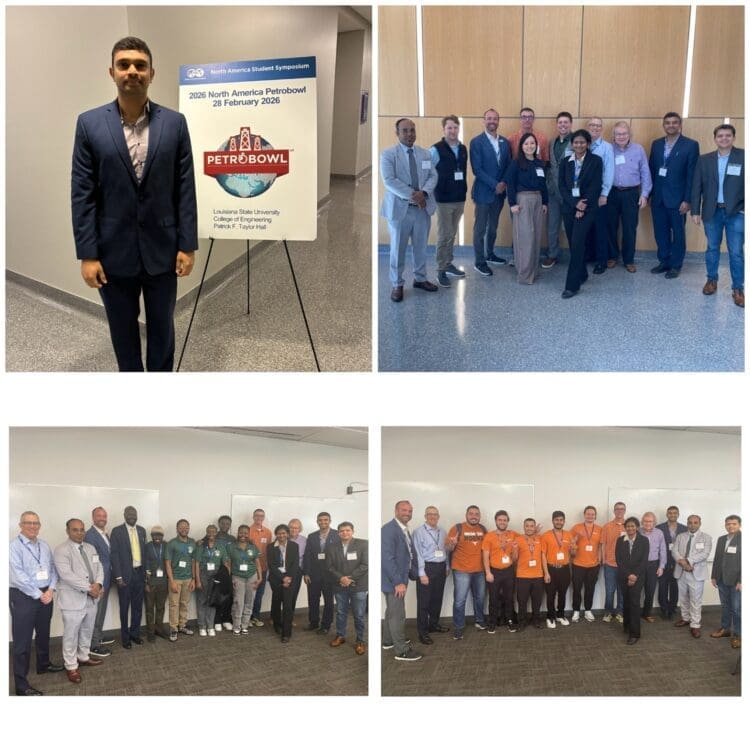

In February 2026, I had the opportunity to serve as a Judge at the North America PetroBowl Championship held at Louisiana State University in Baton Rouge, Louisiana. The competition took place on February 28, 2026, at the Patrick F. Taylor Hall, following the successful two-day SPE North America Student Symposium (NASS). Having served as a judge at the 2025 regional qualifier at the University of Southern California, returning for my second year was something I looked forward to.
This year’s championship brought together 19 teams from across the United States, Canada, and Mexico. The breadth of participation was impressive. Universities from all corners of North America sent their best and brightest to compete in this fast-paced technical quiz covering petroleum engineering fundamentals, industry history, trivia, and current events. One notable change for 2026 was the announcement that there would be no International PetroBowl Championship at the SPE ATCE going forward. Regional winners will still be recognized by SPE International, but the regional championships now carry even greater significance as the pinnacle of PetroBowl competition.
Pool Play: A Morning of Intense Competition
The 19 competing teams were divided into four pools. Pool A consisted of five teams: Universidad Autónoma de Nuevo León, Texas Tech University, Texas A&M International University, Instituto Politécnico Nacional (IPN), and Pennsylvania State University. Pool B included the University of Calgary, Southern Alberta Institute of Technology (SAIT), the University of Texas Permian Basin, Montana Tech, and the Universidad Nacional Autónoma de México (UNAM). Pool D featured Missouri University of Science & Technology, Louisiana State University, and the University of Texas at Austin.


I served as a judge in Pool C. Pool C featured five teams: Texas A&M University, Colorado School of Mines, Oklahoma State University, University of Houston, and University of Louisiana at Lafayette. It was a well-coordinated team, and the chemistry among the officials helped keep the matches running smoothly throughout the morning.
Pool play followed a round-robin format, with each team playing every other team in their pool. In Pool C, we conducted 10 games between 9:00 AM and 12:20 PM. The competition was fierce from the very first match. Texas A&M opened against the University of Houston and set the tone with a victory. Colorado School of Mines also started strong, defeating the University of Louisiana at Lafayette in Game 2. As the morning progressed, it became clear that Colorado School of Mines and Texas A&M were the front runners in our pool. CSM went undefeated with 4 wins, while Texas A&M finished with 3 wins, securing the top two spots and advancing to the bracket round.
What impressed me was the depth of knowledge demonstrated across all five teams. The students showed remarkable composure under pressure. Answering highly technical questions within five seconds of the moderator finishing the question is no small feat. There were several moments where a student would buzz in mid-question, get the answer right, and the entire room would react. That kind of quick thinking under pressure is what makes PetroBowl such a special event.
From the other pools, the results were equally compelling. In Pool A, Instituto Politécnico Nacional dominated with 4 wins and Texas Tech University advanced with 3 wins. Pool B saw SAIT and UNAM finish with 3 wins and advance to the bracket. In Pool D, Missouri University of Science & Technology and the University of Texas at Austin emerged as the top two teams. With the top two from each pool advancing, the quarterfinal bracket was set with eight teams.
The Bracket: Road to the Championship
The quarterfinal bracket matched the top seed from one pool against the second seed from another. The bracket format was single elimination, meaning every game carried enormous weight. One wrong answer, one penalty, and your tournament could be over.
From the quarterfinals, four teams emerged to the semifinals: University of Texas at Austin, Texas A&M University, Colorado School of Mines, and Missouri University of Science & Technology. These four teams had proven themselves through pool play and the bracket round, and the semifinal matches lived up to the billing. The energy in the rooms was palpable. Students stayed to watch, and you could hear reactions echoing down the hallway when a team scored a crucial answer.
The semifinals produced two matchups for the finals: Missouri University of Science & Technology versus the University of Texas at Austin in the championship final, and Colorado School of Mines against Texas A&M University in the third-place match.
The Finals: Missouri S&T Claims the Crown
In the third-place match, Colorado School of Mines edged out Texas A&M University to claim the third-place finish, with Texas A&M taking fourth. Both teams competed at an extremely high level.
The championship final between Missouri University of Science & Technology and the University of Texas at Austin was the kind of match that reminded everyone in the room why PetroBowl matters. Both teams came prepared, both teams were sharp, and the game went back and forth throughout. In the end, Missouri S&T edged ahead and claimed the 2026 North America PetroBowl Championship. UT Austin earned a well-deserved second place.
The final standings:
1st Place – Missouri University of Science & Technology
2nd Place – University of Texas at Austin
3rd Place – Colorado School of Mines
4th Place – Texas A&M University
Every round throughout the day was intensive. The students were competitive, challenging each other with remarkable technical depth and quick reflexes. But what stood out equally was sportsmanship. Win or lose, teams congratulated each other, posed for photos together, and shared the genuine camaraderie that defines this competition. It was true sportsmanship from the future energy professionals of our industry.
Looking Ahead
Congratulations to all 19 competing teams. Every team that took the stage should be proud of the preparation and dedication they showed. PetroBowl is more than a quiz competition – it builds teamwork, sharpens technical knowledge beyond what any classroom can offer, and connects students with industry professionals in a way that leaves a lasting impact. For many of these students, this was their first exposure to the broader SPE community, and I have no doubt it will not be their last. This was my second year judging PetroBowl, and it continues to be one of the most rewarding ways I give back to the SPE community that has given me so much. The brightness and composure of the next generation of energy professionals is reassuring.

Purushothkumar Santhana Mahalingam is an accomplished petroleum engineer with extensive expertise in hydraulic fracturing, well stimulation, and petroleum engineering management. He began his career in the oil and gas industry as a Field Engineer focused on hydraulic fracturing. Subsequently, he transitioned to Procurement Engineer, responsible for procuring essential materials such as proppants, acids, and well stimulation chemicals for fracturing operations and managing district inventory. His responsibilities also include vendor negotiations and writing technical proposals.
Mahalingam has been a member of the Society of Petroleum Engineers since 2011. He has actively participated in key industry conferences, serving as a technical reviewer for URTeC 2025, and is slated to serve as a session chair at the same conference. He was also a speaker for the SPE North American Student Symposium in February 2025 and a Judge in the 2025 North America Regional Petrobowl Competition.
He earned a Master’s in Natural Gas Engineering from Texas A&M University—Kingsville and a Bachelor's Degree in Petrochemical Technology from Anna University, Tiruchirappalli. To further enhance his credentials, he completed a Postgraduate program in Data Science and Business Analytics from the University of Texas at Austin. He gained proficiency in industry-relevant software such as FRACPRO, Meyers, Aspen HYSYS, and PROMAX.