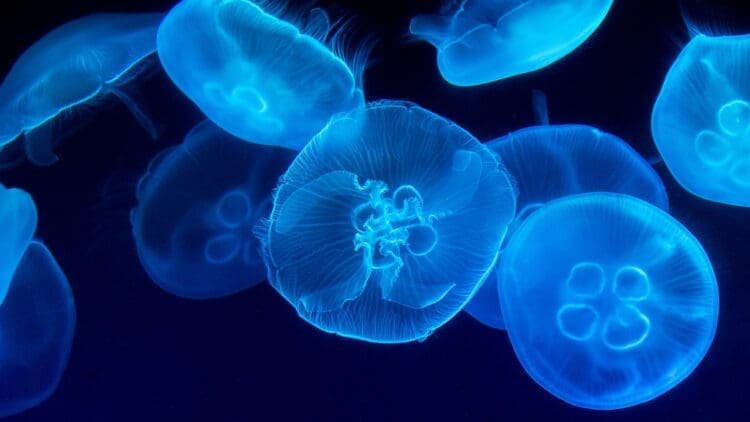
Solar panels don’t usually glow, move, or behave like living things. They sit still and silently turn sunlight into power. But a new type of solar cell is challenging that idea by acting more like a living organism than a piece of hardware. Inspired by glowing jellyfish, these unusual “living” solar cells react to light in a completely different way — and they could change how we think about solar energy.
Why traditional solar cells still have a problem
Solar energy has come a long way, but it isn’t as perfect as it may seem. Most solar panels today are made from silicon, a material that requires large amounts of energy and resources to produce. Manufacturing these panels is expensive, energy-intensive, and not as environmentally friendly as many people assume.
On top of that, silicon panels are rigid and limited in where they can be used. They work well on rooftops and in solar farms, but struggle when flexibility, small size, or biological integration is required. These gaps have pushed researchers to look for alternatives beyond traditional materials.



Swedish researchers develop “living” solar cells
When it comes to renewable energy technologies, there are still a few sustainable gaps that we must overcome, especially in solar energy technologies. Conventional solar cells, i.e., silicon, typically utilized in the majority of solar panels worldwide, are not as green as some may believe. According to a report by The Royal Society of Victoria, silicon solar cells utilize a substantial amount of energy during their production.
Not only are they energy-intensive, but they also present significantly steep upfront expenses. Furthermore, while significant breakthroughs in efficiencies have been achieved, a study published on Science Direct indicates that when it comes to light absorption and versatility, silicon cells are also limited. Fortunately, Swedish researchers have developed “living” solar cells that have the potential to bridge the gap.
A phenomenon deciphered years ago: Inspired by jellyfish
A research team led by Zackary Chiragwandi from the Chalmers University of Technology in Gothenburg, Sweden, has developed pioneering bio-inspired solar cells. These cells, inspired by the jellyfish Aequorea victoria, used a phenomenon that was deciphered years ago by researchers Dr. Osamu Shimomura, Yo Saiga, and Frank H. Johnson.
In 1962, their research mainly focused on a photoprotein in Aequorea victoria called aequorin (which emits blue light), but they accidentally discovered the “Green Fluorescent Protein” (GFP), which emits a bright green fluorescence when placed under ultraviolet (UV) light. It is the GFP that the Swedish researchers used for their bio-inspired solar cells.
These types of cells are not a new concept, as a Cornell University team engineered a bio-inspired HelioSkin that produces PV energy by wrapping around buildings. However, the cells with GFP are more versatile for small applications.
Small scale, but strong possibilities
These bio-inspired solar cells are not meant to replace large solar farms — at least not yet. Their real strength lies in small, flexible, and sensitive applications, such as medical devices, sensors, wearable electronics, or systems integrated into living organisms.
Compared to conventional solar cells, they offer:
-
simpler and cheaper production
-
lightweight and flexible design
-
Potential use at the nano scale
-
compatibility with biological systems
However, challenges remain. Stability over time and efficiency still need improvement before the technology can be widely used.
Why this could still matter for the future
While these jellyfish-inspired solar cells won’t power cities anytime soon, they could fill important gaps that silicon panels cannot. As researchers continue to blend biology with technology, energy systems may become more adaptive, responsive, and integrated into everyday life. Solar power may not always come from rigid panels on rooftops. In the future, it might glow softly, react like a living organism, and take inspiration from creatures that have been mastering light for millions of years.