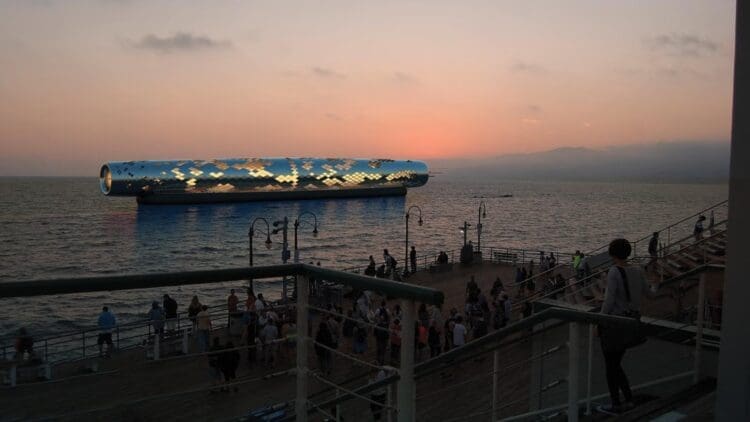

There is a fascination in terms of futuristic energy concepts, and one power plant that was not a real power plant was expected to produce 10,000 MWh of power. The Pipe is one such floating solar installation envisioned off the coast of Saint Monica. The Pipe was envisioned and proposed in 2016 by a Canadian engineering and design team for an international competition. The intention for the project was to generate electricity while producing billions of litres of water. Although the intention behind the project was noble and advantageous, the project never materialized.
Barriers standing in the way of a construction plan
Although the vision for the Pipe was outstanding, it never became a functioning power plant. The design was initially submitted to the international competition. The competition was a platform that encouraged creativity and innovation; however, there was never a need for competitors to produce fully engineered designs.
The design submitted was meant to change the thinking when it comes to water, energy, and public space. Included in this proposal was an estimated electrical capacity and an entirely new approach towards desalination. Although careful consideration went into the design submitted, the design that was submitted did not have to prove to be financially viable either.
Considering desalination technology in the bigger scheme of things
The desalination process focused on electromagnetic separation of ionized dissolved solids. While just a proposed idea of the floating desalination-and-solar installation, desalination depended on reverse osmosis or thermal processes that seem to be well understood due to years of research.
To transform this proposal related to desalination into a large floating infrastructure would entail validation, pilot trials, and approval. All these steps went beyond the scope of the project. It seems as if no municipal agency would give approval to a water system responsible for giving drinking water to the public.
Other challenges faced by the concept of floating infrastructure
Going ahead with this floating infrastructure will come with a variety of engineering difficulties. One of the main challenges is whether the floating infrastructure can meet maritime safety requirements, and whether this floating structure can be effectively structured against the waves. In terms of safety requirements, the design proposed public access to saltwater pools and recreational spaces, which further posed a complication to safety standards.
The cost requirements may also be burdensome. With costs, a full environmental assessment will be required since access to public-access saltwater pools would be complicated in terms of safety standards. While science fiction does often turn into reality, this power plant never did become a real power plant; however, it does offer us a glimpse into an innovation that could very well become a powerful power plant.
The powerful power plant that never became a real power plant
With an estimated 10,000 MWh of annual solar generation, The Pipe would not be able to compete with most solar farms, and it would cost far too much in terms of construction and maintenance. The positive aspect of this proposal was the production of an output of 4.5 billion liters of drinking water. The Pipe stands as a visionary symbol that serves the purpose of inspiring similar endeavors.
The Pipe would never be created, but the concept allowed us to reimagine the link between energy, water, and public space. The design lacked engineering maturity and the economic rationale that was required to turn this mere concept into a feasible energy project. The truth is innovations can surely captivate sustainable concepts and challenge the imagination to embrace a better sustainable energy and water future. With 10 liters daily and no pipes needed, inventions like the Kara Pure 2 are already addressing our needs for clean water.