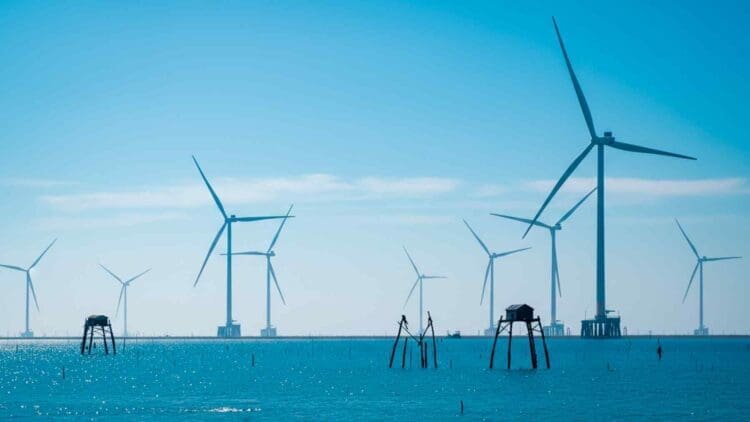
Japan has always been commended for its forward-thinking nature when it comes to technological innovation. As such, it is not surprising that it finds itself in the headlines for developing a project that not many countries would have been ambitious enough to attempt. The Asian nation received a massive helping hand, considering that technology has penetrated the energy industry more than ever before. The world can expect to witness a groundbreaking facility after Japan’s first commercial-scale floating wind project entered full operation at Goto.
Go to host Japan’s floating wind project: A general overview
Ironically, news of Japan’s latest project comes just as the United States is receiving widespread attention for how it is handling wind energy developments. Since the return of Donald Trump to the presidency, the U.S. has been suspending wind energy initiatives, deeming them a threat to national security. Meanwhile, other nations are seeing this as an opportunity to leapfrog the U.S when it comes to clean energy capacity, but wind energy specifically.
Japan’s upcoming development is situated off the coast of Goto City, Nagasaki Prefecture. It shall always be remembered for being the country’s first commercial floating offshore wind facility. In terms of installed capacity, the wind farm will possess 16.8 megawatts (MW). This is considered an average-sized wind farm in the energy industry compared to larger fixed-bottom offshore wind developments worldwide.


However, the intention for the Asian powerhouse was not to establish a massive facility, but rather to enter a brand-new realm. It could be the case that Japan was experimenting to see whether it would be successful before fully committing an abundance of resources to this particular lane of energy generation.
Unpacking the specific details of Japan’s first commercial-scale floating wind
When a project of such a magnitude materializes, the developers would have been working on it behind the scenes for several years. Thus, analyzing the facility requires great attention to detail. One of the unique features of the Goto Offshore Wind Farm is its use of hybrid spar-type floater technology, which mixes a steel upper section with a concrete lower structure designed to withstand the challenging conditions of deep offshore waters. The facilitators of the development were aware of the dangers that come with a small offshore wind project, and so they made an effort to ensure their investments did not go to waste.
The hybrid approach is one that has not been a constant feature since the beginning. Still, it is gaining traction in the contemporary era because it guarantees greater stability and durability, allowing wind turbines to be positioned in waters where traditional fixed foundations are not feasible.
What can the world expect of Goto’s newest offshore wind facility?
Goto is a firm that has a good reputation for the work that it has done in the past on large-scale initiatives. Thus, expectations are justifiably high. According to reports, the wind farm consists of eight turbines, each rated at 2.1 MW, producing a combined 16.8 MW of renewable electricity.
Unveiling the entities behind Japan’s first floating wind project
A single company on its own could not have been capable of developing such a massive operation. The project was developed by Goto Floating Wind Farm LLC, a consortium of six energy and engineering companies, including TODA Corporation, ENEOS Renewable Energy Corporation, Osaka Gas, INPEX Corporation, Kansai Electric Power Co., Inc., and Chubu Electric Power Co., Inc.
It is interesting to witness that while the U.S is going through court cases related to wind energy, other countries are simply not slowing down. Perhaps this might influence the judges’ decision-making as they hope to resume the nation’s dominance in the energy industry. Nonetheless, Asia has added another facility to its already commendable portfolio.