
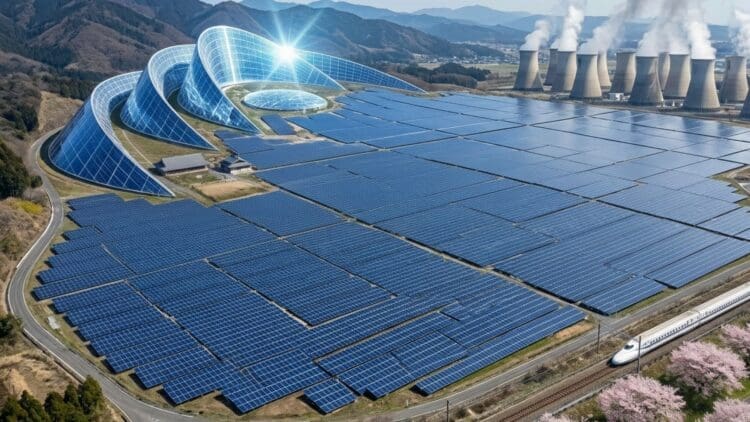

Japan, one of the most densely populated countries in the world, faces significant challenges when it comes to expanding its renewable capacity, particularly in its overcrowded urban regions with limited space. Fortunately, a pioneering mega-solar cell could be the turning point for the country, as the new technology equals 20 reactors, blowing past nuclear power. Discover what this new solar cell technology entails and how it can help Japan, in particular, to renew its focus on solar energy.
Japan’s solar cells blow past nuclear power
The reason why Japan is so densely populated, especially in urban regions, is because 70% of the country consist of uninhabitable mountain landscapes. This has proven to be challenging in light of expanding the country’s renewable capacity, as traditional renewable technologies, such as silicon-cell solar panels and wind turbines, require vast areas of land, which Japan lacks.
Japan has favored nuclear power to increase its energy security, and it has been one of the primary sources in reducing its reliance on fossil fuels and their costly imports. However, public safety concerns and radioactive waste risks highlight that nuclear power may not be the ideal source for achieving the country’s climate targets.


Fortunately, the Japanese government has come to realise that next-generation solar cell technology is the country’s future for renewable energy production. Find out more below.
Next-gen solar technology that equals 20 reactors
After the devastating 2011 nuclear disaster, Japan has been determined to focus on alternative sources for power production. The expansion of its solar capacity has been the ultimate answer, despite the challenges the country faces with traditional solar technology. Now, Japan is investing in next-gen solar technology that has an output equivalent to that of 20 nuclear reactors.
This new technology comprises perovskite solar cell technology. Japanese engineers have made a breakthrough with this solar cell technology, which could decrease the need for solar farms. Several other companies have been focused on the commercial development of perovskite technology, but according to Kyodo News, the technology will only be commercialized in the 2030s due to the tech’s challenges.
The benefits and the challenges of the new tech
This perovskite solar cell technology has been determined to be Japan’s solar capacity solution, as it offers benefits that meet the country’s specific solar needs. These benefits include:
- Affordability potential
- Experts predict that perovskite solar cells will be highly affordable by 2040
- Iodine supply chain potential
- Japan is the second-biggest iodine producer worldwide, which is a key material for perovskite production
- Potential to boost its economic security
- Adaptability and flexibility
- Easily integrated into a variety of surfaces, such as any rooftop, facades, and glass windows
- Removes the need for land use
- High efficiency
- Energy conversion rates are higher compared to traditional panels
- Lightweight
- Their flexibility increases their portability, which increases their application possibilities
Despite all these wonderful benefits, engineers and researchers still have their work cut out for them. Perovskite solar cells’ commercialization is being delayed as they pose the following challenges:
- Upfront and production costs are presently still high
- Long-term stability issues
- Decreased durability, especially when exposed to moisture and heat
- Environmental concerns
- Production involves potentially toxic materials such as lead
As Japan continues to research and develop its next-generation perovskite solar cell technology, we could witness a historical moment for the Japanese solar market soon. The technology has great potential to decarbonize carbon-heavy industries, whilst making solar energy more accessible for all, regardless of where they live. While it may be a few years before perovskite becomes commercialized as a sole solar cell, perovskite-silicon tandem cells have achieved 25% efficiency during their commercial launch, proving how close we are to making solar history.


