
A California solar farm was built beside endangered fox habitat, but instead of fleeing, the foxes moved in and began raising their young among the panels
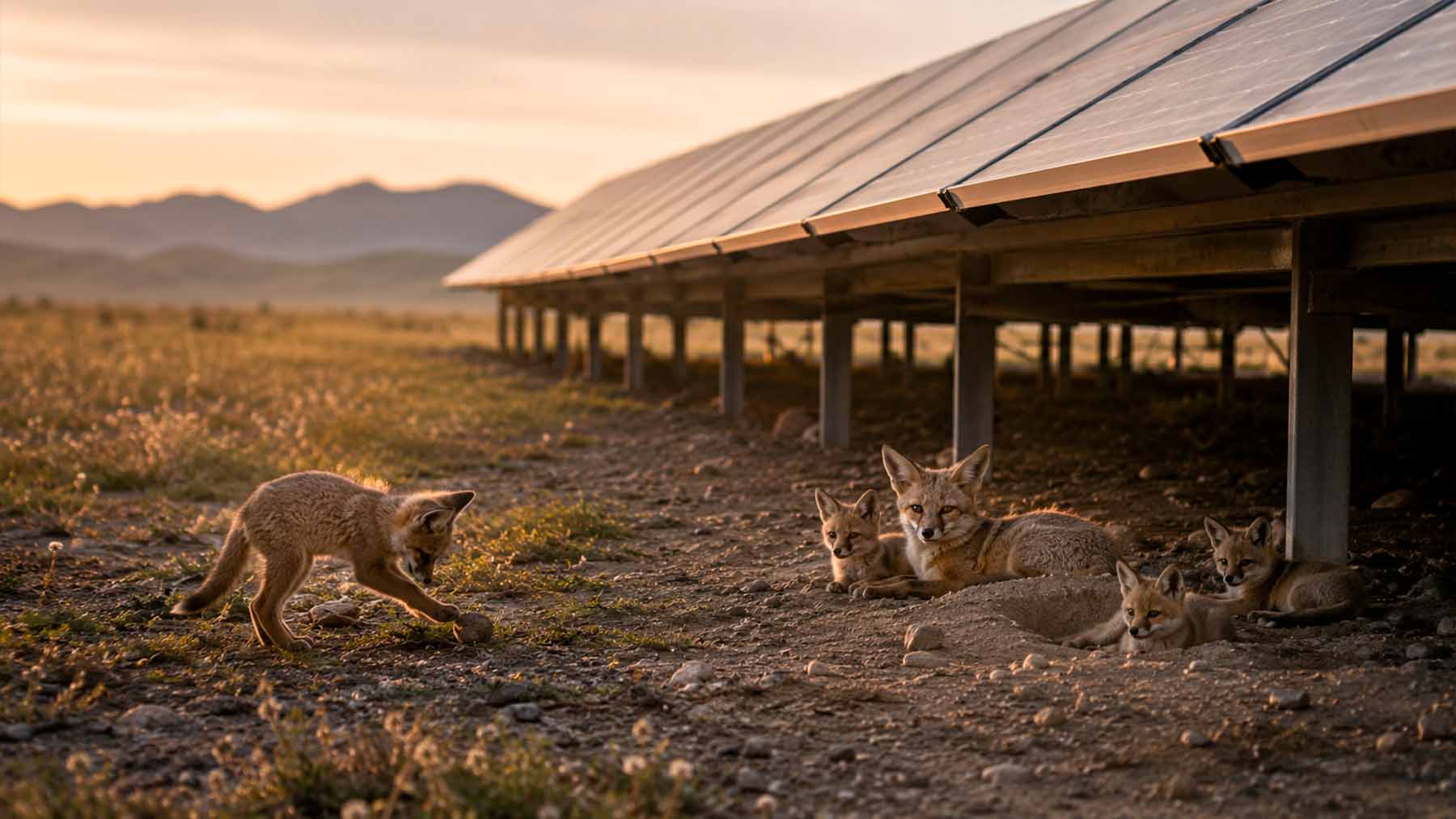 Image generated with artificial intelligence
A small fox emerged beside rows of solar panels on California’s Carrizo Plain, where industrial development had transformed a once-familiar landscape. Solar farms are often assumed to drive wildlife away, especially when fences and machinery occupy the habitat of endangered species.
Yet San Joaquin kit foxes continued to use land within and around the Topaz solar facility after construction ended. Researchers even documented females raising pups near the project.
Why did these endangered foxes remain in such a dramatically altered landscape instead of moving elsewhere?
As construction drew to a close, researchers began a three-year study comparing foxes that used the facility and surrounding land with those living farther away.
How researchers tracked fox families around Topaz
Topaz Solar Farms was completed in late 2014 in San Luis Obispo County, near the northern edge of the Carrizo Plain.
Covering more than five square miles, the project was built on land considered core habitat for the endangered San Joaquin kit fox.
As construction drew to a close, researchers began a three-year study comparing foxes that used the facility and surrounding land with those living farther away.
They monitored survival, reproduction, movement, den use, diet, and encounters with larger predators.
Topaz was not built as a single, uninterrupted expanse of panels. The arrays were divided into smaller sections, leaving open corridors and stewardship areas throughout the property.
The developer also modified sections of the perimeter fence to allow kit foxes to pass through designated openings.
At roughly five pounds, the foxes were small enough to slip through gaps that generally excluded much larger animals, including coyotes.
Researchers fitted adult foxes with radio collars, followed their movements across both study areas, and placed cameras near active dens.
The key question was whether the altered landscape could still support breeding foxes or merely provide a route for animals passing through.
The foxes did more than pass through
The animals were not simply entering the project during occasional nighttime searches.
Researchers evaluated reproduction among 19 radio-collared females. All but one produced pups that were later seen emerging from their dens, according to the California State University Stanislaus
Neither reproductive success nor average litter size differed significantly between the solar and reference areas.
Survival rates also showed no significant difference, although they were somewhat higher around Topaz.
That result was notable for a subspecies that remains federally endangered. Habitat loss, disease, vehicle collisions, and predation continue to threaten scattered kit fox populations across California.
Researchers examined the same ecological measures in both areas over three breeding seasons.
The solar study area, however, extended beyond the rows of panels. It included the facility and surrounding land within roughly one mile.
Most natal dens were found in untilled conservation land near the project rather than directly beneath or between the arrays.
The foxes were not turning solar infrastructure into a new home. Instead, they were moving among a network of protected and managed areas around the facility.
One feature in particular may have made that landscape safer than it appeared.
How the solar site may have offered protection
The foxes remained around Topaz not because they preferred solar machinery, but because the site functioned as a patchwork of accessible refuges.
Its perimeter fencing allowed the small foxes to pass through while generally restricting larger predators such as coyotes and bobcats.
That difference in body size changed how the animals could use the landscape. When threatened, kit foxes could enter fenced arrays or nearby stewardship areas that larger mammals had more difficulty reaching.
The panels may also have provided some overhead protection from golden eagles, the Bren School of Environmental Science & Management confirms.
Nearly all documented eagle predation occurred at the reference site. The only case recorded in the solar study area happened well outside the panel arrays.
Restricting larger predators may also have reduced competition for prey within the fenced areas.
Other conservation measures made the surrounding land more usable. These included managed vegetation, movement corridors, artificial escape dens, and limits on activities that could disturb the foxes.
Together, those features created a network of places where the animals could travel, forage, shelter, and raise their young.
What the study does—and does not—show
The findings do not mean that solar development automatically benefits endangered wildlife.
Topaz incorporated conservation measures before, during, and after construction. Researchers cautioned that the outcome could have been very different without them.
The facility was also built on land that had previously been disturbed by tilling and dry farming. Constructing a similar project on higher-quality habitat could cause much greater harm.
Food remained available around Topaz, although some prey species were more abundant at the undeveloped reference site.
The project also depended on surrounding conservation land. The fenced arrays alone were not enough to support the fox population.
The study therefore supports a narrower conclusion: solar farms and kit foxes can coexist when projects preserve movement corridors, vegetation, denning opportunities, and places where animals can escape predators.
The pups born near Topaz were not proof that solar panels had restored a lost wilderness. They showed that careful planning could soften some of development’s hardest edges.
Seen in that light, the young foxes change what the industrial horizon represents.
Their families did not remain because steel and glass could replace natural habitat. They remained because permeable fencing, protected land, managed vegetation, and open corridors preserved the choices they needed to survive.
That distinction will become increasingly important as the United States builds more renewable-energy projects across open landscapes.
Leaving patches of unused ground is not enough to create wildlife habitat. Animals also need safe ways to move through, around, and sometimes briefly inside a project’s boundaries.

Daniel García is an Editor-in-Chief with strong expertise in structural work and engineering principles. He combines this technical foundation with deep knowledge of energy, spatial design, and emerging technologies, bringing a forward-thinking and analytical approach to editorial leadership.
