
In Colorado’s Lake Powell, the water keeps dropping and 40 million people are one bad winter away from losing the lights
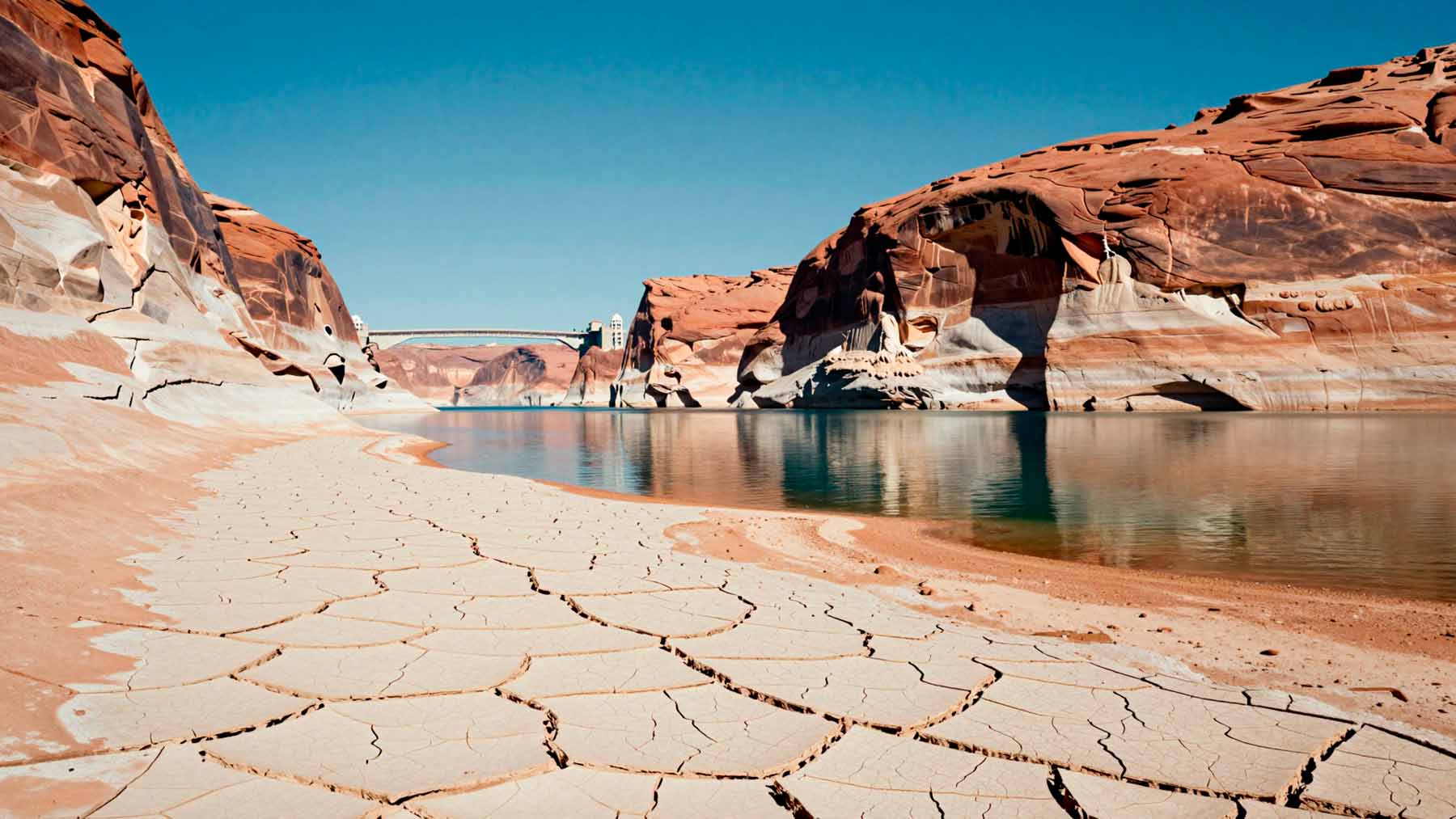 Image generated with artificial intelligence
Standing at the rim of Lake Powell, there’s nothing to signal the danger. No gauge on the canyon wall, no alarm, no visible sign that one of the most critical machines in America is under stress. There’s only a number that engineers track obsessively: 3,490 feet above sea level.
That invisible threshold — called “minimum power pool” — is the line between a dam system that works and one that doesn’t. After two decades of megadrought, and following a punishingly weak 2026 snowpack, Lake Powell sits just dozens of feet above it. Below that line, Glen Canyon Dam can no longer generate electricity for the roughly 40 million people who depend on the Colorado River system.
A river engineered beyond its limits
Long before it became a plumbing system for civilization, the Colorado River was wild. It started in the Rockies, cut through the Colorado Plateau, carved the Grand Canyon, and emptied into the Gulf of California. That changed on October 9, 1936, when generators inside the newly completed Hoover Dam began converting the river’s force into electricity. The 726-foot curved concrete structure became an icon almost overnight.
The Bureau of Reclamation is reportedly maintaining a buffer closer to 3,500 feet, treating the threshold as a zone of increasing danger rather than a hard switch.
Hoover was only the beginning. Engineers added 14 more dams over the following decades, turning the Colorado into a managed network serving roughly 40 million people across seven states. As Douglas Kenney, director of the Western Water Policy Program at the University of Colorado, puts it: “Hydropower revenues are what paid for all of these dams.” The electricity those dams promised made the projects sellable to Congress — even when water storage was the deeper goal. The whole system was designed for a river that no longer exists.
How the dams actually work — and where they differ
On paper, Hoover Dam and Glen Canyon Dam operate the same way. Water stored behind each dam drops through large tubes called penstocks, spins turbines, drives generators, and flows downstream to farms and cities.
Glen Canyon Dam has three ways water can leave Lake Powell. The penstocks are the only route that generates power. The spillways were designed for flood conditions and used exactly once, in 1983. A set of four lower river outlets, rated at up to 15,000 cubic feet per second, handles everything else. Each exit is tied to a specific elevation: at 3,700 feet, Lake Powell is at full pool; at 3,490 feet, it enters minimum power pool and electricity generation stops; below 3,370 feet is “dead pool,” where water can no longer exit by gravity alone.
The danger of cavitation — a threat that has never been tested
As Lake Powell’s surface drops toward the penstocks, a specific mechanical risk emerges: cavitation. When turbines start pulling in air along with water, bubbles form in the flow — and when those bubbles collapse, they release shock waves capable of pitting metal and eroding concrete from the inside.
“It’s the incorporation of water bubbles in the water column,” says Jack Schmidt, director of the Center for Colorado River Studies at Utah State University. “When those water bubbles collapse, they send off shock waves, and those shock waves can destroy concrete and metal. This is a situation that has been calculated, but it’s never been tested because we’ve never been this low.”
As of June 2026, Lake Powell sits at approximately 3,528 feet — only dozens of feet above minimum power pool. The Bureau of Reclamation is reportedly maintaining a buffer closer to 3,500 feet, treating the threshold as a zone of increasing danger rather than a hard switch.
Emergency triage and the politics of a shrinking river
The federal government is already improvising. In April 2026, the Bureau of Reclamation announced it would release between 660,000 and 1 million acre-feet from Flaming Gorge Reservoir while withholding roughly 1.48 million acre-feet that would otherwise flow from Lake Powell to Lake Mead — borrowing from one part of the system to stabilize another.
Hoover Dam’s hydropower output is expected to drop by 40 percent of its maximum capacity in 2026. Lincoln County Power District in Nevada, which once relied on Hoover Dam for all of its electricity, is now heavily investing in solar. Layered on top: the 1922 Colorado River Compact divided water based on flow estimates now proven too optimistic, and temporary shortage guidelines from 2007 are expiring with no replacement agreed upon.
Smaller fixes, harder choices
The Bureau of Reclamation is studying major modifications to Glen Canyon Dam — new tunnels, rerouted outlets, or a bypass tunnel around the dam entirely. Cost estimates range from $500 million to $3 billion. Phoenix is expanding water reclamation at its Cave Creek Plant, expected to produce 7 million gallons of purified drinking water daily by 2027. Farmers are testing low-flow irrigation nozzles and shifting toward less water-intensive crops.
Most experts point to the same conclusion: the most realistic long-term answer is demand reduction. Use less, waste less, stop planning growth around a river that’s been over-allocated for a century. The dams bought the Southwest time. Whether the region uses that time wisely depends on choices that are as political and cultural as they are technical.
What comes next
The immediate question is the 2026–2027 winter snowpack. A strong season gives Lake Powell breathing room. A weak one — like this past year — pushes the system closer to thresholds engineers have spent decades trying to avoid.
Schmidt put it plainly: “It’s not that the system is going to collapse this year. But it’s very low and it’s in a perilous state. If next winter is also dry, then we’re in a five-alarm fire drill.”
Watch for whether the seven Colorado River Basin states reach a new operating agreement before the 2007 guidelines fully expire, and whether Congress funds dam modifications. The elevation number at Lake Powell won’t appear on any canyon wall. But for 40 million people, it may be the most important figure in the American West.

Carlos is an engineer with strong expertise in technical and industrial topics. He previously worked at international companies such as Siemens and is multilingual.
