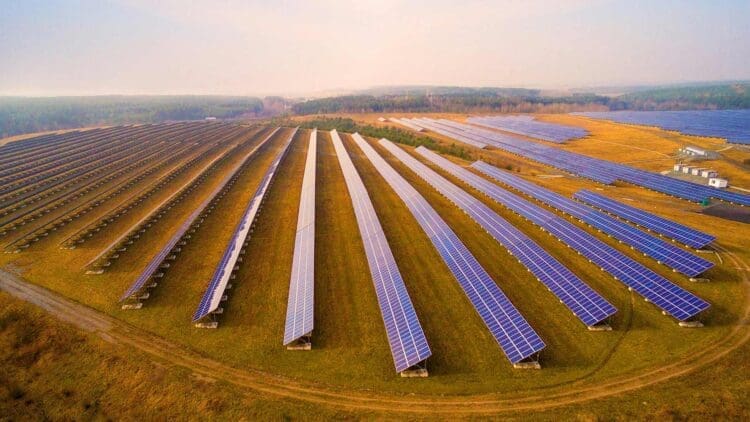

Outside of Europe’s borders, there is an incredible facility transforming Europe’s renewable energy environment, but most people don’t even know of its existence. This place, just outside of the European continent, is Europe’s largest single solar installation, the Karapınar Solar Power Plant / Karapınar Solar PV Park. Located in the Central Anatolian Desert, in Karapınar, Turkey, this facility has 3.5 million solar panels, has an installed capacity of 1,350 MWp, generates about 3 billion kWh, and has been a staple in the production and delivery of sustainable energy to the region for some time now.
Karapınar: What was once desert land is now home for solar power generation
Located in what used to be desert land, Karapınar stretches over almost 20 square kilometers, about 2600 football fields. Operating at 100% capacity, it is a good driver in the production and delivery of sustainable energy and has, as of March 2023, been delivering dynamic solar power to the community.
The facility in a nutshell
This facility is designed to incorporate 3,256,038 solar panels (rounded up to 3.5m). Out of that 3.5m, approximately 80% were manufactured by Kalyon PV right in Ankara. This staggering amount of solar panels is what contributes to the 1,350 MWp capacity, placing the facility as one of the largest in the world and, without a doubt, the largest in Turkey. Using advanced single-axis trackers boosts efficiency by 15 percent more than fixed track systems. Kalyon Enerji’s Karapınar plant generates around 3 billion kWh annually and fulfills the electricity demand of over 2 million people, the equivalent of a big city in Europe. It also eliminates around 1.5 to 1.7 million tons of CO₂ annually.

Can Karapınar lower Türkiye’s annual carbon footprint?
Kalyon Enerji states that the plant will lower Türkiye’s annual carbon footprint by 3 million metric tons and will also save the country approximately $450 million in imported energy, thereby reducing the annual carbon footprint.
The Karapınar site also showcases a remarkable Central Control Building, a combination of art and functionality by Bilgin Architects. Control operations on the 40-hectare site are facilitated through the stainless-steel masterpiece, which reflects the desert and complements the environment, ultimately reducing the energy demands on the building.
Today, the site is a landmark for Turkish and European energy ambitions
With 80% of its solar panels produced within the country, Karapınar shows Turkey’s commitment toward a homegrown clean-energy industry. As Europe designates this facility as one of the largest in its class, the site provides a rich framework for transnational partnerships for clean energy and energy autonomy.
Turkey leads a bidding war for renewables developers
Turkey has been auctioning contracts to renewables developers in line with its ‘dirt cheap’ renewables policy, and that has been enthusiastically embraced by bidders winning contracts at a low cost (6.99 US cents/kWh) in the 2017 auctions.
Karapınar illustrates this:
-
Magnitude of the plant. 3 million solar panels. Solar at a regional planetary scale deployment.
-
Local collaboration. The local content policy (LCP) provided domestic economic stimulus and supported local sustainability measures.
-
Yielding innovation. The architectural design and the integration of tracker technology enhanced yield and durability.
-
Boundary borders. The plant has a positive impact on advancing the energy transition in Europe while also being physically located in Turkey.
A desert solar farm, viz. Karapınar Solar Power Plant. Karapınar has been outstanding in providing a solution to the integration of environmental and industrial in a domestic development. The Karapınar Solar Power Plant is an example of large-scale renewable deployment.
Karapınar demonstrates the potential of both eastern and western Europe to go green and of living with renewable solar technology. The positive impact and the Karapınar ambition will be the gateway to millions. The green power will also advance a major geopolitical shift where the European energy future will be located just beyond its borders.