
America’s busiest port watched nearly 10 million containers pass through in a single year and decided the ships carrying the next wave may need nuclear power
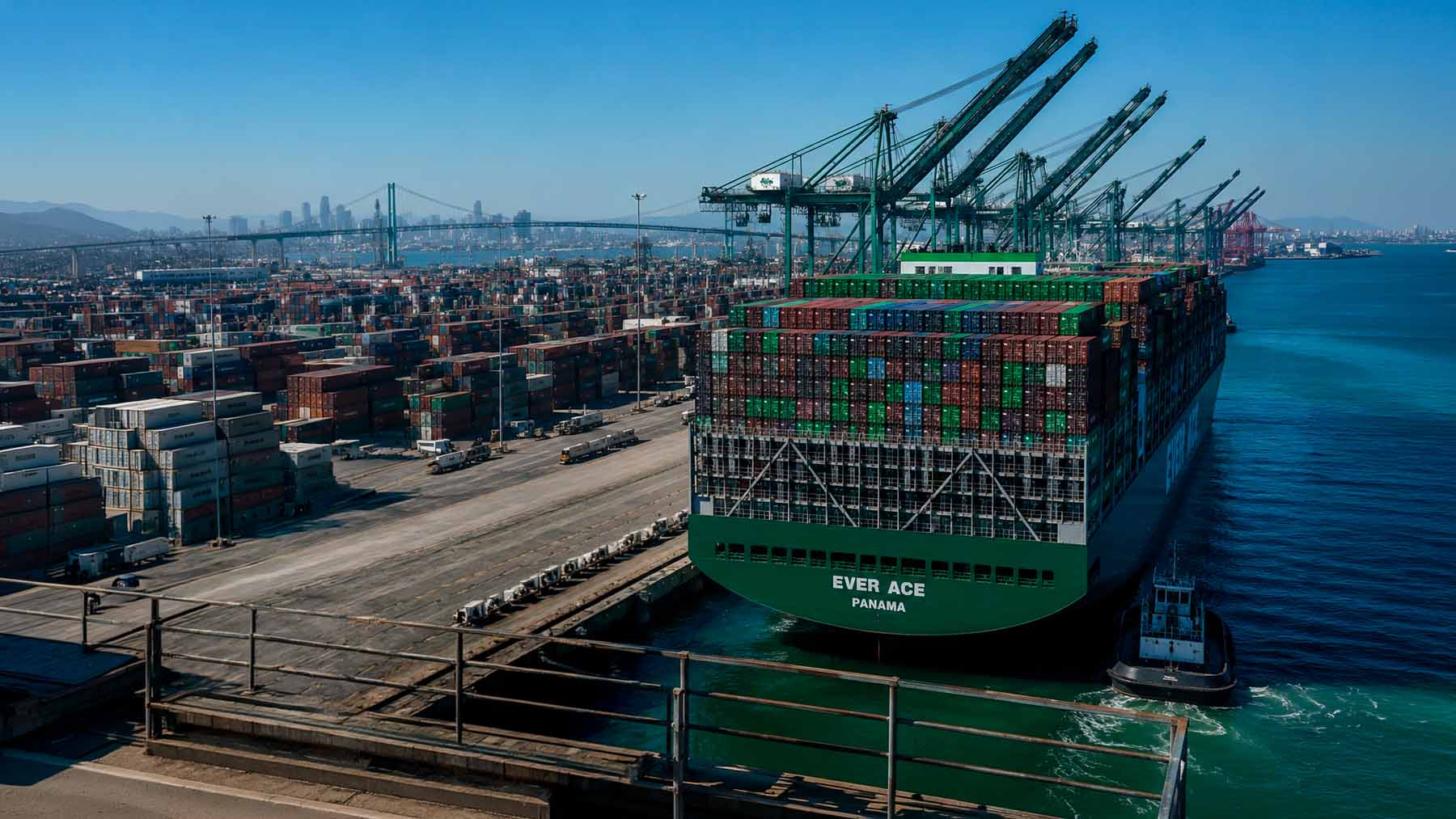 AI-made
At a signing ceremony in Washington, D.C., the Port of Long Beach did something no American port had done before — it formally committed to nuclear energy. Not a feasibility study buried in a committee report, but a binding Memorandum of Cooperation with the Maritime Administration to develop and test small modular reactor technology for commercial ships and port infrastructure.
The ambitions behind the agreement extend well beyond the paperwork. Long Beach — which handled a record 9.9 million TEU in 2025 — is targeting double that volume by 2050, and it needs the power infrastructure to match.
A first-of-its-kind agreement in U.S. maritime history
Maritime Administrator Stephen Carmel didn’t mince words at the signing ceremony. The agreement, he said, brings SMR technology into “active testing” — language that signals a clear step beyond theoretical planning.
This isn’t a working group producing a white paper — it’s a structured partnership with defined objectives and real federal stakeholders attached to it.
That distinction matters. The Memorandum of Cooperation between the Port of Long Beach and MARAD is specifically designed to support nuclear-powered vessels entering commercial service at U.S. ports. No framework for that has ever existed before. This isn’t a working group producing a white paper — it’s a structured partnership with defined objectives and real federal stakeholders attached to it.
Long Beach Board of Harbor Commissioners President Frank Colonna framed it in practical terms. “This Memorandum of Cooperation with MARAD positions the Port of Long Beach to help develop energy sources for the goods movement industry,” he said, “while maintaining our role as the premier gateway for trans-Pacific trade.” He also pointed to the port’s track record of testing and demonstrating new technologies, suggesting this agreement fits a pattern rather than just a headline.
Why Long Beach, and why now
The scale of Long Beach’s operation makes the choice of partner logical. The port processed nearly 9.9 million TEU in 2025 — a record — and has already handled more than 4.8 million TEU in the first half of 2026 alone. Growth isn’t a projection. It’s already happening.
The port’s stated goal is to double its container volume by 2050, and that kind of expansion demands a proportional increase in reliable electricity infrastructure. Battery-dependent systems and grid-dependent shore power alone may not be sufficient at that scale. SMR technology is one answer the port is now formally exploring.
There’s also an industrial credibility argument. Long Beach is already home to BlueCore Energy, a company that leases port property to assemble, test, and store maritime power modules. That’s not a pilot program announced in a press release — it’s an active operation on port land, and it gives Long Beach tangible standing as a testing environment for next-generation maritime energy technology.
What the partnership will actually do
The agreement pulls in a wide set of federal partners. MARAD and the Port of Long Beach will collaborate with the U.S. Coast Guard, the Department of Energy, and the Nuclear Regulatory Commission to define the operational protocols, safety standards, and inspection processes needed to support SMR-powered vessels arriving at and being serviced at U.S. ports.
That last point deserves attention. Before a nuclear-powered commercial ship can dock at a U.S. port, someone has to figure out exactly what that looks like — how inspections work, what safety thresholds apply, who has jurisdiction over what. None of those frameworks currently exist in a commercial context. This partnership is designed to build them.
The agreement also connects to earlier groundwork. In May 2026, MARAD issued a request for information seeking industry input on developing a U.S.-built, scalable, commercially viable SMR for the marine transportation system. The Long Beach partnership is a direct follow-on — moving from information gathering into structured collaboration. One of its explicit outputs is the development of shared best practices that other U.S. ports could eventually adopt. Long Beach isn’t just solving its own problem; it’s building a template.
SMRs and the broader push to rethink how ships are powered
Shipping is one of the hardest sectors to decarbonize. Batteries offer limited range at commercial scale, and hydrogen faces infrastructure and storage challenges that remain unresolved for deep-sea routes. Nuclear, in the form of small modular reactors, is increasingly viewed as one of the few technologies capable of delivering zero-emission propulsion at the scale and range that global trade actually requires.
The momentum isn’t limited to Long Beach. ABS recently granted preliminary design approval for a 15,000 TEU nuclear-powered containership concept developed with Samsung Heavy Industries in South Korea — a significant signal. A major classification society formally validating a nuclear containership design isn’t a routine event.
Multiple other research programs worldwide are now exploring next-generation nuclear propulsion for commercial vessels. The Long Beach agreement sits inside that broader current. It’s a U.S.-specific milestone, but it reflects a global shift in how seriously the maritime industry is beginning to treat nuclear as a practical option.
What comes next
The work ahead is substantial. Protocols need to be written, safety standards need to be tested against real operational scenarios, and regulatory frameworks need to catch up to technology that’s moving faster than the rules governing it.
Watch for how quickly the Coast Guard, DOE, and NRC align on inspection and safety standards — that coordination will likely determine the pace of everything else. Whether other major U.S. ports seek similar agreements with MARAD is the other question worth tracking closely.
The Port of Long Beach signed the first agreement of its kind. Whether it remains the only one for long is what comes next.
Disclaimer: Our coverage of events affecting companies or institutions is purely informative and descriptive. Under no circumstances does it seek to promote an opinion or create a trend, nor can it be taken as investment advice or a recommendation of any kind.

Carlos is an engineer with strong expertise in technical and industrial topics. He previously worked at international companies such as Siemens and is multilingual.
