
Scientists taught a computer to “feel” a wind turbine’s stress and strain before a single blade is ever built
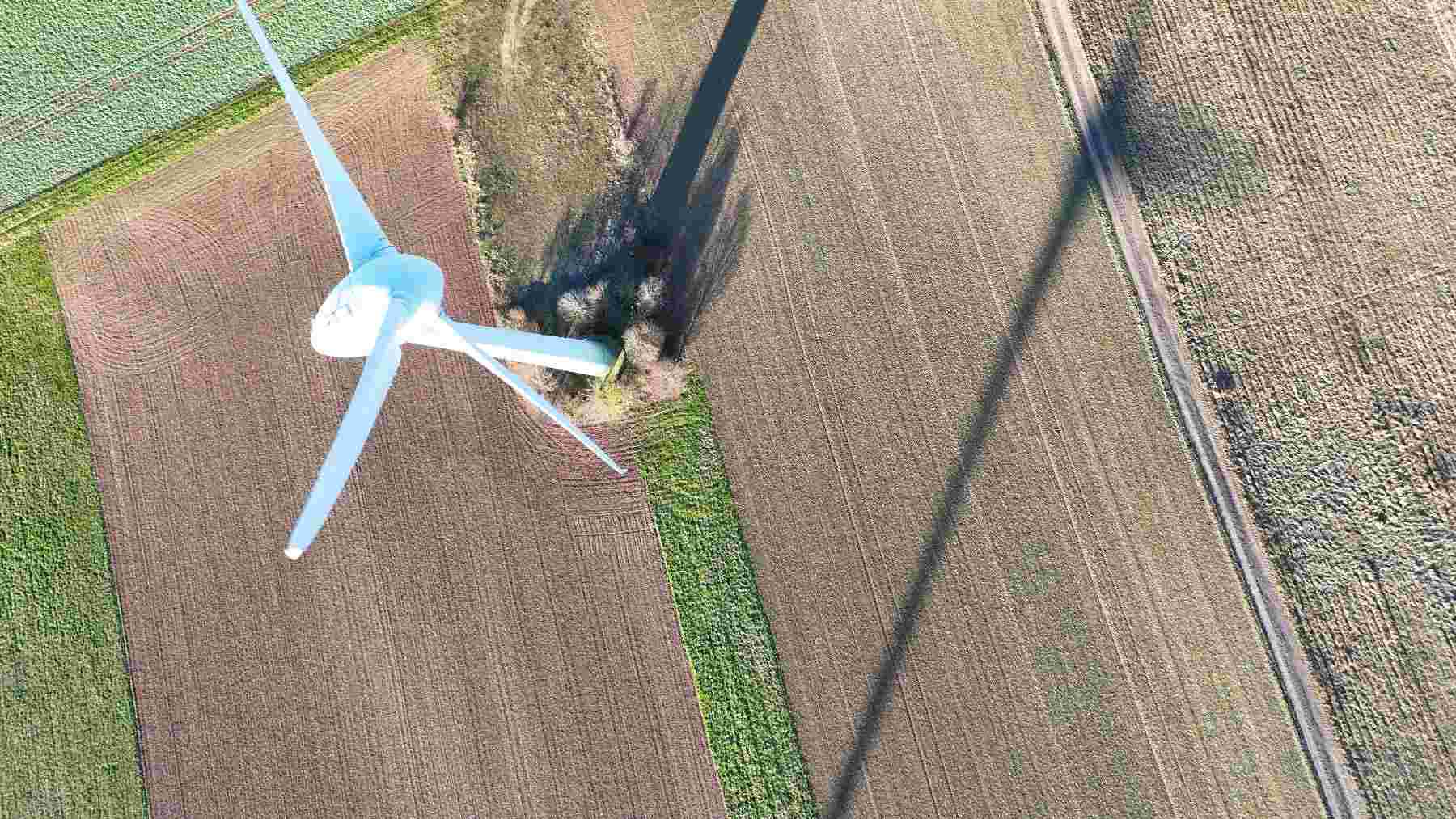
A modern wind turbine is a machine under constant negotiation with the atmosphere. Its blades flex and twist through thousands of load cycles every hour, its controller adjusts pitch and torque in real time, and the forces rippling through its tower and drivetrain shift with every gust. Capturing all of that in a physics-based simulation is possible — but expensive, slow, and ill-suited to the rapid design exploration that the wind industry increasingly demands.
A new machine-learning framework may be starting to change that calculus.
The simulation bottleneck holding wind energy back
Aeroelastic simulations are the backbone of modern turbine engineering. They model how a rotor blade bends, twists, and vibrates under real wind loads — information that’s essential for structural certification, fatigue analysis, and control system design. Without them, engineers can’t know whether a turbine will survive 20 years of continuous operation.
Relevant inputs here include wind speed, turbulence intensity, pitch angle, and other operational parameters that define the turbine’s environment and state.
Speed is the problem. Each high-fidelity simulation run in tools like HAWC2 carries a significant computational cost, and design optimization doesn’t require one run — it requires thousands, sweeping across wind speeds, turbulence levels, and operating conditions to map out the full performance landscape. That kind of exhaustive search quickly becomes impractical.
The result is a familiar engineering tension: tools that capture physical reality most faithfully are too slow for rapid iteration, while faster methods sacrifice accuracy. The wind industry needs something in between — a lighter tool that still respects the physics.
Enter the surrogate: teaching machines to mimic a turbine
That’s where surrogate models come in. A surrogate is a machine-learning approximation trained on simulation data. Once trained, it can predict outputs — blade loads, tower moments, power curves — in milliseconds rather than minutes, without replacing the physics-based simulator it learned to imitate.
The new framework centers on the IEA 3.4 MW reference turbine, a community-standard design used widely in wind energy research precisely because it gives different teams a shared, well-documented baseline for comparison. To build the training dataset, the researchers ran aeroelastic simulations across multiple wind conditions and operational modes using HAWC2.
That dataset then became the foundation for training three distinct machine-learning approaches: Artificial Neural Networks, Gaussian Process Regression, and Random Forests. Each brings different mathematical assumptions and computational trade-offs to the problem.
Engineering the features: what the models actually learn
A surrogate model is only as good as the inputs it’s given. Feature engineering — selecting and transforming input variables — determines what the model actually “sees” when making a prediction. Relevant inputs here include wind speed, turbulence intensity, pitch angle, and other operational parameters that define the turbine’s environment and state.
The researchers didn’t settle on a single feature strategy. Multiple approaches were tested, paired with different data scaling methods, to evaluate how robust each combination was across different response variables. Some outputs, like power production, are relatively smooth functions of wind speed.
Others — fatigue loads at specific structural joints, for instance — are noisier and considerably harder to predict reliably. The goal was never to declare one model the winner; the framework was designed to document a fair, reproducible comparison that others can follow, challenge, or extend.
Openness as a design principle
One of the framework’s most deliberate features is its commitment to openness. Both the simulation dataset and the full surrogate-modeling workflow are being made publicly available — a meaningful step in a field where reproducing another team’s results has historically been difficult.
Reproducibility matters in scientific machine learning for a specific reason: without a shared baseline, it’s nearly impossible to know whether a new method is genuinely better or just tuned to a particular dataset. Publishing the benchmark gives the community a fixed reference point. It also connects to a broader push for open science in wind energy research — a recognition that shared infrastructure accelerates progress far faster than parallel, siloed efforts ever could.
What this means for future turbine design
The practical payoff of surrogate models lies in optimization loops. Instead of running thousands of expensive HAWC2 simulations to screen design configurations, engineers could query a trained surrogate in real time — rapidly evaluating structural safety across a wide design space before committing to detailed analysis.
The applications reach well beyond blade geometry. Surrogate models could support offshore turbine siting, where environmental conditions vary significantly by location, and assist with controller tuning and fatigue lifetime estimation — tasks that currently demand repeated simulation runs.
As the researchers suggest, the next frontier is scaling these frameworks to larger turbines and harsher environments. The wind industry is pushing toward bigger rotors and more demanding sites, and the need for fast, reliable load prediction will only intensify. Frameworks like this one are laying the groundwork for that future — one benchmark at a time.
Reference: Tsaklis, I., Pettas, V., Guilloré, A., Conti Gost, N., et al. A data-driven model framework for predicting operational and load responses of the IEA 3.4 MW wind turbine, Wind Energ. Sci. Discuss. [preprint], https://doi.org/10.5194/wes-2026-158, in review, 2026.

Daniel García is an Editor-in-Chief with strong expertise in structural work and engineering principles. He combines this technical foundation with deep knowledge of energy, spatial design, and emerging technologies, bringing a forward-thinking and analytical approach to editorial leadership.
