
New Mexico’s wind farms were set to disrupt millions of birds until conservationists stepped in, rerouted river crossings, and added wire diverters along the most dangerous flight paths
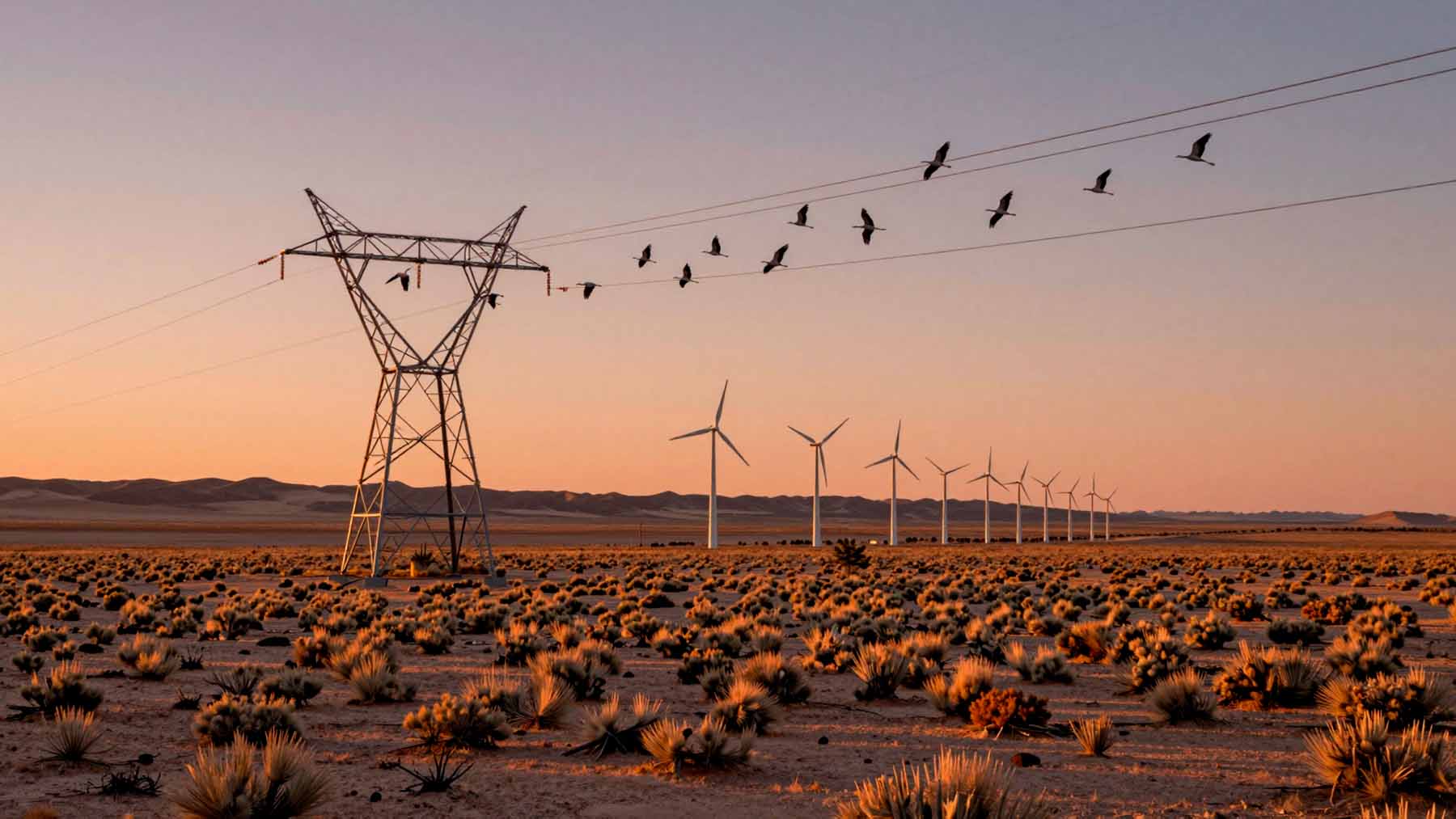 Image generated with artificial intelligence
New Mexico’s wind farms threatened millions of birds — until conservationists rerouted river crossings and added wire diverters
The largest renewable energy infrastructure project in U.S. history is now complete. SunZia’s 550-mile transmission line is carrying electricity generated by 914 wind turbines from New Mexico across the Western grid — a milestone in the push to decarbonize the country’s energy supply.
But scale brings consequences. Transmission lines crossing hundreds of miles of open landscape don’t just move electrons — they cut through the flyways and habitats that birds have used for centuries. Getting this project right meant confronting that tension before construction ever began.
Poorly planned infrastructure can fragment habitat, disrupt migration corridors, and create collision hazards along flyways birds have relied on for generations.
A grid built for clean energy — and a problem no one could ignore
The U.S. has a clear imperative: expand its transmission grid dramatically to deliver renewable energy and keep climate goals within reach. That’s not a controversial position — it’s the conclusion of Audubon‘s 2023 Birds and Transmission Report, which states plainly that there’s no path to stabilizing the climate without modernizing how electricity moves across the country.
Transmission lines carry real costs for wildlife. Poorly planned infrastructure can fragment habitat, disrupt migration corridors, and create collision hazards along flyways birds have relied on for generations. These aren’t hypothetical risks — they’re documented consequences of building at scale without adequate planning.
SunZia’s 550-mile line was essential to unlocking New Mexico’s wind resources, which peak in the late afternoon and evening — exactly when grid demand tends to run highest. That alignment made the project strategically valuable, and it made getting the environmental planning right non-negotiable.
Years of collaboration before a single turbine turned
Audubon began working with Pattern Energy and project partners in 2018, years before construction started. That timeline matters. Early engagement meant conservation science could shape design decisions, not just critique a finished plan.
The collaboration spanned multiple planning stages, and at each one Audubon shared recommendations grounded in the best available science on bird behavior, flight patterns, and habitat sensitivity. Those recommendations weren’t advisory documents filed and forgotten — they fed directly into how the project was designed. This is the model that conservation organizations and energy developers are increasingly being asked to follow: not adversarial, not transactional, but genuinely integrated. SunZia didn’t happen by accident. It happened because the right conversations started early enough to matter.
Concrete changes that made the project safer for birds
The collaboration produced structural changes — not cosmetic ones.
Pattern Energy committed to installing bird flight diverters on the highest-risk portions of the transmission line. These devices make wires more visible to flying birds, reducing collision risk along stretches where it would otherwise be greatest. Transmission line crossings along the Rio Grande River were also relocated — a decision that directly reduces hazards for Sandhill Cranes and other migratory species that follow the river corridor on their seasonal journeys. That kind of adjustment is only possible when developers and conservationists are talking before routes are locked in.
Where feasible, portions of the line were co-located alongside existing rights-of-way. Concentrating infrastructure in already-disturbed areas minimizes habitat fragmentation rather than cutting new paths through intact landscape.
Conservation commitments that went beyond what regulators required
Regulatory compliance sets a floor, not a ceiling. SunZia cleared that floor — and kept going.
The project includes conservation offsets and protections that exceeded what permitting agencies required. That distinction matters. Meeting legal minimums is expected; voluntarily going further signals something about how a developer understands its role in the landscape it’s operating within.
Those additional commitments also establish a reference point for future projects and the agencies reviewing them — a documented example of what “above and beyond” actually looks like in practice. Audubon recognized this explicitly, featuring SunZia as a case study in its 2023 Birds and Transmission Report precisely because the project demonstrates what’s achievable when the bar is set higher.
What SunZia signals for the future of grid expansion
SunZia is complete, but the broader work it represents is just beginning.
The Western Governors’ Association is now leading a multi-state effort to modernize and expand transmission infrastructure across the Intermountain West. That effort will involve dozens of decisions about routing, siting, and design — decisions that will either protect or degrade bird habitats depending on how they’re made. SunZia offers a replicable model: bring conservation organizations in early, integrate science into planning from the start, and treat environmental responsibility as a design principle rather than a compliance checkbox.
Whether this approach becomes standard practice or remains an exception worth celebrating is the central question going forward. Birds, communities, and ecosystems across the West will be living with the answer for decades. How developers, conservationists, and regulators respond — starting now — will determine what the clean energy grid actually costs the natural world.

Carlos is an engineer with strong expertise in technical and industrial topics. He previously worked at international companies such as Siemens and is multilingual.
