
North Sea wind turbines are “stealing the wind” from each other and no one can agree on how far the theft reaches
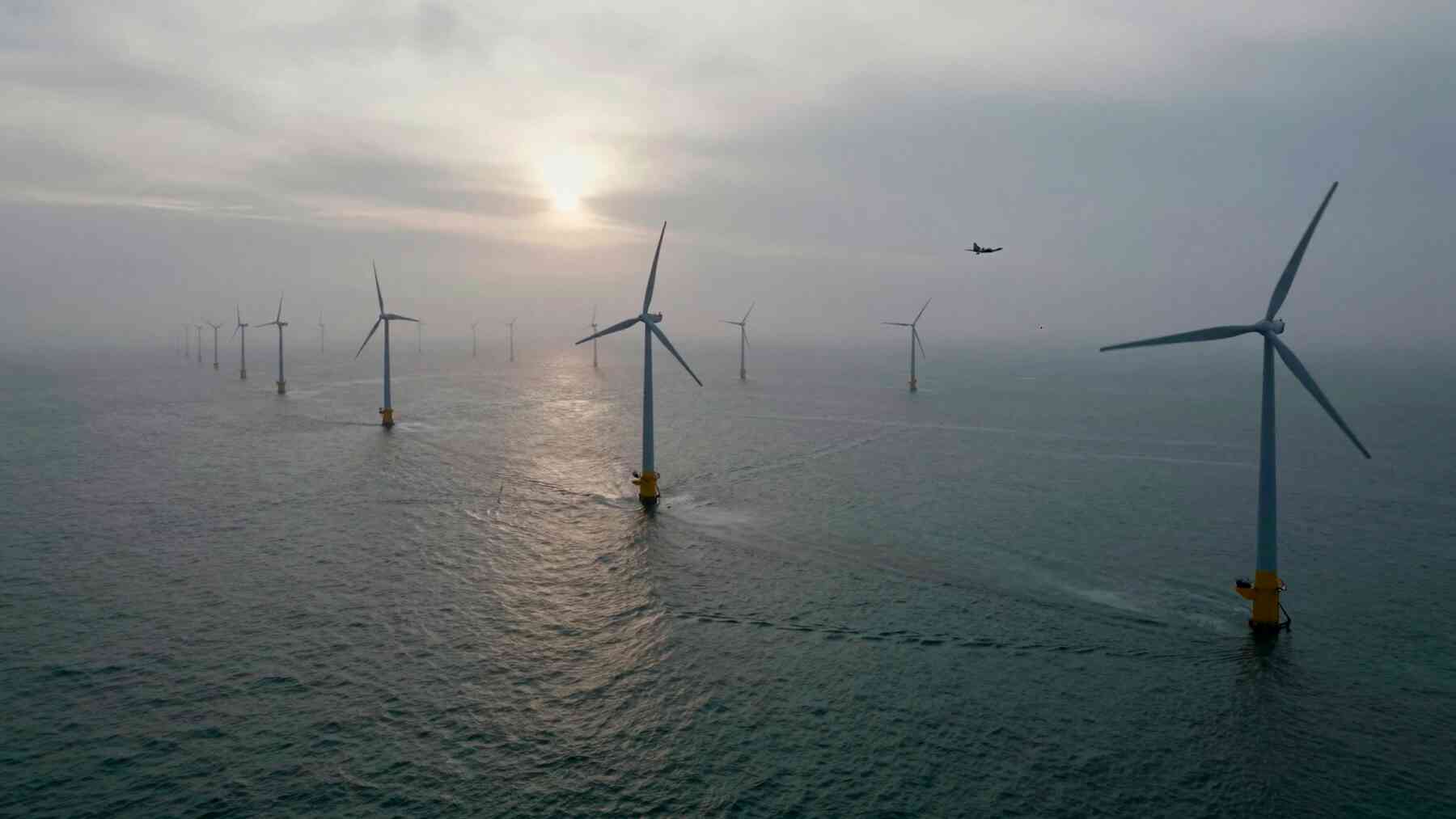
Offshore wind farms in the North Sea don’t just harvest the wind — they reshape it. As turbines extract energy from the air, they leave behind slower, more turbulent wakes that can stretch for dozens of kilometers, reducing the output of farms downwind.
Forecasting those wakes accurately depends on atmospheric models, and buried inside those models is a choice that turns out to matter: the planetary boundary layer scheme. A new study tested two leading schemes against real North Sea observations — measurements from a fixed tower and a research aircraft flying over the same region on the same day. Depending on where the instruments were and what they measured, each scheme told a different story.
Why the boundary layer scheme matters for wind energy
Offshore wind is expanding fast, particularly in the North Sea and Baltic, where large-scale deployment is already underway. As more farms come online, accurate wake forecasts become critical — not just for project planning, but for grid management and energy trading.
Wind speed results at aircraft altitude were split: MYNN performed better on cRMSE and R², while 3DPBL performed better on bias and earth mover’s distance.
Models like the Weather Research and Forecasting (WRF) model simulate wakes using wind farm parameterizations (WFPs), which typically treat turbines as elevated sources of turbulence and sinks of momentum. Accuracy depends heavily on the planetary boundary layer scheme, which governs how turbulence and momentum mix vertically — a choice that’s rarely been tested in wind farm contexts. The widely used Fitch WFP was long compatible only with the one-dimensional MYNN scheme. A recent integration with the newer 3D planetary boundary layer scheme (3DPBL) finally made a direct comparison possible.
A real-world test over the German Bight
Researchers used a well-studied case study: October 14, 2017, captured during the WIPAFF aircraft campaign over the German Bight. Stably stratified atmospheric conditions that day produce the strongest and longest wakes — exactly the scenario where model differences matter most.
The FINO1 meteorological tower sits immediately west of the Alpha Ventus wind farm, recording wind speed at heights between 34 and 102 meters. A research aircraft flew transects roughly 100 meters above the wind farm, collecting high-frequency wind speed and turbulence kinetic energy data. WRF simulations were run with both MYNN and 3DPBL schemes using otherwise identical setups, isolating the PBL scheme as the single variable. Performance was assessed across four metrics: bias, centered root mean square error (cRMSE), R², and earth mover’s distance.
Two schemes, two answers — depending on altitude
At the FINO1 tower, within the turbine rotor layer, the 3DPBL scheme outperformed MYNN for wind speed cRMSE — a statistically significant result. That matters because cRMSE captures the pattern of variability rather than just the mean, making it a demanding test of model skill.
At aircraft altitude — roughly 100 meters above the turbines — the picture reversed for turbulence. MYNN outperformed 3DPBL on TKE bias, with 3DPBL overpredicting turbulence at that height. Wind speed results at aircraft altitude were split: MYNN performed better on cRMSE and R², while 3DPBL performed better on bias and earth mover’s distance. Under stable stratification, turbine-generated turbulence is suppressed from mixing upward, and the two schemes respond quite differently to that suppression.
The physics behind the disagreement
MYNN uses one-dimensional Smagorinsky horizontal mixing. The 3DPBL scheme explicitly calculates horizontal turbulent flux divergences, giving it more pathways to generate TKE and resulting in consistently higher background turbulence throughout the boundary layer.
That elevated background TKE in 3DPBL slows ambient winds slightly. Slower winds mean less drag force on turbines, producing shorter, weaker wakes compared to MYNN. Within the rotor region, the extra turbulence more realistically captures local conditions — but above the rotor layer, it tips into overprediction. Previous studies showing 3DPBL advantages involved complex terrain such as the Columbia River Gorge and California’s Altamont Pass. Finding similar advantages in the relatively flat offshore North Sea environment is notable in its own right.
What this means for offshore wind forecasting
No single PBL scheme wins across the board. The better choice depends on where you’re measuring, what variable you care about, and which error metric you prioritize.
An extended 28-day analysis at the FINO1 tower corroborated the single-day results. Over that longer period, 3DPBL outperformed MYNN on two of three statistically significant metrics, lending confidence to the finding that 3DPBL holds a real advantage within the turbine rotor layer.
For forecasters and developers, the practical guidance is to consider which atmospheric layer matters most before selecting a scheme — a developer focused on turbine-level wind speeds may reach a very different conclusion than a grid operator modeling wake propagation at higher altitudes. Future work should test these findings using datasets from the third Wind Forecast Improvement Project (WFIP3) and the land-based AWAKEN campaign, with ocean-atmosphere coupling representing another open avenue that could address remaining wind speed errors.

Carlos is an engineer with strong expertise in technical and industrial topics. He previously worked at international companies such as Siemens and is multilingual.
