
Scientists mapped just 2 percent of a nuclear dump site on the Atlantic seafloor and found 3,500 leaking barrels
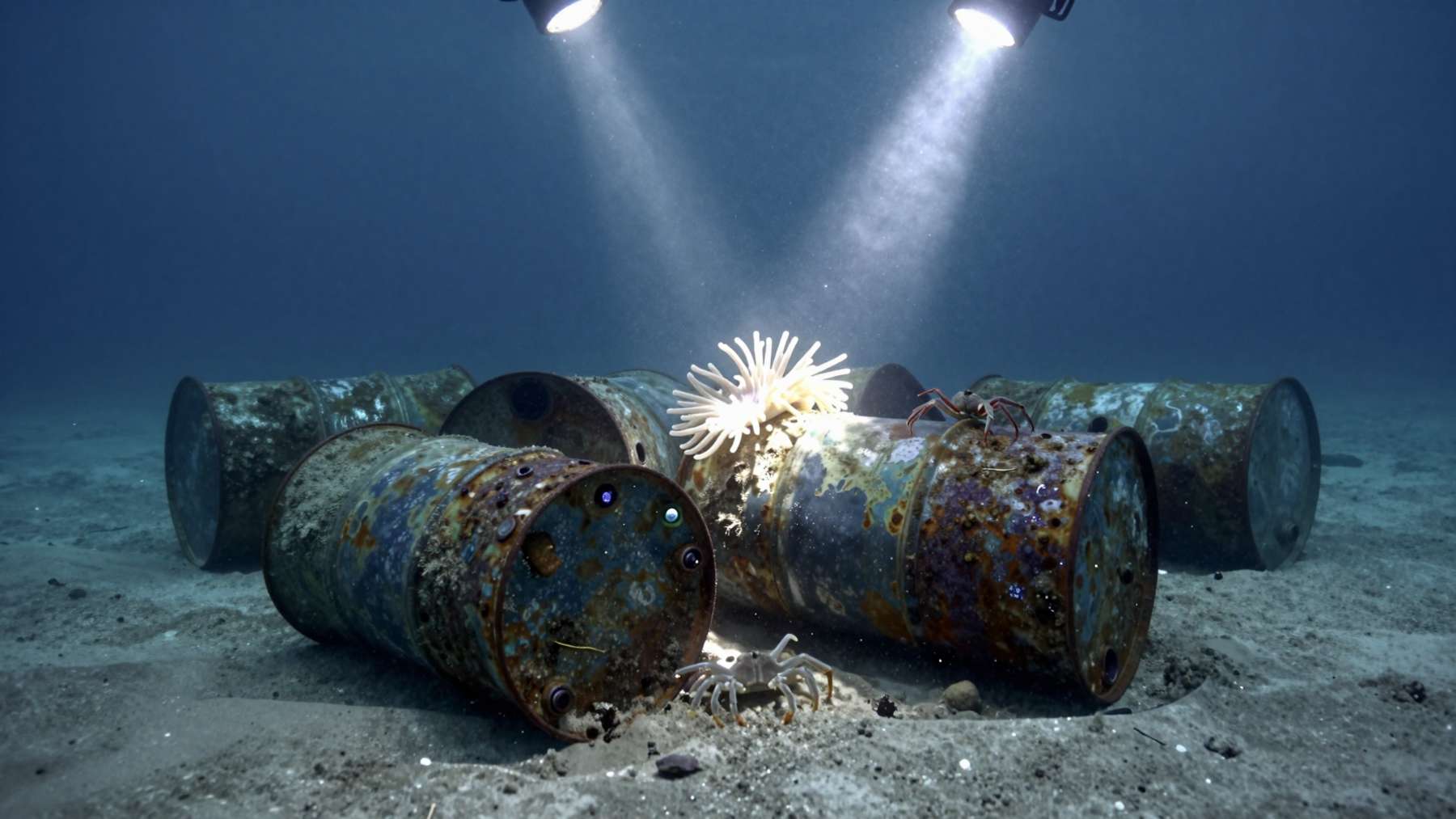
Somewhere on the floor of the North Atlantic, roughly 200,000 barrels of radioactive waste sit in the cold and the dark — a quiet consequence of a decade of legal dumping by European nations that ended in 1982. Many are corroding. Sea sponges, anemones, and crabs have made them home.
Now scientists are going down to find them. A recent survey mapped just two percent of the 14,500-square-kilometer disposal site — and located 3,500 barrels. Researchers have begun collecting samples from the seafloor, launching what may become one of the most comprehensive deep-sea radioecological studies ever conducted.
A decade of dumping, buried for half a century
Between 1971 and 1982, multiple European nations treated the North Atlantic as a disposal solution. The practice was legal at the time — sanctioned under international agreements that few would defend today. By the time it ended, more than 200,000 barrels of radioactive waste had been sunk across a 14,500-square-kilometer zone on the ocean floor.
stored much of its Cold War plutonium waste in single-shell tanks near Washington state’s Columbia River, dozens of which have leaked into surrounding soil.
Europe wasn’t alone. The U.S. stored much of its Cold War plutonium waste in single-shell tanks near Washington state’s Columbia River, dozens of which have leaked into surrounding soil. These weren’t rogue operations — they reflected a mid-20th-century assumption, held broadly and acted on without much hesitation, that oceans and remote sites could absorb whatever humans discarded.
What was being discarded matters. Radionuclides emit ionizing radiation: energy capable of damaging biological tissue and altering DNA. The danger isn’t abstract. It accumulates, persists, and moves through living systems in ways that resist prediction or containment.
How scientists found thousands of barrels with a robot
For the past two years, France’s National Center for Scientific Research (CNRS) has used the French Oceanographic Fleet to survey the dump site. The operation is methodical and slow — the seafloor doesn’t give up its inventory easily.
In 2025, researchers deployed an autonomous robot capable of diving to 6,000 meters. Equipped with a multibeam echosounder and synthetic antenna imaging sonar, it mapped large sections of the seabed in detail, distinguishing individual objects on an otherwise featureless deep-ocean floor.
The results were striking. After covering just 2 percent of the total disposal zone, the robot had already located 3,500 barrels — and the unmapped remainder likely holds far more. Many are now encrusted with sea sponges, anemones, and crabs, marine life that has colonized the waste containers and woven them into the deep-sea landscape.
Collecting samples from the seafloor
Locating the barrels was only the first step. Understanding what they’re doing to the surrounding environment required physical samples, which meant going deeper.
The crewed submersible Nautile — more than 2,000 dives logged since its 1984 launch — descended to collect specimens from around 50 barrels spread across five distinct areas of the site. Sediment, water, and microbial community samples were gathered alongside material taken directly near the containers.
The dual goal: assess each barrel’s immediate local impact, and build broader knowledge about how radioactive materials behave after five decades in a marine environment. According to researchers Javier Escartin and Patrick Chardon, new radiation protection procedures and sampling methodologies had to be developed specifically for this operation — from defining the sampling strategy to managing onboard safety protocols.
Why the barrels may be moving radiation through the food chain
The barrels present a specific ecological problem that goes beyond simple leakage. On a seafloor that is otherwise soft sediment, a metal barrel functions as a hard substrate — a surface that marine organisms actively seek out for attachment and shelter.
That colonization creates a potential transfer pathway. As Escartin and Chardon wrote in The Conversation: “The barrels alter the environment by providing a hard substrate that becomes colonized, potentially facilitating the transfer of radionuclides to living organisms.” Once radionuclides enter living tissue, they can move up the food chain in ways that extend far beyond the immediate dump site. The researchers also noted that this is “one of the first radioecological studies in the deep sea,” meaning the full scope of contamination remains unknown. Analysis is still ongoing.
What comes next: a months-long international analysis
With samples now collected, scientists from France, Norway, Germany, and Spain have begun a months-long joint analysis. The work will identify specific radionuclides present, confirm their concentrations, and map how radiation has dispersed through the surrounding environment.
When complete, the study is expected to rank among the most comprehensive deep-sea radioecological assessments ever conducted — a measure of how little has previously been done at this depth and scale. Remediation isn’t the immediate goal. The barrels aren’t coming up. What this work offers instead is a detailed record of what happened when past generations treated the deep ocean as a place beyond consequence — and, researchers suggest, the knowledge future policy will need to avoid repeating it.

Carlos is an engineer with strong expertise in technical and industrial topics. He previously worked at international companies such as Siemens and is multilingual.
