
Solar panels are moving into the open ocean and no one fully knows what they will do to life beneath them
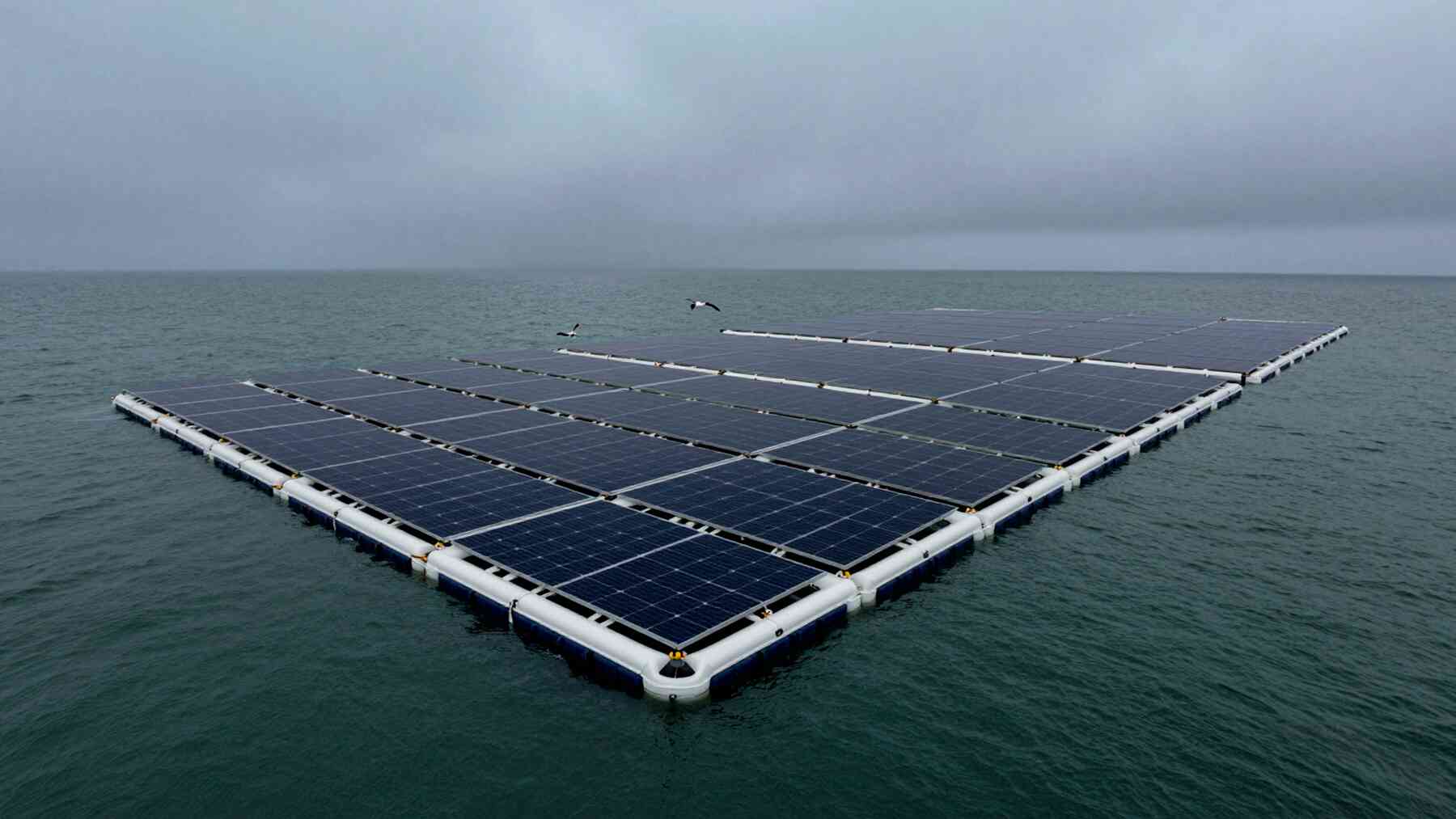
Solar panels belong on rooftops, or so the logic went. Now they’re heading to the open ocean — not to sheltered bays or inland reservoirs, but to the same North Sea that sustains fish, plankton, seabirds, and marine mammals.
Offshore floating photovoltaics are no longer a distant concept. Pilot installations already operate in the North Sea, and gigawatt-scale deployment is being planned across Europe. Generating 1 GW requires just 5.3 km² of ocean surface, compared to 135 km² for the equivalent in offshore wind. What that floating canopy does to the life beneath it remains largely unknown — and a new scientific framework is now racing to find out before deployment outpaces the science.
A solar technology unlike anything the ocean has seen before
Offshore floating photovoltaics — OFPV — come in three main designs. The elevated truss mounts panels on a raised frame, letting waves pass underneath. The floating pontoon rests directly on the surface. And the floating foil integrates solar modules into a thin, circular membrane resembling an aquaculture cage. Each design interacts with the ocean differently, yet all share one core characteristic: they cover the water surface at a scale the ocean has never encountered before.
Compared to offshore wind, OFPV adds roughly 50 times more hard surface area per gigawatt of capacity — at scale, a structural transformation of local habitat.
The surrounding seawater cools the panels, boosting efficiency beyond what land-based installations can achieve. Whether any of this holds at gigawatt scale remains unproven — and that uncertainty makes the ecological question more pressing, because deployment is accelerating before the science has caught up.
Blocking the sky: how solar panels change the sea below
When OFPV covers the ocean surface, it cuts off the exchange between air and sea. Wind stress drops. Incoming solar radiation decreases, and heat transfer at the surface is reduced. These shifts affect the physical conditions driving everything in the water column below.
The consequences for ocean stratification are genuinely complicated. Reduced wind mixing could increase stratification, trapping warmer water near the surface — but turbulence from floaters and mooring lines could break that stratification down. Both processes operate simultaneously. Their net effect depends on OFPV design, deployment scale, and local environment, and without in-situ measurements or computational fluid dynamics simulations, that influence can’t yet be quantified. Stratification controls nutrient movement, light penetration, and energy flow through the entire pelagic food web.
From plankton to fish: a food web under pressure
The most direct ecological impact of OFPV is shading. Phytoplankton depend entirely on sunlight to grow, and modeling suggests that when OFPV coverage exceeds 40% of the tidal excursion area, primary production can drop significantly.
A second pressure comes from the structures themselves. OFPV platforms introduce hard substrate into open water, and biofouling communities — mussels, anemones, and other sessile organisms — colonize quickly. These animals filter phytoplankton directly from the water, competing with zooplankton for the same food source. The panels reduce supply; the fouling communities increase demand. Compared to offshore wind, OFPV adds roughly 50 times more hard surface area per gigawatt of capacity — at scale, a structural transformation of local habitat. Changes at the base of the food web ripple upward through zooplankton, fish, seabirds, and marine mammals.
Measuring the unmeasurable: where EU policy meets knowledge gaps
The EU’s Marine Strategy Framework Directive — the MSFD — organizes marine health assessment around 11 ecosystem descriptors. A new study mapping OFPV impacts onto that framework found five descriptors face the greatest risk: D1 (pelagic biodiversity), D2 (non-indigenous species), D4 (food webs), D5 (eutrophication), and D7 (hydrographical conditions).
Of 53 MSFD indicators assessed in the Dutch North Sea context, only 16 appear usable for evaluating OFPV impacts. Thirteen lack defined thresholds entirely. Without thresholds, regulators can’t determine whether a deployment is pushing a marine area toward or away from Good Environmental Status. The policy framework exists, but its instruments simply weren’t built with floating solar in mind.
Smart design could be the difference between harm and harmony
Scale matters enormously. A small pilot installation may produce effects too subtle to detect, while the same design deployed across dozens of square kilometers could trigger measurable shifts in phytoplankton communities, nutrient cycles, and fish populations. Early pilots may give a false sense of safety.
Design choices can reduce ecological risk. Many small, dispersed installations are likely less damaging than a single large block. Placing OFPV in well-mixed, shallow environments may produce fewer stratification effects than deployment in seasonally stratified waters, and minimizing hard substrate — which points toward elevated truss designs — limits biofouling pressure. Siting OFPV in productive upwelling regions could affect dependent fisheries, making marine spatial planning essential.
The study’s core recommendation is direct: every future OFPV deployment should be paired with in-situ monitoring and ecosystem modeling. Whether that happens will depend on whether monitoring becomes a condition of deployment, not an afterthought.
The complete study is available here: Schneider LK, Hendriks E, van Duren LA, Heye S, de Rijk S, Troost TA and Prins TC (2026) Offshore floating photovoltaic: from ecological impact pathways to MSFD criteria. Front. Mar. Sci. 13:1805702. doi: 10.3389/fmars.2026.1805702

Carlos is an engineer with strong expertise in technical and industrial topics. He previously worked at international companies such as Siemens and is multilingual.
